
SoSACO-v2: Empowering Ants with a "Sense of Smell" for Lightning-Fast Social Network Search
Expert Systems With Applications
The paper introduces SoSACO-v2, an enhanced bio-inspired algorithm based on Ant Colony Optimization (ACO) designed for rapid path search in massive, high-connectivity graphs and social networks. It employs a "sense of smell" mechanism (odor trails) and a 1-tabu list to provide near-instant paths between any two nodes, significantly outperforming classical Dijkstra in speed.
TL;DR
In the era of massive social networks like Twitter or Facebook, finding a path between two individuals in milliseconds is more valuable than finding the perfect path in minutes. SoSACO-v2 evolves Ant Colony Optimization (ACO) by endowing "digital ants" with a sense of smell, allowing them to navigate massive graphs by FOLLOWING odor trails toward high-connectivity hubs. This result is a system up to 540x faster than Dijkstra on huge graphs.
The Problem: The "Optimal" Trap
In classical graph theory, we are obsessed with the shortest path. However, when a graph exceeds nodes, Dijkstra's algorithm becomes a computational bottleneck. In dynamic scenarios (where people add or remove links constantly), the graph changes faster than the algorithm can compute.
The authors argue that in social networks, we need agility over optimality. Why spend 10 seconds finding a path of length 5 when you can spend 10 milliseconds finding a path of length 6?
Methodology: High-Speed Bio-Inspiration
The core innovation of SoSACO-v2 is the Sense of Smell (SoS) mechanism.
1. Radial Odor Diffusion
The algorithm pre-processes "food nodes" (hubs with high centrality). These nodes "emit" an odor that decays with distance. Ants don't have to stumble upon the destination randomly; they can "smell" the proximity of a global hub and move toward it using a gradient-descent-like logic.
2. The Multi-Colony Pincer Movement
Unlike version 1, which was restricted to paths involving a food node, SoSACO-v2 launches two distinct breeds of ants:
- Breed A starts from the source.
- Breed B starts from the target.
When an ant from Breed A touches the pheromone trail or the odor zone of Breed B, a search branch is triggered. This "meeting in the middle" drastically reduces the search space (the area covered is instead of ).
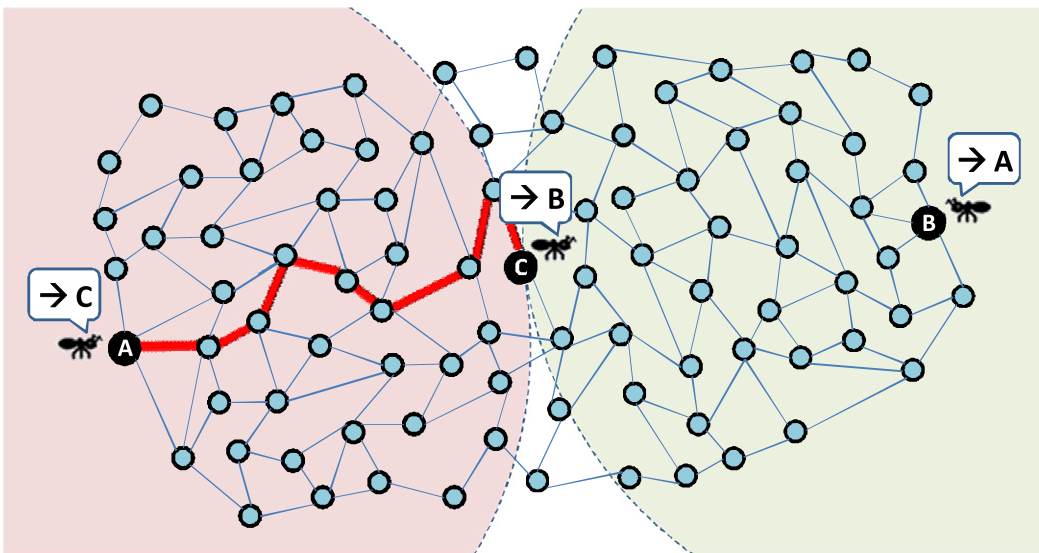 Figure: The splitting of ant breeds to refine paths to the meeting point.
3. The -Tabu List
To prevent ants from getting stuck in infinite loops (a common failure in social networks with many local clusters), the researchers implemented a 1-tabu list. This forces ants to explore new nodes for at least one step before allowing a revisit, maintaining a balance between exploitation (following trails) and exploration (finding shortcuts).
Experimental Battleground: Generic vs. Social
The authors tested SoSACO-v2 on two fronts: a generic 200k node random graph and the real-world Slashdot social network.
| Metric | Dijkstra (Optimal) | SoSACO-v2 (17% Coverage) |
|---|---|---|
| Response Time (ms) | 656,461 | 1,474.59 (⚡ 445x Improvement) |
| Mean Path Cost | 3,046 | 7,552 |
| Success Rate | 100% | 100% |
While the path cost is higher, the Response Time is where SoSACO-v2 wins. In a social network context, a response time of ~1.4 seconds versus ~10 minutes (Dijkstra) is the difference between a functional product and a crashed system.
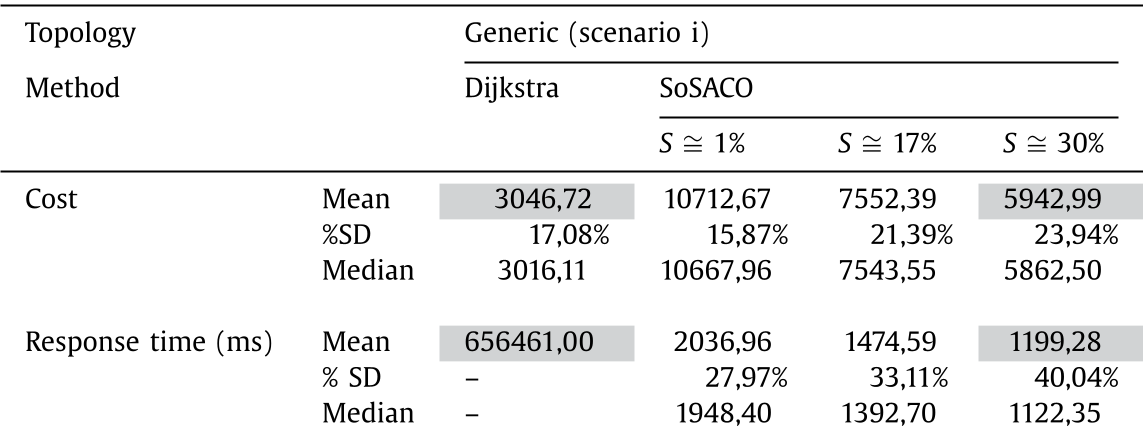 Table: Quantitative comparison between Dijkstra and SoSACO variants.
Handling Dynamicity
Real-world graphs are alive. SoSACO-v2 handles "link dropping" (nodes disappearing) by introducing reinforcement ants. If a link on a high-pheromone path is dropped, the system injects new ants into the "closed road" to find an immediate detour, preventing the "zombie ant" problem where the colony gets stuck following a dead-end trail.
Critical Insight & Conclusion
SoSACO-v2 proves that stochastic metaheuristics are not just for toy problems—they are essential for "Huge Computing." By trading off a small percentage of path quality, we gain orders of magnitude in search speed.
The Future? The authors suggest a parallel implementation. Because ACO is inherently parallel (each ant is an independent agent), deploying SoSACO-v2 across a server cluster could potentially handle graphs with billions of nodes, such as the full Twitter or Facebook interest graphs, in near real-time.
Takeaway: In massive-scale systems, "good enough" and "right now" always beats "perfect" and "eventually."