
SPPMiner: Breaking the Complexity Bottleneck in Dynamic Social Pattern Mining
Expert Systems With Applications
This paper introduces SPPMiner, a polynomial-time, single-pass algorithm designed to mine parsimonious periodic patterns in dynamic social networks. By utilizing a "Supergraph" structure to store entities and interactions once, it achieves SOTA performance in time and memory efficiency, particularly in medium to high-density networks.
TL;DR
Discovering periodic interactions (e.g., weekly meetings, yearly reunions) in massive social networks is traditionally a "needle in a haystack" problem with exponential costs. SPPMiner redefines this task by introducing a Supergraph structure that processes data in a single pass. It achieves a 180x speedup over previous SOTA while keeping memory usage constant regardless of how long the network has existed.
The Problem: The High Cost of "Remembering"
In digital sociology, identifying stable, repeating interactions is vital for behavior prediction. However, existing methods like PSEMiner and ListMiner struggle with two major hurdles:
- Redundancy: They often store the same common subgraphs multiple times across different timestamps.
- Breadth-First Exhaustion: They rely on tree-traversal techniques that become intensely time-consuming as the "tree" of potential patterns grows.
The authors observed that most dynamic network entities (nodes and edges) remain dormant or repeat simple structures. Why recompute everything from scratch at every timestamp?
Methodology: The Supergraph Intuition
The core innovation of SPPMiner is the Supergraph (SG). Instead of treating each timestamp as a separate graph, it treats the entire dynamic history as a single, evolving entity.
1. Compact Embedding
The Supergraph stores every unique vertex and edge only once. Each entity is associated with:
- Time Set (TS): A rolling window of the last active timestamps (capped at ).
- Descriptors: Small data structures that track specific periodicities (e.g., "repeats every 7 days").
2. Efficiency through Pruning
The algorithm employs two critical pruning properties to ensure the output remains meaningful (Parsimonious Periodic Patterns):
- Closed Pattern Pruning: Eliminates sub-patterns that have the same support as a larger pattern.
- Subsumption Pruning: Removes periodicities that are logically covered by more frequent or broader periods (e.g., a "daily" pattern technically includes a "every 2 days" pattern; SPPMiner only keeps the most informative one).
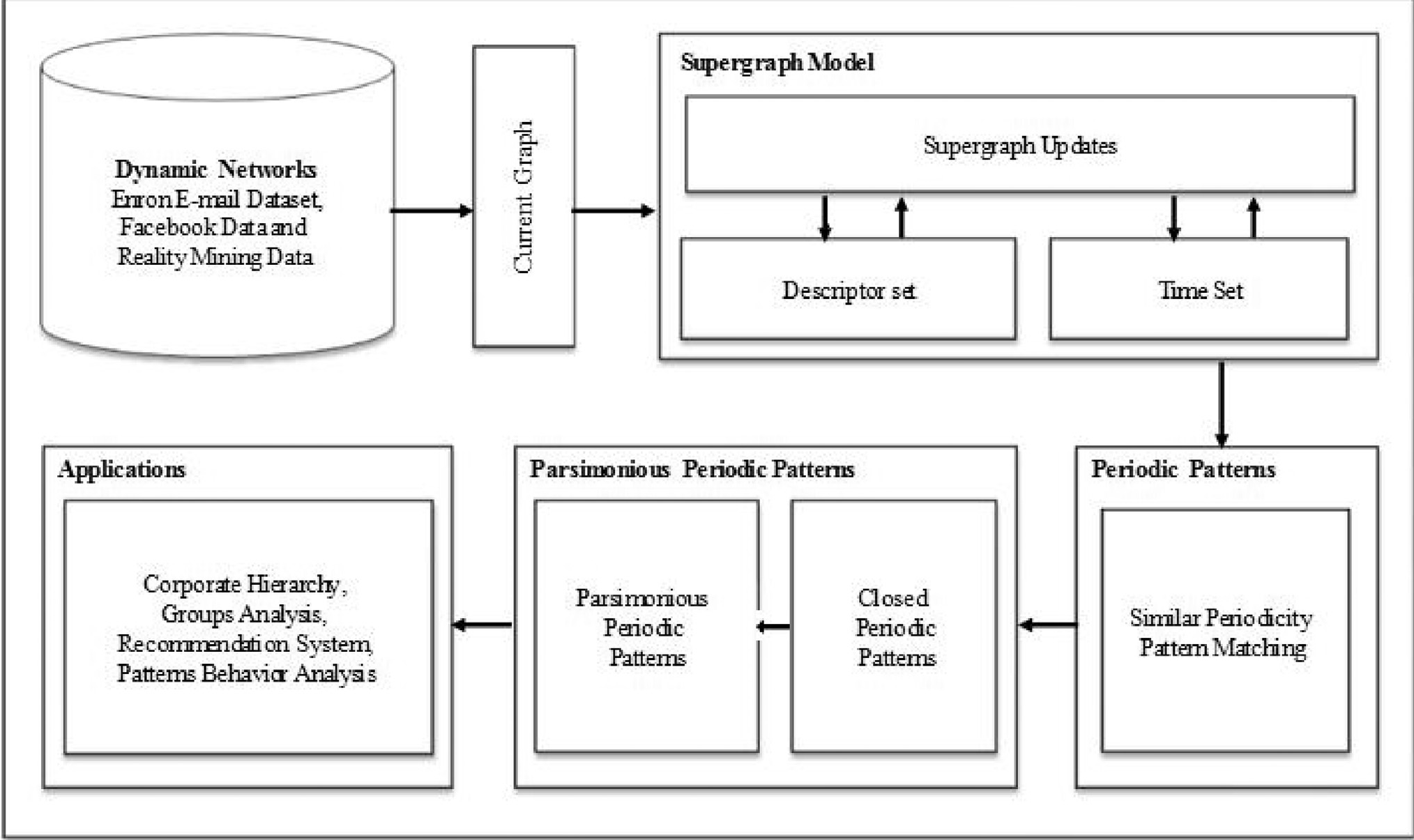 The image above illustrates how SPPMiner updates descriptors within the Supergraph to track period support without full graph scans.
Experiments: Real-World Dominance
The researchers tested SPPMiner against Facebook (90k users), YouTube (1.1M users), and Reality Mining datasets.
- Speed: On the YouTube dataset, SPPMiner completed tasks in a fraction of the time required by PSEMiner (nearly 180x faster).
- Density Robustness: While traditional methods slow down as networks become more "dense" (more interactions per node), SPPMiner remains efficient. In synthetic tests with 8% density, it was 292% faster than ListMiner.
- Memory Independence: Unlike traditional algorithms where memory usage grows with the number of timestamps (), SPPMiner’s memory footprint is bound by the number of entities and the maximum period (), effectively making it "future-proof."
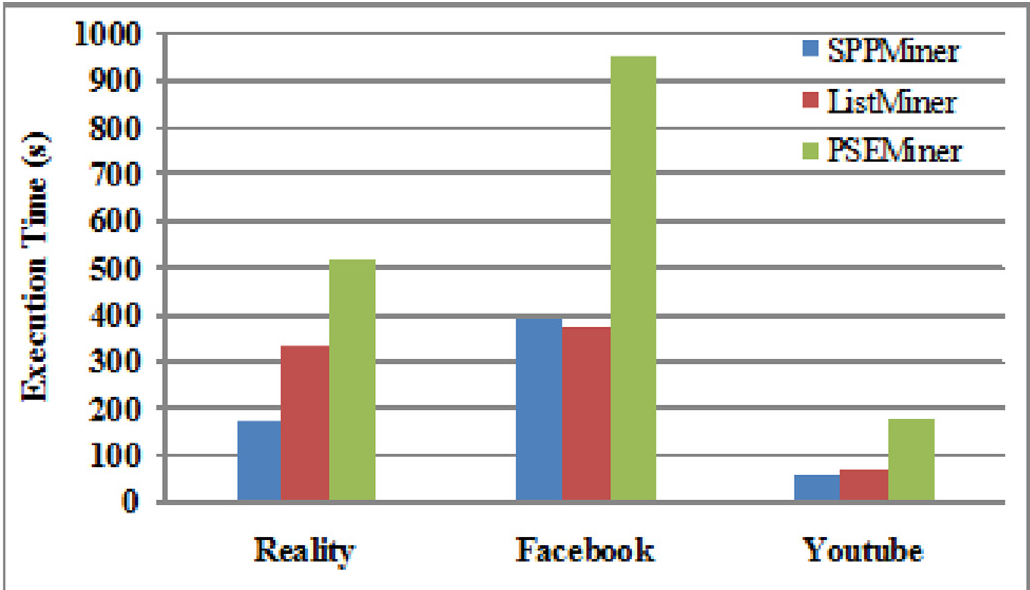 Figure: Execution time comparison between SPPMiner and existing SOTA on Reality Mining and Facebook datasets.
Critical Insight & Future Outlook
The brilliance of SPPMiner lies in its polynomial-time complexity in a field where np-hardness is the norm. By bounding the "memory" of each entity to , the authors created a system that is theoretically and practically scalable.
Limitations: The current iteration handles "perfect" periodicity. Real-world data is often noisy (e.g., a "weekly" meeting that occasionally shifts from Monday to Tuesday). The authors acknowledge that incorporating fuzzy periodicity or time-shifts is the next frontier.
Conclusion
SPPMiner is a milestone for industrial social network analysis. It transforms periodic pattern mining from a heavy, offline batch process into an efficient, online-capable workflow. For anyone building behavior prediction models or community detection tools, the "Supergraph" approach offers a blueprint for handling massive temporal data without breaking the memory bank.