
Beyond Votes: Decoding Human Expertise Through Syntactic and Semantic Cues
Expertise Detection in Crowdsourcing Forums Using the Composition of Latent Topics and Joint Syntactic–Semantic Cues
This paper introduces a robust NLP framework for Expertise Detection in Crowdsourcing Forums (CSFs) like Zooniverse and StackExchange. By composing latent topics with joint syntactic-semantic cues, the method predicts user proficiency even when explicit metadata like votes are missing, achieving high predictive accuracy across multiple domains.
TL;DR
In the world of crowdsourcing, a "Like" or an "Upvote" is a noisy proxy for truth. This paper presents a sophisticated NLP methodology that looks deeper into the syntax, semantics, and latent topics of user posts to verify expertise. By analyzing 3 million sentences from platforms like StackExchange and Zooniverse, the researcher demonstrates that experts don't just use different words—they build their sentences differently.
The Core Motivation: The Popularity Trap
Most crowdsourcing forums (CSFs) use reputation systems built on "Majority Vote." However, as any Redditor knows, the most popular answer isn't always the most accurate one. The author argues that true expertise leaves a linguistic footprint. For example, an astrophysicist describing a galaxy in Zooniverse utilizes specific syntactic structures (e.g., descriptive adjective phrases) and imagery that a casual observer lacks. The challenge is: Can we build a mathematical model that captures this "expert style" across different domains?
Methodology: The Anatomy of an Expert Post
The study moves beyond simple Bag-of-Words (BoW) models, which are often "brittle" and domain-dependent. Instead, it focuses on three layers of analysis:
1. Structural Fingerprinting (Syntax & Punctuation)
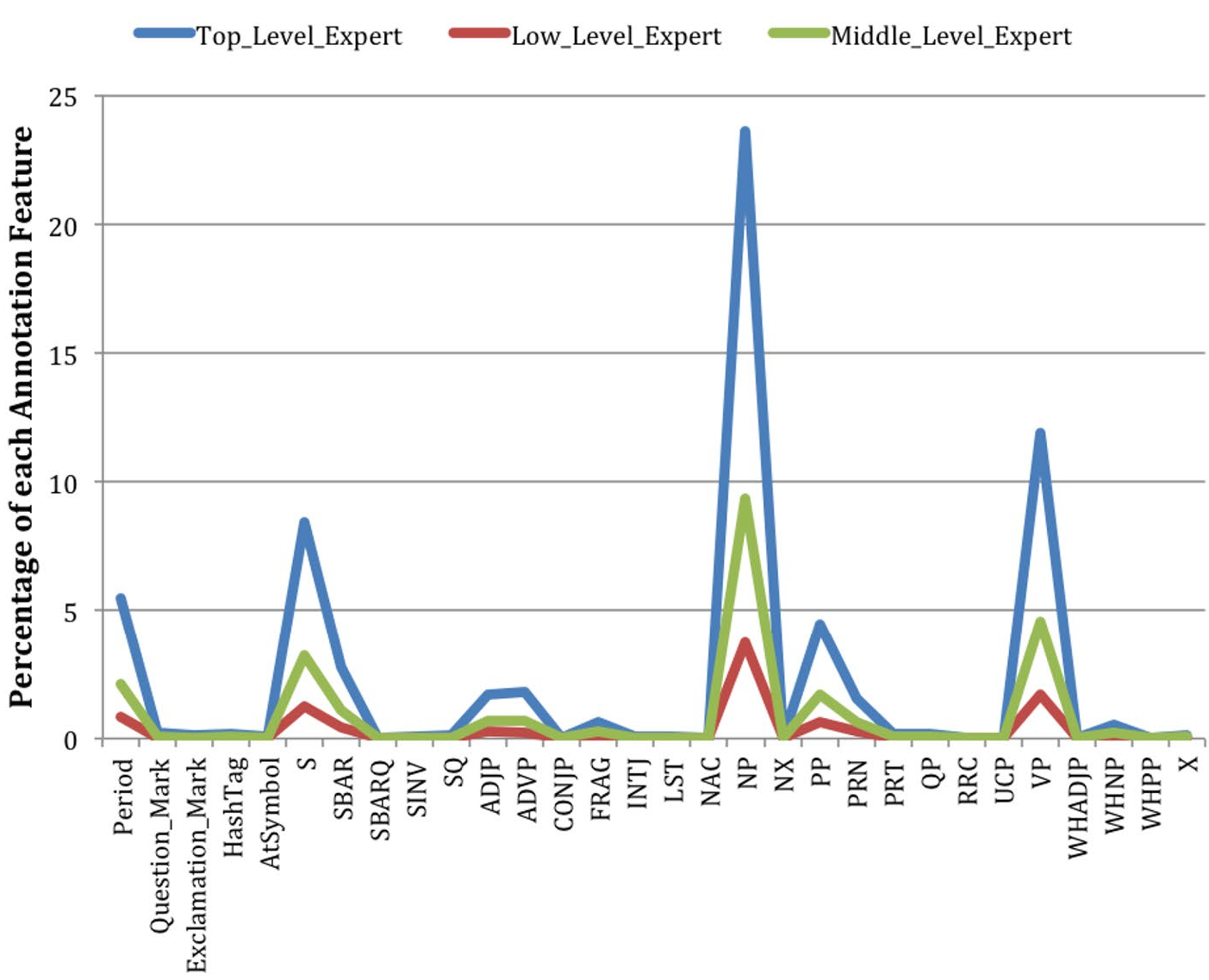
The author identifies Joint Syntax–Punctuation Patterns (SPP). By using constituency parsing, the research reveals that experts in technical forums (StackOverflow) use more analytical structures (quantifiers, list markers) and verb-subject inversions for focus. In contrast, Zooniverse experts use more descriptive imagery, often punctuated by exclamation marks reflecting the "awe" of scientific discovery.

2. Latent Topic Mapping
Using Latent Dirichlet Allocation (LDA), the model extracts "expert words" that aren't just frequent, but contextually significant. The study found that users with high Proficiency in Programming (PIP) or Proficiency in Classification (PIC) naturally cluster around specific technical topic distributions.
3. The Expertise Framework
The paper maps syntactic tags to 9 Expertise Dimensions:
- Completeness: Use of full NP-VP structures.
- Analytical: Presence of cardinal numbers (CD) and list markers (LST).
- Inquisitiveness: Questioning habits (captured via WHNP and SQ tags).
- Social Interaction: Use of personal pronouns and social symbols like hashtags.
Experimental Results & Insights
The model was tested across 8 diverse corpora. A key finding was the Adaptability of the model: a model trained on StackOverflow (programming) could still reasonably predict expertise in an English Language forum by relying on structural cues rather than just vocabulary.
| Metric | StackOverflow | Server Fault | English | Zooniverse |
|---|---|---|---|---|
| R² (Variance Explained) | 0.7290 | 0.7940 | 0.6850 | 0.3100 |
Why was the PIP model more successful than PIC?
The author notes that in StackExchange, points are awarded for the content of the writing. In Zooniverse, points (PIC) relate to the action of classification, which may be independent of how much the user writes. This reveals a critical insight: NLP-based expertise detection is most effective when the task and the text are inextricably linked.
Critical Analysis & Conclusion
This work provides a robust blueprint for the next generation of "Trust Systems" on the web. By moving the evaluation of a contributor from "how many people liked it" to "how rigorous is the linguistic construction," we can mitigate the effects of echo chambers and misinformation.
Limitations:
- The model struggles with very short text (microblog style), where syntactic structures are too sparse to provide a strong signal.
- Punctuation ambiguity: In programming contexts, a "!" is a logical operator, whereas in natural language, it's an emotion—current models need better "code-vs-text" disambiguation.
Future Outlook: The researcher suggests integrating Deep Learning (LSTMs/Transformers) to further refine these patterns. As AI-generated content floods these forums, the ability to distinguish "Human Expert" syntactic fingerprints from "LLM-generated" patterns will become a foundational problem in digital safety.