
Opening the Black Box: Why XAI is the Future of Smart Healthcare
Explainable AI in Healthcare
This paper proposes a framework for integrating Explainable AI (XAI) into smart healthcare systems and wearable devices. By leveraging model-agnostic techniques like LIME and SHAP alongside clinical expertise, the authors demonstrate how to move beyond "black-box" medical predictions toward accountable and transparent diagnostic systems.
TL;DR
AI is transforming healthcare through wearables and predictive analytics, but its "black-box" nature remains a barrier to clinical adoption. This paper argues for shift toward Explainable AI (XAI), proposing a framework that combines automated explanations with clinician expertise to ensure transparency, accountability, and continuous model improvement.
The Trust Gap in Medical AI
Deep learning models, particularly those used in smart healthcare apps and Fitbits, have reached impressive accuracy. However, they suffer from a terminal flaw in a medical context: they cannot explain why a certain diagnosis was reached. For a doctor, a "90% risk of heart failure" is insufficient without knowing if that risk is driven by blood sugar, heart rate, or previous respiratory issues.
Current methods face a "trade-off" dilemma:
- Self-Explainable Models: Decision trees or IF-THEN rules are transparent but often lack the predictive power of complex deep learning.
- Black-Box Models: High-accuracy RNNs and Transformers provide results but provide zero visibility into their internal logic.
Methodology: Bridging AI and Clinical Expertise
The authors propose a system that doesn't just output a prediction, but a "rationale" that can be audited. The core of the methodology involves using model-agnostic XAI methods (like LIME, Anchors, or Shapley values) which sit on top of any AI model to quantify the contribution of specific health factors.
The Collaborative Loop
The proposed architecture involves a critical feedback loop between the machine and the human expert:
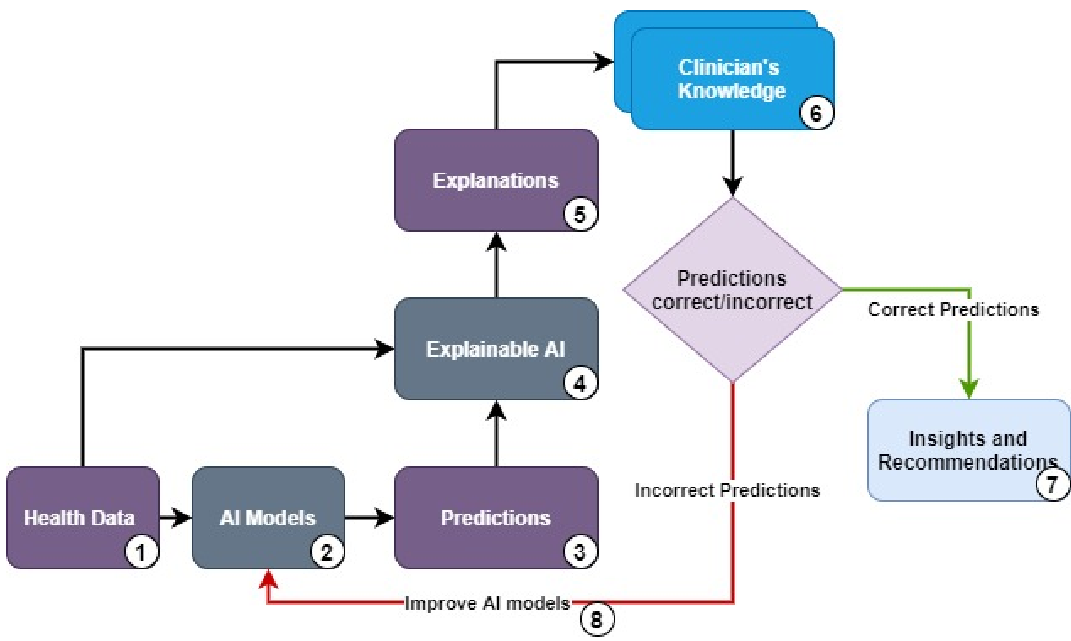
- Prediction: The AI analyzes wearable data (e.g., blood sugar, calorie intake).
- Explanation: The XAI module identifies that "Calorie Intake" was the primary driver for a hyperglycemia alert.
- Clinical Validation: A clinician reviews the explanation. If the logic is sound, they prescribe action; if the logic is flawed (e.g., the model ignored a fever), the contradiction is used to retrain and improve the model.
From Theory to Practice: LIME in Action
The paper references successful applications where XAI techniques like LIME (Local Interpretable Model-agnostic Explanations) were used with Recurrent Neural Networks (RNNs). By highlighting factors such as kidney failure or anemia as primary contributors to heart failure risk, XAI shifts the AI from being a "magic ball" to a "diagnostic tool" that clinicians can actually verify against medical literature.
Critical Analysis & Conclusion
Summary and Key Contributions
The strength of this work lies in its emphasis on Accountability and Traceability. In an era of strict data regulations (like GDPR's "right to an explanation"), this framework provides a roadmap for healthcare providers to implement AI while staying legally and ethically compliant.
Limitations
While the framework is robust, the paper acknowledges two significant hurdles:
- Computational Cost: Model-agnostic XAI techniques often require multiple permutations of data, which can be resource-intensive for real-time wearable monitoring.
- User Interface Design: An explanation is only as good as its delivery. Designing GUIs that provide "human-friendly insights" for both specialized doctors and non-expert patients remains a significant challenge.
The Road Ahead
The future of smart healthcare isn't just about better sensors or deeper networks; it's about Human-in-the-loop AI. By treating the clinician's knowledge as a validation layer for AI logic, we can create systems that are not only more accurate but more trustworthy.