
B5G and Explainable AI: A New Shield Against Global Pandemics
Explainable AI and Mass Surveillance System-Based Healthcare Framework to Combat COVID-19 Like Pandemics
This paper proposes a Beyond 5G (B5G) empowered healthcare framework that integrates Explainable AI (XAI), blockchain, and mass surveillance to combat COVID-19. By leveraging the low latency of 5G and hierarchical edge computing, the system enables real-time multimodal diagnosis (X-ray, CT, vital signs) and social monitoring (distancing, mask-wearing) with enhanced transparency and security.
TL;DR
The COVID-19 pandemic exposed the limitations of centralized healthcare infrastructure. This paper introduces a Beyond 5G (B5G) framework that combines Explainable AI (XAI), Edge Computing, and Blockchain to create a transparent, low-latency system for both clinical diagnosis and mass surveillance (mask detection and social distancing). By processing data at the edge, the system achieves faster response times while maintaining data integrity through blockchain.
Problem & Motivation: The Black Box and the Bottleneck
In the race to contain infectious diseases, Deep Learning (DL) has shown great promise in analyzing medical imagery. However, two major hurdles remain:
- Interpretability: Doctors are hesitant to trust a model that simply outputs "COVID-19 Positive" without explaining why.
- Infrastructure: Sending terabytes of CT scans and real-time surveillance video to the cloud causes massive latency and raises severe privacy concerns.
The authors argue that the transition from 5G to B5G provides the necessary bandwidth to move computation to the Edge, bringing the "brain" closer to the hospital and the street camera.
Methodology: Intelligence at the Edge
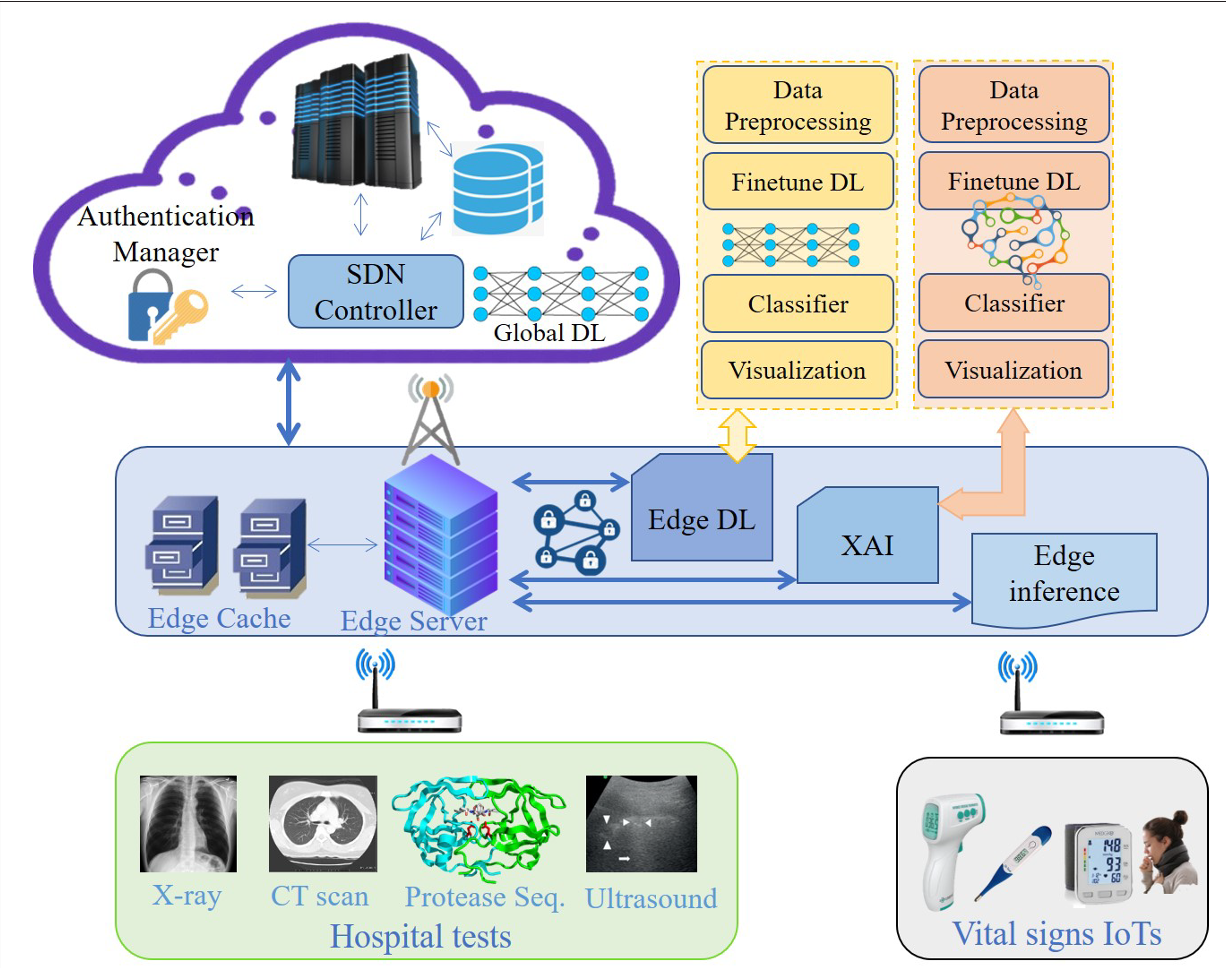
The proposed framework is divided into three layers:
- Stakeholder Layer: Patients and hospitals providing multimodal data (X-rays, cough sounds, body temperature).
- Edge Layer: The core of the system where "Deep Tree" models carry out inference. Crucially, this layer includes an XAI module using LIMA (Local Interpretable Model-Agnostic) and Grad-CAM to visualize which parts of a lung scan contribute to a diagnosis.
- Cloud Layer: Reserved for heavy training of the DL models during off-peak hours.
Security via Blockchain
To prevent the tampering of sensitive health records, the framework utilizes Blockchain technology. Each block contains a "Markle root" and infection pattern generators based on finite automata, ensuring that the tracking of suspected cases is both immutable and verifiable by authorized government bodies.
Experiments & Results: Efficiency Matters
The researchers compared three architectures: ResNet50, Inception v3, and Deep Tree.
Key Findings:
- Model Latency: The Deep Tree model outperformed others in inference speed on edge devices (NVIDIA Jetson/GTX 1080).
- Scheduling: Implementing Shortest Job First (SJF) scheduling at the edge reduced the average waiting time for diagnostic results compared to First-Come-First-Serve (FCFS).
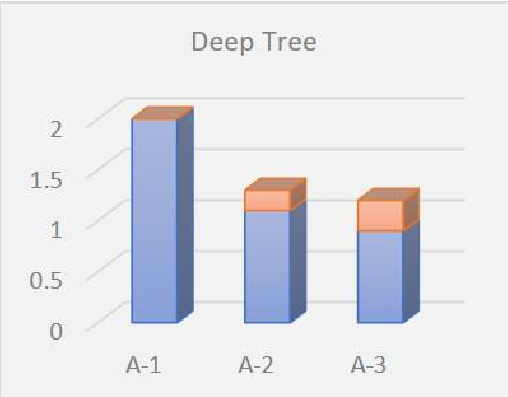
The results confirm that the "Edge + 5G" approach provides a negligible cost difference compared to the cloud while offering superior local control and privacy.
Critical Analysis & Conclusion
Takeaways
The paper successfully demonstrates that combating a pandemic requires a heterogeneous technology stack. It is not enough to have a good model; you need the low latency of 5G to deploy it and the transparency of XAI to make it actionable for clinicians.
Limitations & Future Work
While the framework is comprehensive, the reliance on Mass Surveillance via UAVs and thermal cameras raises significant ethical and civil liberty questions that are only briefly addressed through "Blockchain security." Future research should focus on Privacy-Preserving AI (like Federated Learning) to further decouple personal identity from health status.
In conclusion, this B5G-XAI framework sets a blueprint for "Smart City" resilience, turning the network itself into a diagnostic and protective instrument.