
Explainable Predictive Coding: Decoding the "Black Box" of Legal Document Review
Explainable Text Classification in Legal Document Review A Case Study of Explainable Predictive Coding
This paper introduces "Explainable Predictive Coding," a framework for legal document review that identifies specific text snippets (rationales) to justify classification decisions. By utilizing Document and Rationale models based on Logistic Regression, the system achieves significant efficiency gains in Electronically Stored Information (ESI) discovery.
TL;DR
In the high-stakes world of litigation, "Predictive Coding" has long been a powerful but opaque tool for sorting through millions of documents. This paper introduces a method to make these AI decisions human-understandable by identifying the specific "rationales" (text snippets) that trigger a "responsive" classification. By focusing on these snippets, legal teams can reduce the volume of text they need to read by up to 85%, potentially saving millions of dollars in document review costs.
Problem & Motivation: The "Black Box" Challenge
In modern legal discovery, a single lawsuit can involve hundreds of thousands of files—ranging from one-sentence emails to 1,000-page spreadsheets. While Machine Learning (specifically text classification, or "Predictive Coding") helps cull this data, lawyers often hesitate to trust it because:
- Lack of Transparency: They don't know why a document was marked relevant (the "Black Box" problem).
- Inefficiency: Even if a document is correctly flagged, an attorney might spend 20 minutes reading it only to find that the "responsive" part was a single footer or a specific paragraph on page 50.
The authors' insight is simple: A document is responsive if at least one of its snippets is responsive. If an AI can point directly to that snippet, it provides both an explanation and a shortcut.
Methodology: Two Paths to Explainability
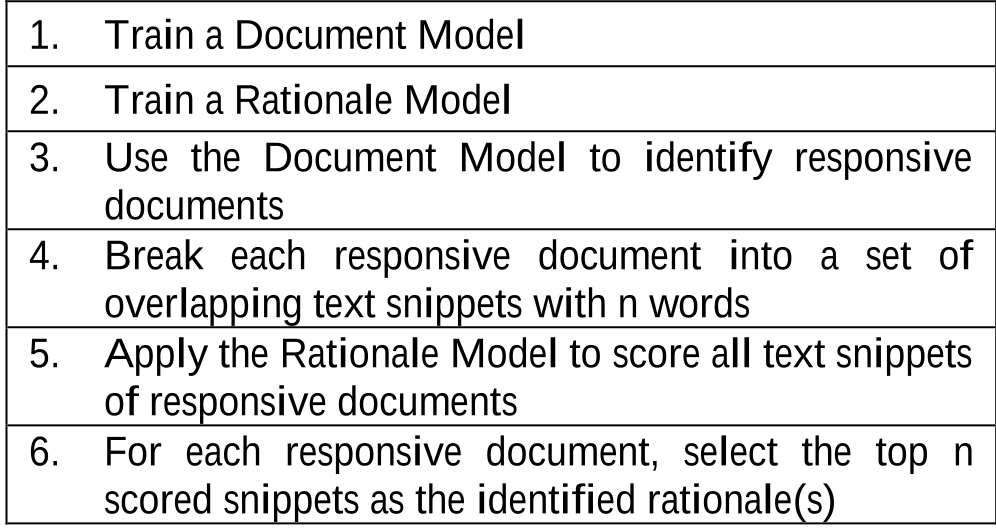
The authors designed a two-phase process. First, standard Predictive Coding identifies relevant documents. Second, the system identifies the "rationales" within those documents. They compared two methods for this:
- The Document Model Method:
- Uses a model trained on entire documents.
- Breaks new documents into overlapping snippets (e.g., 50, 100, or 200 words).
- Scores each snippet; the highest-scoring snippet is the "explanation."
- The Rationale Model Method:
- Requires attorneys to highlight why they marked a training document as responsive.
- Trains a specific model on these highlighted snippets versus random snippets from non-responsive documents.
Experiments & Results: Efficiency at Scale
The study used a massive real-world dataset of 688,294 documents (with 23,791 having human-annotated rationales).
Key Findings:
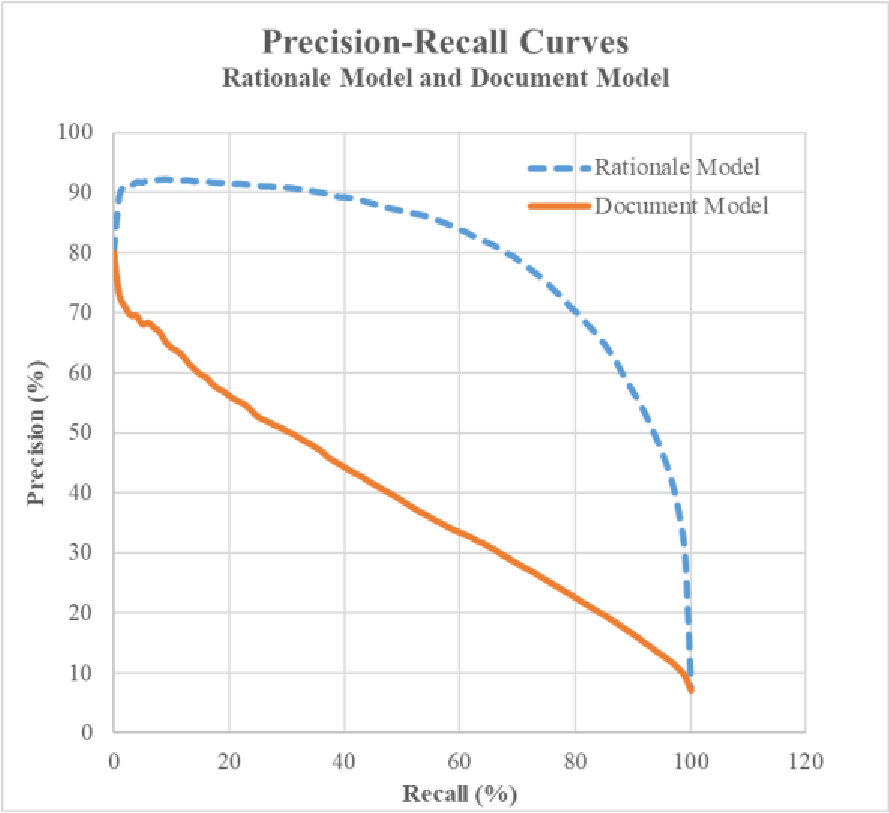
- Precision/Recall: The Rationale Model was highly effective, achieving 70% precision at 80% recall.
- The "Snippet" Advantage: By reviewing just the top four 50-word snippets of a document, attorneys could capture 76% of responsive material while ignoring nearly 80% of the irrelevant text within those documents.
- Noise Tolerance: Interestingly, the Document Model performed better on larger snippets (200 words), as it was trained on the "noise" of full documents and thus was less confused by irrelevant words surrounding a rationale.
Impact on Workload
Using the Document Model alone (which requires no extra work from lawyers during training), an attorney could achieve 44% recall by reading just one 50-word snippet per document. Across the entire case, this translates to saving 21.8 million words of manual reading.
Critical Analysis & Conclusion
Takeaway
Explainable Predictive Coding moves AI from a "trust me" tool to a "show me" tool. It doesn't just improve accuracy; it fundamentally changes the economics of legal review by allowing humans to focus on the high-value needles rather than the entire haystack.
Limitations & Future Work
- Simple Models: The study uses Logistic Regression (Bag-of-Words). While effective and fast for legal ESI, it lacks the semantic understanding of modern Transformers (like BERT or GPT), which could likely identify rationales with even greater nuance.
- Inconsistent Rationales: Human attorneys don't always agree on why a document is relevant, which can introduce noise into the training data for the Rationale Model.
As the legal industry moves toward more complex AI, this paper provides a vital bridge—demonstrating that explainability is not just a theoretical preference, but a practical necessity for cost-effective justice.