
Exploiting Social Networks: How Semi-Supervised Learning Shatters the Illusion of Privacy
Exploit of online social networks with Semi-Supervised Learning
This paper introduces a novel Semi-Supervised Learning (SSL) framework designed to exploit privacy vulnerabilities in Online Social Networks (OSNs). By utilizing Local and Global Consistency (LGC) graph-based models and Co-training mechanisms, the authors demonstrate that sensitive private attributes (like university affiliation) can be accurately inferred using only a tiny fraction of labeled data, significantly outperforming supervised baselines.
TL;DR
Even if you hide your profile on Facebook or LinkedIn, you are likely still "exposed." This paper presents a Semi-Supervised Learning (SSL) framework that can predict your private information—such as where you went to school—by looking at your friends and groups. Unlike previous methods that required massive datasets, this approach proves that an attacker only needs to know the details of a tiny handful of users (less than 5%) to map out the private attributes of an entire network with high accuracy.
The "Privacy Illusion": Why Your Settings Aren't Enough
Most users believe that by toggling their privacy settings to "Hidden," they are safe. However, social networks are inherently relational. While your attributes (age, hometown, school) might be hidden, your connections (friendship links, group memberships) are often publicly or semi-publicly visible.
The authors identify a massive gap in existing security research:
- Supervised Learning is too expensive: Previous "attacks" required too much labeled data to be practical for a causal adversary.
- Unlabeled Data is Abundant: On average, 70% of Facebook profiles are incomplete or hidden. This "hidden" data is actually a goldmine for Semi-Supervised Learning.
The SSL Framework: Bridging Labels and Graphs
The core insight of this paper is that social networks are mathematically represented as graphs . This structure allows information to "flow" from the few users who do share their info (labeled data) to those who don't (unlabeled data).
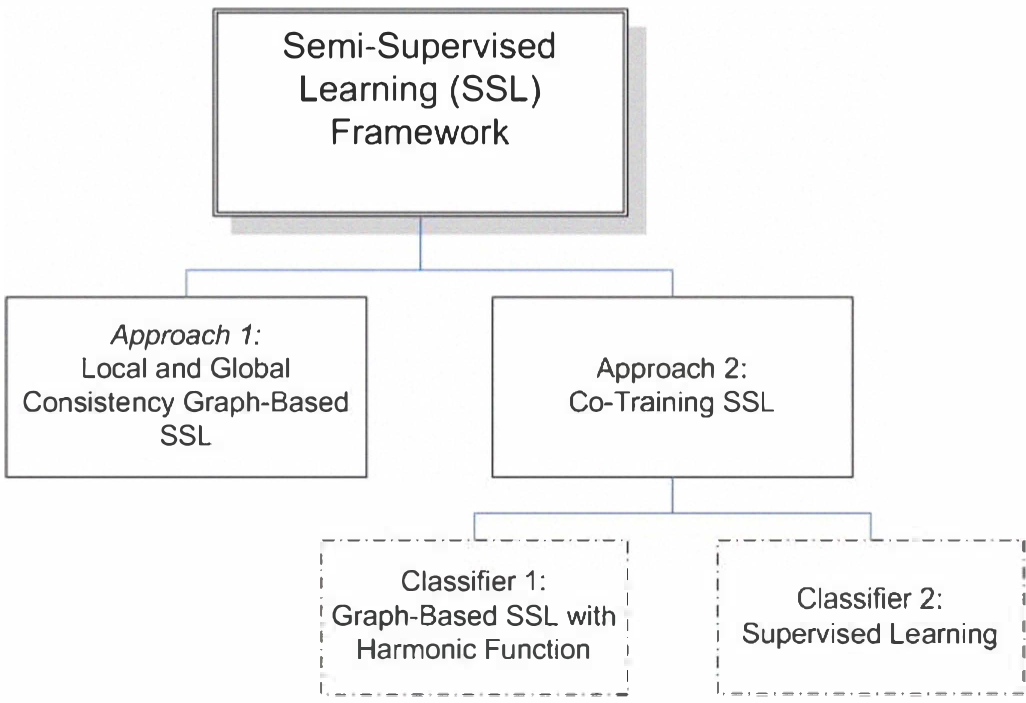
1. Local and Global Consistency (LGC)
The LGC model treats privacy exposure as a label propagation problem. It assumes that if two people are closely linked in a graph, they likely share common attributes. By optimizing a cost function that balances local smoothness (being similar to your neighbors) and global consistency (staying true to the initial known labels), the model can "color in" the missing parts of the social graph.
2. Co-Training: Two Heads are Better Than One
The framework also utilizes a Co-training strategy. Social data is split into two "views":
- Relational View: Friendship links and group memberships.
- Profile View: Statistical attributes like gender, age, and hometown coordinates.
By training two different classifiers and letting them "teach" each other about their most confident predictions, the model can cross-verify information. For example, if your friends suggest you went to Harvard, and your hometown is near Cambridge, MA, the model's confidence in that prediction sky-rockets.
Experimental Proof: SSL vs. Supervised Learning
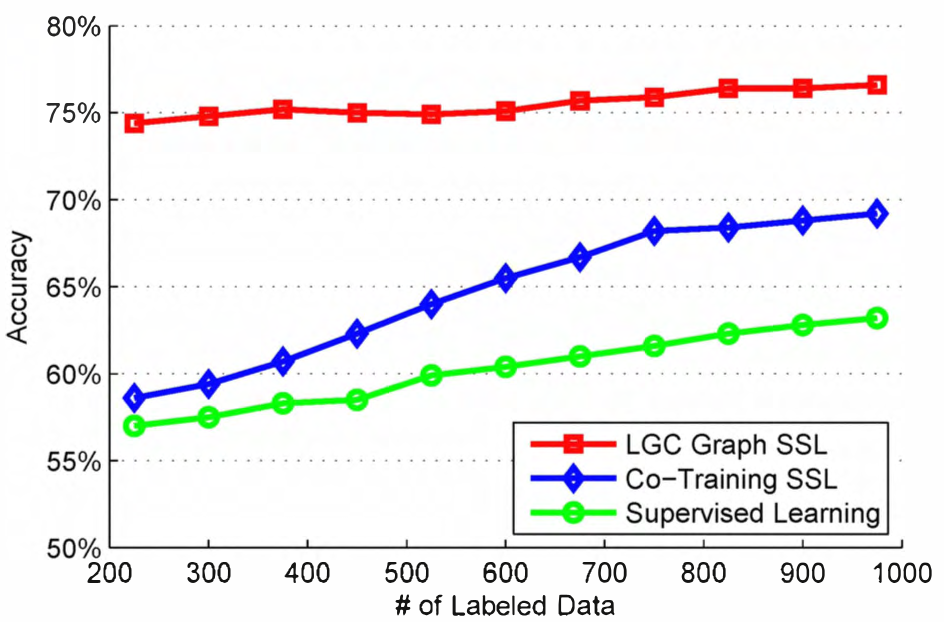
The authors tested their framework on real-world data from Facebook and StudiVZ (a German social network). The task was simple but invasive: predict which university a user attended.
Performance Metrics
- Facebook: With only 4.5% of the data labeled, the LGC model achieved 74.4% accuracy, while supervised learning (kNN) struggled at 57%.
- StudiVZ: The performance was even more staggering. As soon as the labeled data reached ~20%, the SSL models hit over 90% accuracy.
The difference in performance is largely due to the "Smoothness Assumption": in social networks, people with similar backgrounds tend to cluster together (Homophily). SSL exploits this physical intuition far more effectively than supervised methods that treat users as isolated data points.
Deep Insights & Vulnerabilities
The results provide a sobering look at network security:
- Group Info is a Leakage Vector: StudiVZ results were better than Facebook's because StudiVZ had richer group membership data. Groups are powerful proxies for private interests.
- The Small-World Advantage: Because social networks have "small-world" properties (few hops between any two people), the LGC method can propagate labels across a massive population with very few starting points.
Conclusion: A Call for Better Protection
This paper serves as a warning that Semi-Supervised Learning aggravates the privacy problem. It turns the sheer scale of social networks—once thought to provide "anonymity in numbers"—into a tool for more precise exploitation. To protect users, we must rethink privacy not just as hiding what we say, but as hiding who we know.
Takeaway for Researchers: The effectiveness of graph-based SSL in this context suggests that future "Privacy-Preserving OSNs" must implement noise injection or edge-obfuscation to break the manifold upon which these SSL models operate.