
DSI Framework: Deciphering the Chain Reaction of Social Event Participation
Exploiting the Dynamic Mutual Influence for Predicting Social Event Participation
This paper introduces the Dynamic Social Influence (DSI) framework, a novel discriminant approach for predicting social event participation by modeling the iterative mutual influence among users. By integrating dynamic social dependencies into a two-stage learning process, the authors achieve a significant performance leap, outperforming state-of-the-art baselines like SoRec and GcPMF.
Executive Summary
TL;DR: Predicting whether someone will attend an offline event is complicated by the "word-of-mouth" effect. This paper proposes the Dynamic Social Influence (DSI) framework, which moves beyond static profile matching to model the iterative, mutual influence friends have on each other. By treating social influence as a dynamic variable that lowers or raises a participant's logical "threshold," the researchers achieved over 75% precision in real-world scenarios, significantly outperforming traditional Matrix Factorization techniques.
Academic Positioning: This work bridges the gap between traditional Recommender Systems (focused on preference) and Social Influence Analysis (focused on spread), proving that in social gatherings, influence often outweighs personal topic preference.
Problem & Motivation: Why Preferences Aren't Enough
Why do we go to events? Existing SOTA models (like PMF or SoRec) assume it’s a mix of our static interests and our friends' interests. However, the authors argue that:
- Interests are Multifaceted: A programmer might like board games, but his work colleagues don't. Static social constraints would wrongly assume the colleagues should like the game.
- Decisions are Reversible & Iterative: Unlike a viral video "cascade" where you watch and move on, event attendance is a negotiation. If a key friend backs out, the whole group might collapse—a "chain reaction" that static models cannot capture.
Methodology: The Dynamic Threshold
The DSI framework treats participation as a discriminant problem: Participation = (Intention > Threshold).
The breakthrough is making that Threshold dynamic. Using a modified Independent Cascade (IC) model, the threshold for user regarding event is calculated as:
Core Intuition:
- : Your baseline resistance to attending events.
- : A differentiable Sigmoid function that "smooths" the binary decision of whether a friend is attending.
- : The latent strength of influence friend has over you.
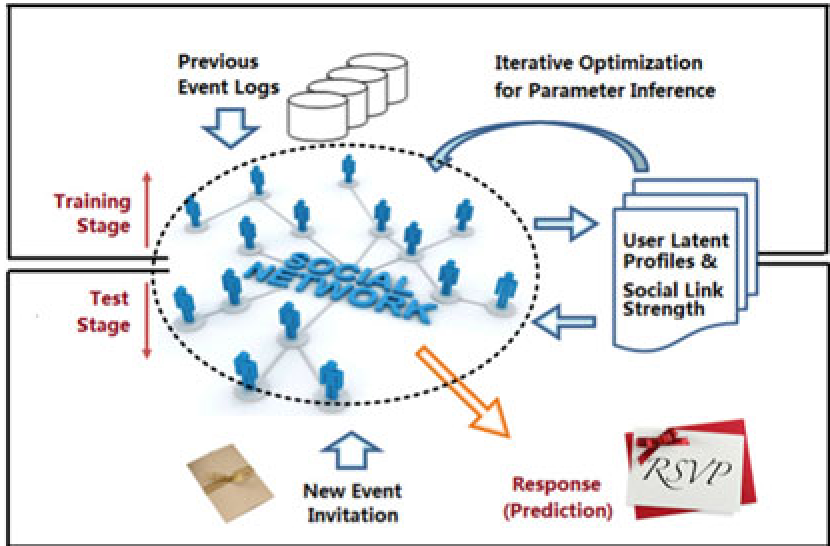
The model runs in two stages:
- Training: Iteratively solving for latent profiles () and influence weights ().
- Testing: Simulating the "social digestion" process where users influence each other until a stable equilibrium of attendance is reached.
Experiments & Results: Crushing the Baselines
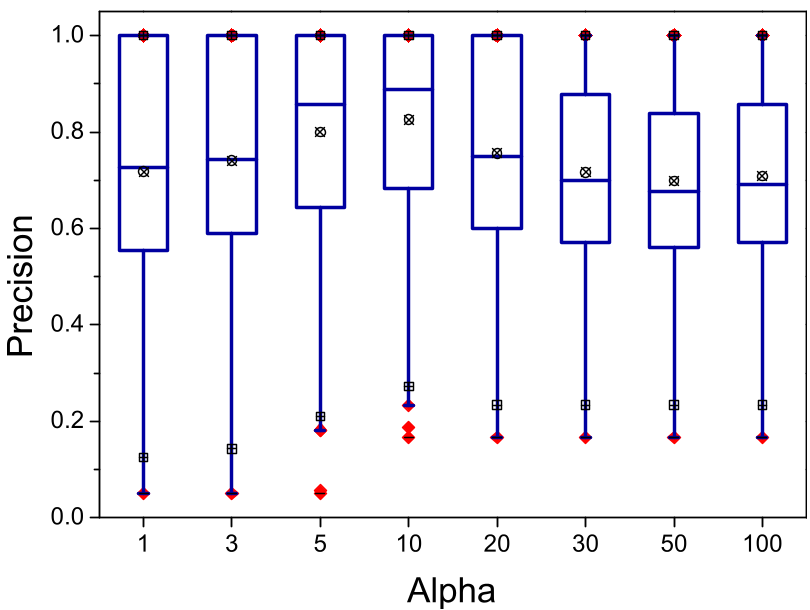
The framework was tested on a massive Meetup.com dataset (9,605 events, 24,107 users).
SOTA Comparison:
| Method | Precision (%) | Improvement |
|---|---|---|
| DSI (Ours) | 75.88 | - |
| SoRec (Social PMF) | 60.23 | +25.98% |
| GcPMF (Cost-aware) | 47.47 | +59.85% |
Key Insights from Results:
- Cold-Start Resilience: DSI handles new users better because it infers participation through social links even when the user profile is empty.
- Negative Influence Matters: The inclusion of negative weights (conflicts between users) explained why certain large groups had unexpectedly low participation rates.
- Efficiency: By applying Network Pruning (using metrics like Average Weight to filter out inactive users), the authors reduced computation time linearly without sacrificing much accuracy.
Critical Analysis & Conclusion
Takeaway
The DSI framework proves that social participation is a "group decision-making" process rather than a set of independent individual choices. The dynamic thresholding mechanism is a powerful tool for any community-oriented product.
Limitations & Future Work
While robust, the model currently assumes social connection strengths are somewhat stable over the training period. In highly volatile communities, these connections might change faster than the model updates. Future work involving Temporal Graphs could further refine the "Time-Varying" factors discussed in the paper.
Ultimately, this research provides a blueprint for event organizers: to maximize attendance, don't just pick a popular topic—target the influential "hubs" of the community whose participation will trigger the democratic threshold-lowering effect for everyone else.