
Social-Aware Routing: Navigating the "PU Communities" in Cognitive Radio Networks
Exploiting primary user social features for reliability-driven routing in multi-hop cognitive radio networks
This paper introduces a reliability-driven hybrid routing scheme for Multi-hop Cognitive Radio Networks (CRNs) that exploits the social features of Primary Users (PUs). By defining "PU Communities" and using Maximum Likelihood Estimation (MLE) to predict spectrum availability, the proposed method integrates dynamic programming with perimeter routing to bypass high-interference zones, achieving significantly higher end-to-end communication reliability.
TL;DR
In Multi-hop Cognitive Radio Networks (CRNs), the movement of Primary Users (PUs) isn't random—it's social. By identifying dense "PU Communities," this paper proposes a hybrid routing strategy that uses Maximum Likelihood Estimation and Perimeter Routing to bypass interference hot-spots, drastically increasing the reliability of data transmission for Secondary Users (SUs).
The Problem: The "Blind Spot" in Spectrum Routing
Most existing routing protocols for CRNs treat spectrum availability as a transient, random variable. They focus on finding the shortest path or the most energy-efficient route. However, they overlook a critical physical reality: Primary Users are humans. Humans cluster in specific locations—offices, malls, or transit hubs—creating "PU Communities."
If a routing path for an SU is planned through one of these communities, the spectrum availability is consistently low, leading to frequent transmission failures. Prior works failed to account for this geographic diversity and the temporal stability of these social clusters.
Methodology: Quantifying Social Features
The authors bridge the gap between social behavior and network performance through three innovative steps:
1. The Concept of "K-Community"
The paper defines a PU Community as a group of PUs aggregated in a hot-spot. A K-Community is specifically an area where the number of coexisting PUs exceeds a threshold . This provides a quantitative index for spectrum "danger zones."
2. Maximum Likelihood Estimation (MLE) of PU Density
Instead of just sensing active PUs (which change rapidly), the SUs estimate the number of potential PUs (). Using a Markov chain model (transitioning between active/inactive states), they apply MLE to historical sensing data to predict .
The logic is sound: While a PU might stop talking (becoming inactive), they rarely leave the physical area immediately. Estimating the total population provides a much more stable routing metric than sensing current channel occupancy.
3. The Hybrid Routing Scheme
The routing engine consists of two layers:
- Reference Routing (Global): Uses Dynamic Programming to find an optimal path based on distance and energy constraints, assuming a "clean" environment.
- Perimeter Routing (Local): When an SU detects it is entering a PU Community, it deviates from the reference path using a "Right-Hand" or "Left-Hand" rule to navigate around the cluster's boundary.
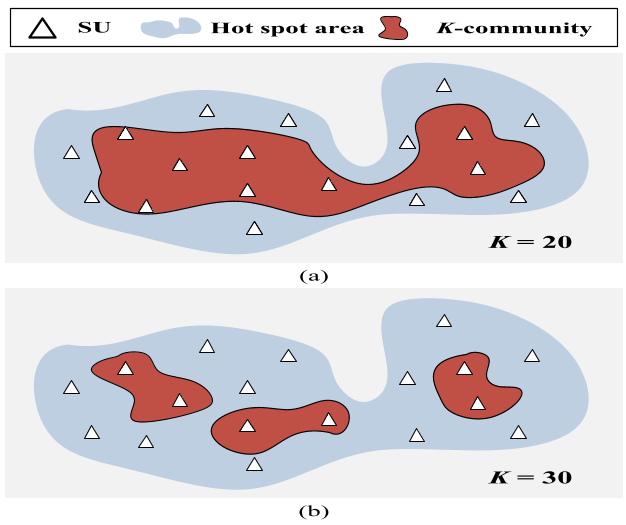
Experiments and Insights
The simulation results validate the intuition that "social-aware" is "reliability-aware."
- Visual Proof: In the simulation, the "Reference Route" attempted to cut straight through a dense PU cluster. The proposed "Hybrid Route" sensed the community and successfully performed a perimeter maneuver to find a path with higher spectrum availability.
- Reliability Gains: By avoiding the (outage probability) spikes associated with dense PU areas, the Successful Transmission Rate (STR) saw marked improvements.
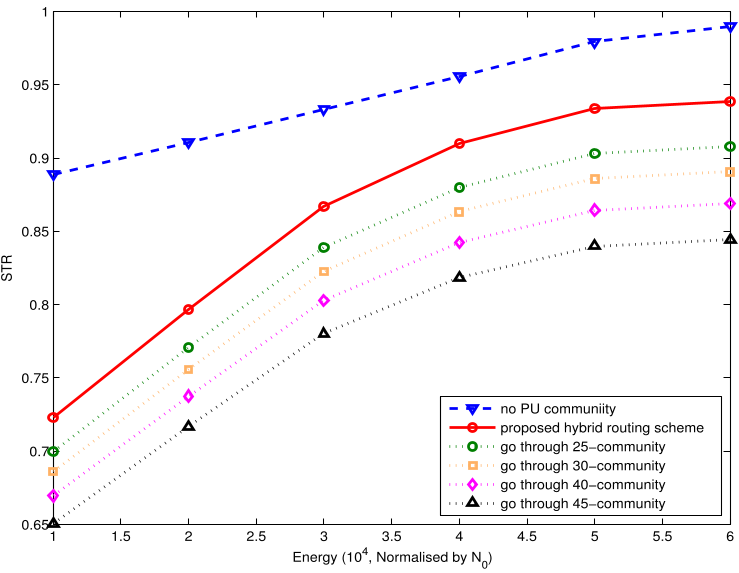
Critical Analysis & Conclusion
This work highlights a shift from reactive spectrum access to proactive social awareness. The core contribution is recognizing that the "potential" population of PUs is a better routing metric than "instantaneous" channel state.
Limitations:
- Optimal K: The paper leaves the determination of the optimal threshold for future work. A that is too low might result in overly long, inefficient paths.
- Boundary Definition: The perimeter routing assumes a circular "danger zone" (), whereas real-world social clusters are often irregular (following streets or building footprints).
Future Outlook: This methodology could be highly effective in Vehicular Networks (VANETs), where traffic jams create temporary but highly dense "PU communities" that secondary safety sensors must navigate around.