
Leveraging Social Ties: A Game-Theoretic Paradigm for Cooperative D2D Communications
Exploiting Social Ties for Cooperative D2D Communications: A Mobile Social Networking Case
This paper proposes a coalitional game-theoretic framework for cooperative Device-to-Device (D2D) communications by exploiting human social ties. It introduces a Network-Assisted Relay Selection (NARS) mechanism that leverages social trust and social reciprocity to incentivize devices to act as relays, achieving up to 122% performance gain over non-cooperative baselines.
Executive Summary
TL;DR: This paper bridges the gap between social psychology and wireless networking by proposing a D2D cooperation framework based on Social Trust and Social Reciprocity. By modeling device interactions as a coalitional game, the authors provide a mechanism that encourages "selfish" nodes to relay data for one another, resulting in a staggering 122% throughput gain while ensuring the system remains stable and cheat-proof.
Context: Within the wireless landscape, this work is a seminal piece that moves beyond viewing users as mere "data points" and instead treats them as "social entities," using game theory to solve the long-standing problem of cooperation stimulation in decentralized networks.
Problem & Motivation: The "Selfish Node" Bottleneck
In standard D2D (Device-to-Device) paradigms, we assume Node A will happily exhaust its battery to relay Node B's high-definition video. In reality, this never happens.
Prior works attempted to solve this with:
- Payment-based systems: High overhead, complex credit management.
- Reputation systems: Requires a central authority to monitor every behavior.
The authors' Insight is elegant: We don't need to pay strangers if they are our friends (Social Trust), and even if they are strangers, they will help if they know we will help them back (Social Reciprocity).
Methodology: The Physical-Social Interplay
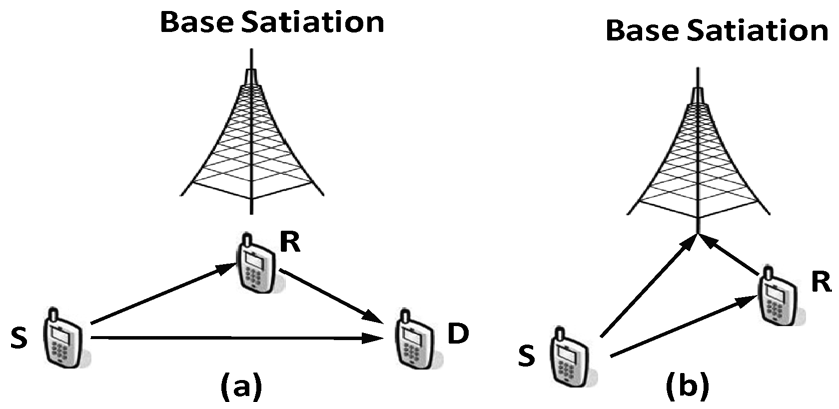
The genius of this approach lies in the dual-layer modeling. The authors define two distinct graphs that must overlap for cooperation to occur:
- Physical Graph: Can Node A physically reach Node B?
- Social Graph: Does Node A know/trust Node B, or is there a mutual benefit?
1. The Coalitional Game
To find the optimal relay configuration, the authors use a Coalitional Game. The goal is to reach the Core—a state where no group of users can "rebel" and find a better deal elsewhere.
2. Reciprocity Types
The paper distinguishes between:
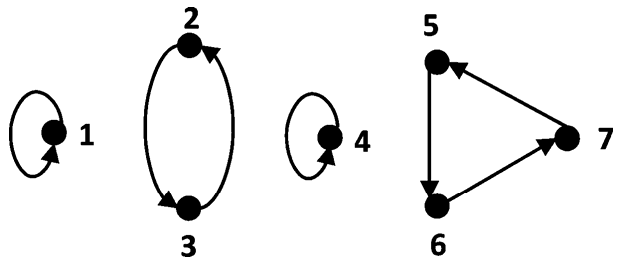
- Direct Reciprocity: "I help you, you help me" (A B).
- Indirect Reciprocity: "I help you, someone else helps me" (A B C A).
3. The NARS Mechanism
The Network-Assisted Relay Selection (NARS) mechanism is the practical implementation. It uses an iterative "Cycle Finding" algorithm to group nodes into self-sustaining cooperation loops.
Experiments & Results: Real-World Validation
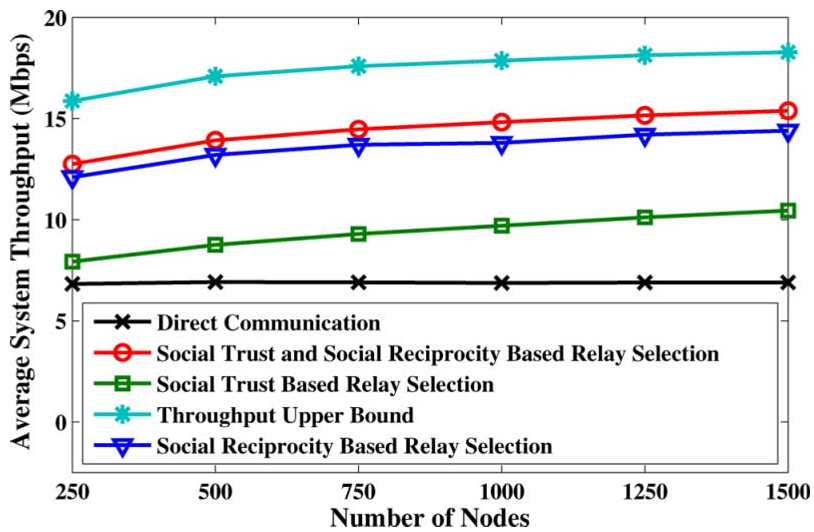
The authors didn't just rely on synthetic models; they used the Brightkite dataset (a location-based social network) to simulate real human social ties.
Key Findings:
- Throughput Boost: The combined social-trust and reciprocity model outperformed selfish direct communication by 122%.
- Efficiency: The algorithm converges linearly with the number of nodes, making it feasible for real-time base station deployment (running in <1s for hundreds of nodes).
- Stability: The mechanism is proven to be Collectively Truthful, meaning users cannot gain an advantage by lying about their relay preferences.
Critical Insight & Conclusion
Takeaway
The primary contribution of this work is proving that social context is a primary resource in wireless optimization. By recognizing that social ties mitigate the need for complex "policing" of nodes, the NARS mechanism provides a low-overhead path to massively increased spectral efficiency.
Limitations & Future Work
While robust, the current model relies on a binary "Trust vs. No Trust." The authors acknowledge that social trust is actually a spectrum (e.g., you trust a friend more than a friend-of-a-friend). Future iterations involving Weighted Social Graphs and Multi-hop Social Ties could further refine the accuracy of these cooperation incentives.
As we move toward 6G and hyper-dense D2D meshes, this "Physical-Social" synergy will likely become the bedrock of network resource management.