
Exploiting Time: Why Adaptive Stream Learning is the Future of Educational Data Mining
Exploiting Time in Adaptive Learning from Educational Data
This paper introduces an adaptive learning approach for predicting student exam outcomes (success/failure) in Virtual Learning Environments (VLEs) by treating educational interactions as non-stationary data streams. The researchers utilize the Adaptive Random Forest (ARF) algorithm on a custom subset of the OULAD dataset, achieving superior classification accuracy compared to traditional batch methods.
TL;DR
Predicting student success is a race against time. This paper argues that traditional "batch" machine learning models are too static for the evolving world of Virtual Learning Environments (VLEs). By implementing Adaptive Random Forests (ARF), the authors demonstrate that treating student data as a continuous stream—where history is summarized and the model evolves—yields significantly higher accuracy in predicting exam results (~90%) compared to traditional methods.
Background: The Static Data Trap
Most Educational Data Mining (EDM) research views a semester's worth of student data as a single, stationary snapshot. However, learning is a journey, not a photo. A student who struggles in the first month but adapts in the third month has a trajectory that a static model often averages out, losing critical nuance. The authors argue that the "time factor" is the key to unlocking better interventions.
Methodology: The Shift to Data Streams
The core innovation lies in the transition from Batch Random Forest (RF) to Adaptive Random Forest (ARF).
1. Model Architecture and Adaptation
Unlike standard RF, which requires a complete retraining on the entire dataset to update, ARF is designed for evolving data.
- Drift Detection: ARF monitors the performance of individual trees. If the "Concept" (the relationship between behavior and outcome) shifts—perhaps due to a change in course difficulty or teaching style—the model flags a warning.
- Background Training: When a warning is triggered, the algorithm starts training a new tree in the background, only replacing the old one if the performance drift is confirmed.
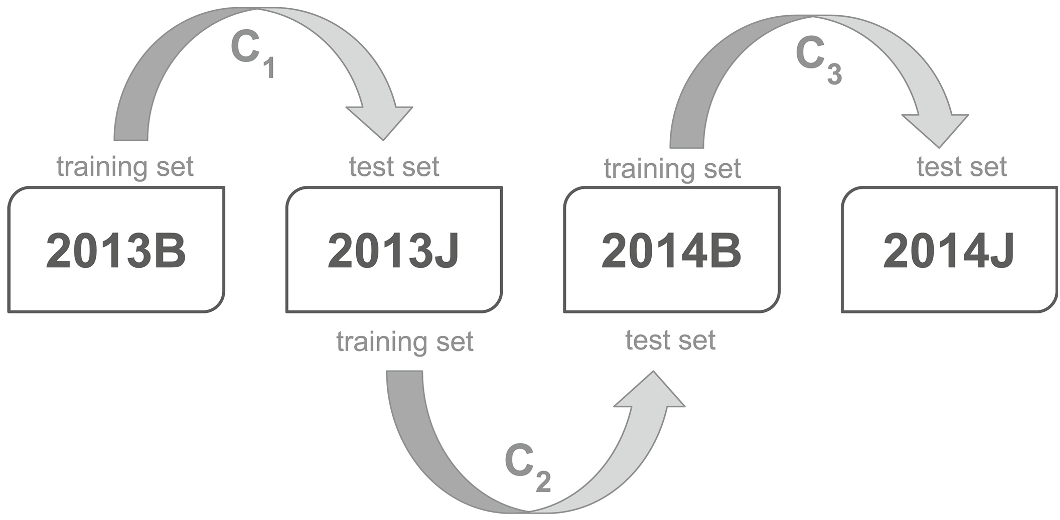 Figure 1: The experimental setup using semesters as discrete time units to evaluate model evolution.
2. Feature Engineering
The authors curated a subset of the OULAD (Open University Learning Analytics Dataset), focusing on:
- Demographics: Gender, IMD band (deprivation), disability.
- Learning Behavior: Interaction counts with Quizzes, Forums, Glossaries, and collaborative tools.
- Performance: Average scores and number of assessments.
Results: Performance and Stability
The researchers tested both algorithms on 25,819 students. The results were categorized into three configurations (C1, C2, C3) representing different temporal chunks.
| Metric | Random Forest (Batch) | Adaptive Random Forest (Stream) |
|---|---|---|
| Max Accuracy | 87.69% | 89.92% |
| Recall (Pass) | 0.87 | 0.99 |
The higher recall for the "Pass" class in ARF suggests that the model becomes exceptionally good at identifying successful students as it accumulates historical parameters.
The "What Matters?" Analysis
Through a feature importance analysis, the study revealed a critical insight: Behavior beats demographics.
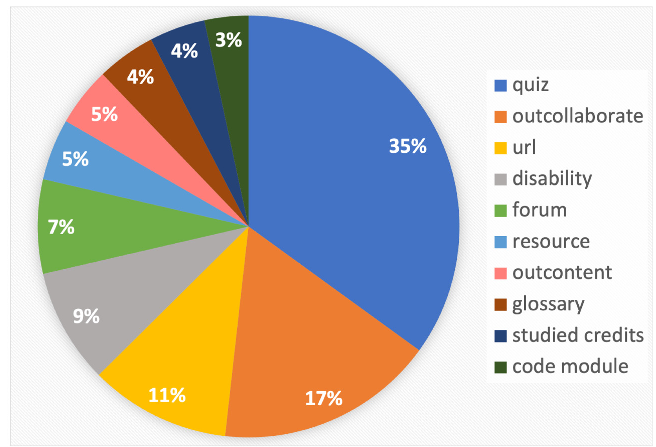 Figure 2: Top features for success prediction. Note the dominance of "Quiz" and "Out Collaboration" interactions.
- Quizzes and Out Collaboration: These were revealed as the strongest predictors. Regular interaction with interactive content is the best insurance against failure.
- Stability: ARF’s feature rankings were more stable over time compared to RF, indicating that it successfully internalized the "learning essence" across different semesters.
Critical Insight & Conclusion
The study proves that incremental analysis is not just a computational optimization (saving memory by not storing all logs) but a performance necessity. By mirroring the way a human brain evolves its knowledge through stimuli, adaptive algorithms provide a more accurate reflection of the pedagogical process.
Limitations and Looking Forward
While the binary classification (Pass vs. Fail) is robust, real-world educational data often has more granularities (Distinction vs. Pass). Future work will likely involve:
- Explaining the "Why": Using XAI to tell a teacher why a student is flagged.
- Real-Time Intervention: Using drift detection to trigger an email to a tutor the moment a student's "click-stream" deviates from the success path.
In conclusion, the integration of the time dimension transforms educational data from a static archive into a living, predictive tool for student success.