
Unified Ranking: Combating Sybil Attacks with Trust and Distrust Fusion
Exploiting Trust and Distrust Information to Combat Sybil Attack in Online Social Networks
This paper introduces a unified ranking mechanism that combines both trust and distrust information to detect Sybil identities in online social networks. By integrating a similarity-based graph pruning technique with a variant of the Personalized PageRank algorithm, the method effectively mitigates target seeding attacks and improves detection accuracy.
TL;DR
To combat the persistent threat of Sybil attacks—where attackers create massive fake identities—this paper moves beyond traditional "trust-only" models. It introduces similarity-based graph pruning to neutralize targeted attacks and a Unified Ranking Mechanism that propagates both trust and distrust scores. The result is a robust system that achieves SOTA performance even when the attacker knows the location of your honest seeds.
Background & Motivation: The Weakness of Trust
Most modern Sybil defenses are built on two pillars:
- Small Cut: Attackers can make clones, but they can't easily make "real" friends, creating a bottleneck between honest and Sybil regions.
- Fast Mixing: Random walks from honest nodes stay within the honest region for a long time.
However, the authors point out a critical vulnerability: Target Seeding Attacks. If an attacker knows which nodes are used as "trust seeds," they can focus all their "attack edges" on those specific nodes. This "infiltrates" the trust, making fake accounts look legitimate. Furthermore, real social networks are often "slow-mixing," causing traditional algorithms to perform poorly.
Methodology: The Core Innovations
1. Similarity-Based Graph Pruning
Before propagating trust, the system "cleans" the local neighborhood of honest seeds.
- The Intuition: An honest node and its real friends likely share many common neighbors. An attacker might trick one person, but tricking a whole clique is much harder.
- The Action: The algorithm calculates the local structural similarity (common friends) and prunes edges that fall below a threshold .
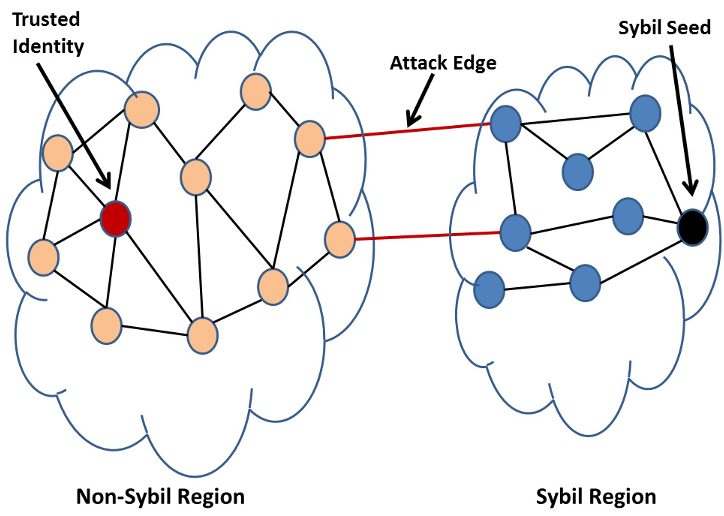 Note: The pruning focuses on a diameter around honest seeds to protect the trust source without fragmenting the whole network.
2. Reliable Sybil Seed Selection
Unlike previous methods that might pick Sybil seeds blindly, this paper proposes a Spamicity metric: By identifying clusters of nodes that are overwhelmingly identified as malicious by subroutines (like SybilRank), the system picks "anchor points" for propagating negative distrust.
3. Unified Ranking (The Fusion)
The system runs two parallel Personalized PageRank (PPR) processes: one starting from honest seeds (positive scores) and one from Sybil seeds (negative scores). The final trustworthiness is a weighted sum: This fusion ensures that even if a Sybil node manages to get some trust, its high distrust score will drag it down the rankings.
Experiments & Results
The authors tested their method on Facebook and citation networks (AstroPh, HepTh).
Key Finding 1: Targeted Attack Resilience In targeted attack scenarios where traditional SybilRank fails, the pruning technique (at ) stabilizes the AUC (Area Under Curve), preventing the "dip" in performance as the number of Sybils increases.
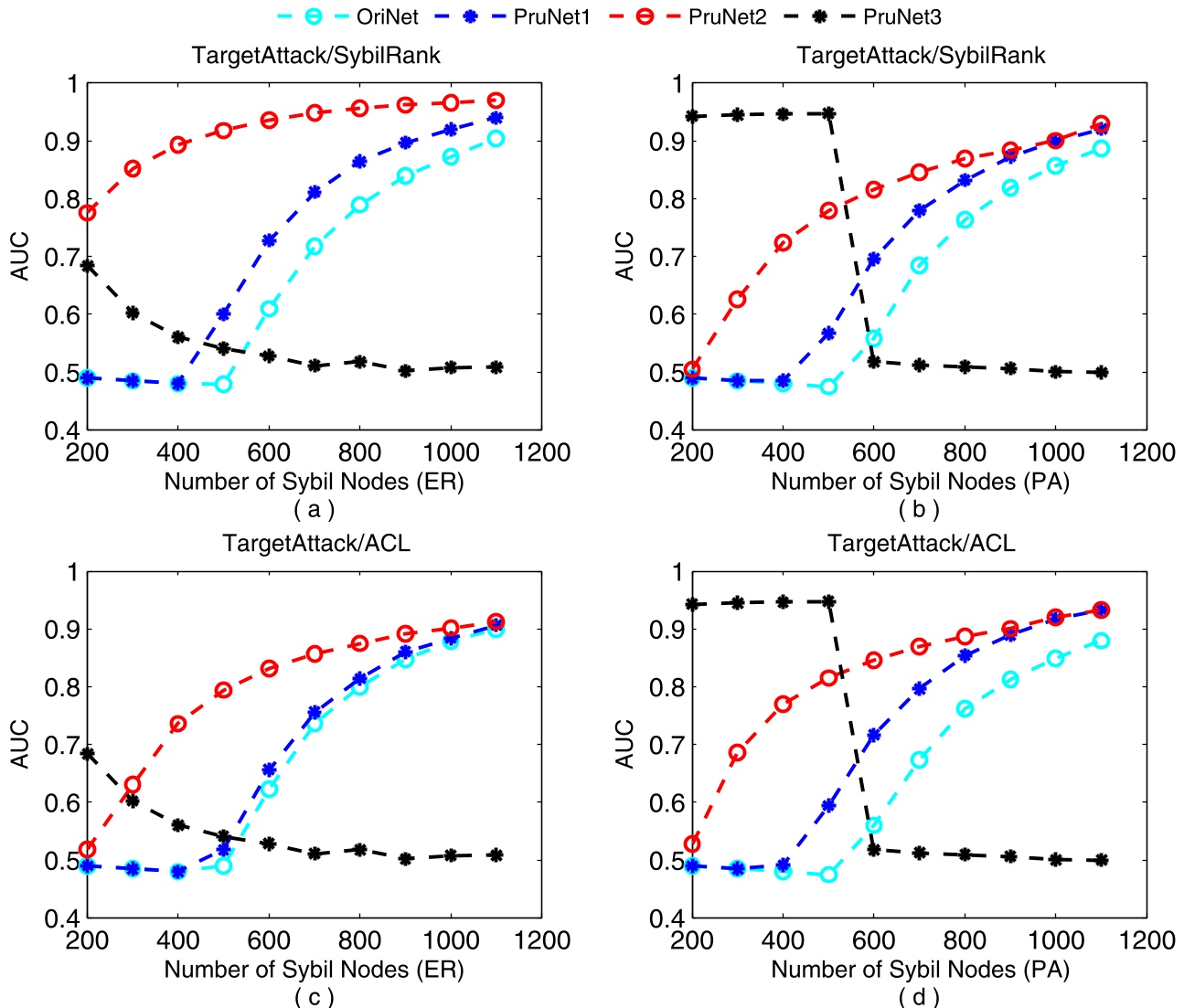 The charts show that pruning (red/green lines) consistently maintains higher AUC than standard methods (black/blue lines) under various attack intensities.
Key Finding 2: Robustness to Scale The "Unified" model proved particularly effective in large-scale attacks (5,000+ Sybils). While trust-only models struggle when the "small cut" is blurred, the inclusion of negative distrust provides a much-needed corrective signal.
Critical Insight & Conclusion
The main value of this work lies in recognizing that distrust is not just the absence of trust. In a graph-structured world, distrust provides a distinct topological signal. By pruning the graph based on local community structure and using a dual-propagation mechanism, the authors have created a framework that is significantly harder for sophisticated adversaries to "game."
Limitations: The method requires a "Human-in-the-loop" (Oracle function) for initial Sybil seed verification, which might limit its speed in lightning-fast automated environments. However, for platform-level security (like Facebook or Twitter), this hybrid approach provides a powerful layer of defense.