
Socioware: The Weaponization of Social Trust and Insider Threats
18075_Exploiting Trust Stealthy Attacks Through Socioware and Insider Threats.
This paper introduces the concept of "Socioware," a specialized category of malware that exploits the inherent trust in Online Social Networks (OSNs) to conduct cybercrime. It establishes a four-tier taxonomy of OSN malware and demonstrates a novel attack model where insider threats leverage socioware to compromise organizational security.
TL;DR
Online Social Networks (OSNs) have transformed from mere communication tools into potent attack vectors. This paper introduces Socioware—malware designed specifically to exploit the trust users place in their "friends" and social circles. By categorizing these threats and linking them to insider activities, the authors reveal a stealthy ecosystem where traditional antivirus and firewalls often fail.
The "Trust Gap" in Modern Cybersecurity
The fundamental problem is simple yet devastating: humans trust "friends" more than strangers. Attackers exploit this psychological bias to distribute malware at scale. Existing literature often analyzes how malware spreads (the social graph), but this paper focuses on how the malware is built to subvert browser security and how a malicious employee (the insider threat) can use these tools to bypass a company's billion-dollar perimeter.
The Socioware Taxonomy: Four Shields of Malice
The authors classify OSN malware into four distinct classes based on their technical "modus operandi":
- Class-I (In-session Tampering): Uses MitB (Man-in-the-Browser) to inject unauthorized content. It doesn't need to steal your password; it just changes what you see and click while you are logged in.
- Class-S (Stealing Credentials): Purely focused on exfiltrating OSN login data. Once credentials are stolen, the infection can be automated globally.
- Class-E (Exploitation): Leverages classic web flaws like XSS, CSRF, and Clickjacking within the OSN platform itself.
- Class-O (Outside-in / Indirect): Exploits third-party components like Content Delivery Networks (CDNs) to serve "Malvertisements" (malicious ads) that require zero user interaction to infect profiles.
Methodology: Dissecting the Man-in-the-Browser (MitB)
The paper provides a deep dive into how Socioware maintains persistence and visibility. Unlike traditional Man-in-the-Middle (MitM) attacks that happen on the network, MitB agents are user-level rootkits.
Key Hooking Techniques:
- Inline Hooking: "Hot patching" function instructions to redirect execution flow to malicious code.
- DLL Injection: Forcing a browser to load a malicious library at runtime, effectively running the malware with the browser's own permissions.
- IAT Hooking: Patching pointers in the Import Address Table to intercept critical Windows API calls.
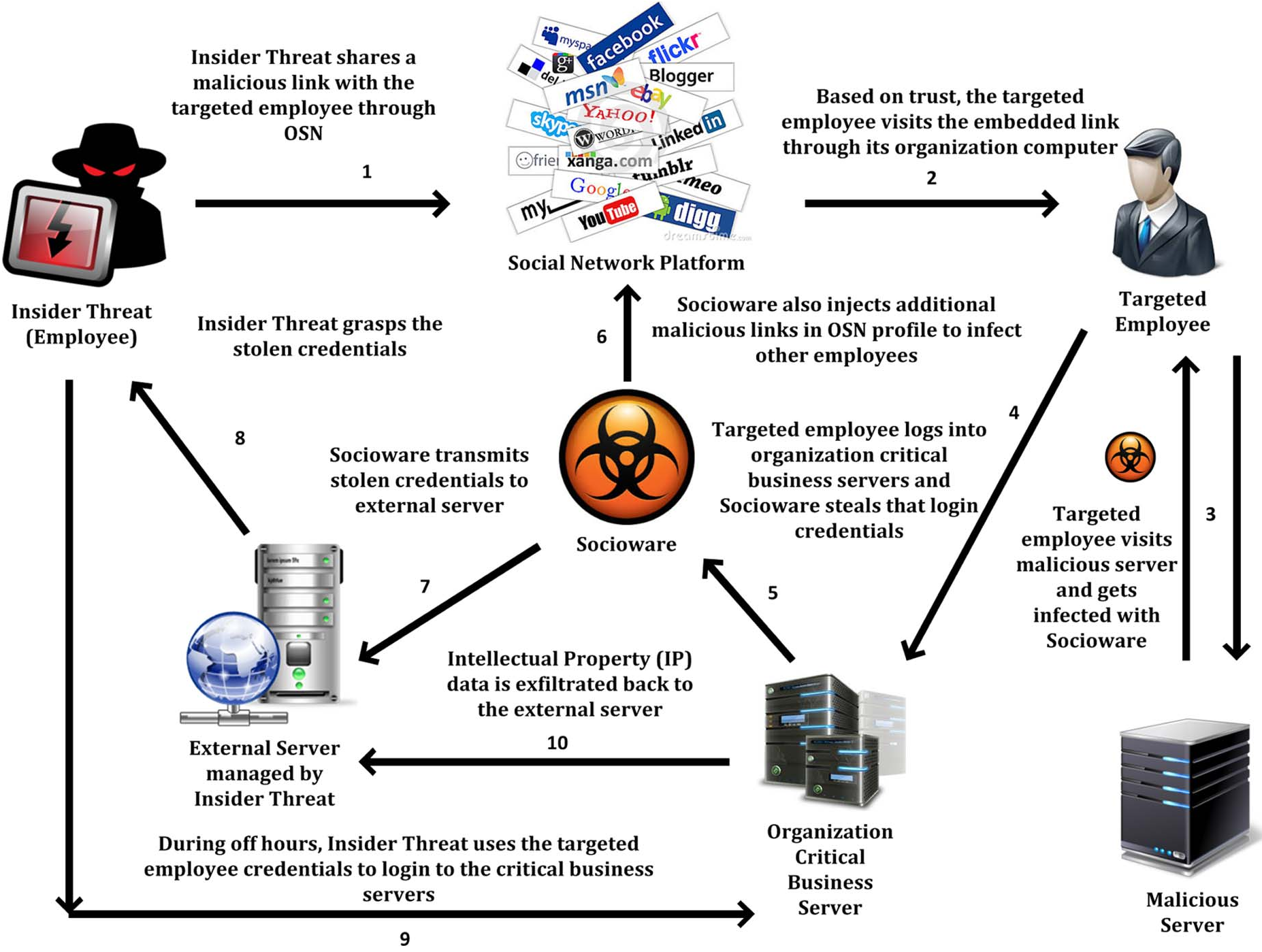 Above: The lifecycle of an insider threat using Socioware to infect an organization.
The Insider Threat: A Trojan Guest
Perhaps the most alarming contribution is the Insider Threat Attack Model. It demonstrates how an employee can:
- Target a colleague on a social network.
- Send a malicious link via the OSN, bypassing corporate email filters.
- Execute a "Drive-by Download" to install Socioware.
- Use that Socioware to steal the colleague's internal server credentials once they log into the corporate network.
Results and Next-Gen Defenses
Standard defenses like SSL/TLS are insufficient against Socioware because the data is stolen before encryption happens at the browser level. The authors suggest a paradigm shift:
- Webpage Code Polymorphism: Dynamically changing HTML labels (e.g., changing "password" fields to random strings like "i934385hfndfb") so automated MitB markers can't find the data.
- Client-side Encryption: Encrypting form data via JavaScript immediately upon submission, making it useless if intercepted by a local hooker.
- Signature-based Webpage Verification: The server checks a "signature" of the rendered page to ensure no unauthorized JS modules were injected by a browser extension.
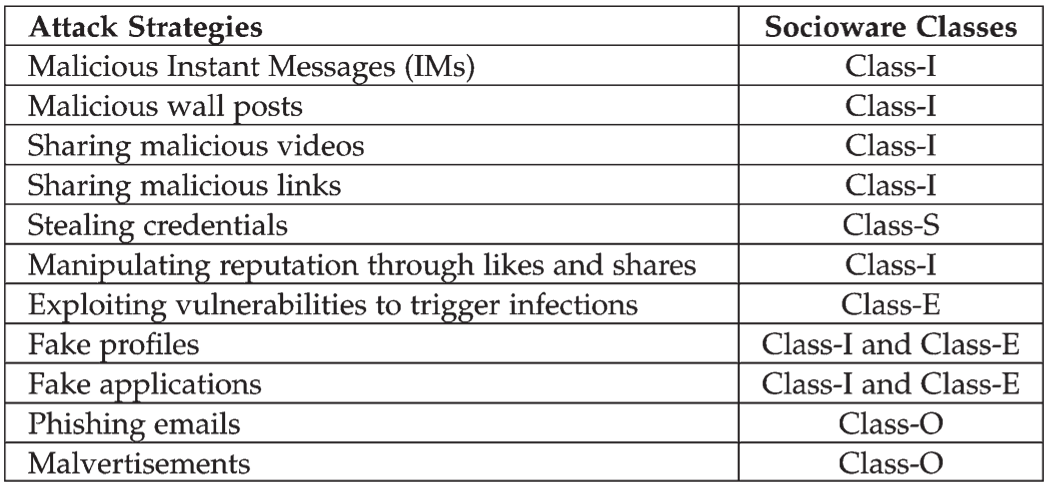 Above: Common attack strategies mapping to the proposed Socioware classes.
Critical Insight: The Future of OSN Security
The research concludes that OSN security must become proactive and polymorphic. Relying on user education (e.g., "don't click that link") is a losing battle. Instead, OSN providers must implement inline URL verification and emulated sandboxes to pre-screen content before it ever reaches the user's feed. The blurring line between personal web usage and professional environments means that a compromise in your personal Facebook account is now a direct path into your employer's data center.