
Deciphering Digital Loyalty: What Actually Drives Fan Growth on Facebook?
An Exploratory Study of Factors Affecting Number of Fans on Facebook Based on Dialogic Theory
This exploratory study applies Kent and Taylor's Dialogic Theory to identify factors influencing fan growth on Facebook, specifically analyzing the "iCook" fan page. By leveraging secondary data and regression analysis, the research identifies "Comments," "Shares," and "Return Visits" as critical predictors of daily fan increases.
TL;DR
Building a massive following on social media is more than a numbers game of "post more often." This study uses Dialogic Theory to prove that user engagement—specifically shares, comments, and the return rate of active fans—are the true engines of growth. Interestingly, for established pages, simply spamming posts or external links has surprisingly little impact on gaining new followers.
The "Virtual" Marketing Dilemma
In the era of Social Networking Sites (SNS), businesses have traded expensive TV commercials for inexpensive digital reach. However, a new challenge has emerged: Invisibility. Unlike a physical store, digital managers cannot "see" their customers' hesitation or delight.
The authors argue that previous academic attempts to solve this via "Content Analysis" were too slow and subjective. Instead, they pivot to a data-driven approach based on Dialogic Theory, which treats a fan page not as a digital billboard, but as a conversation hub.
Methodology: Operationalizing Dialogic Theory
The study focuses on iCook, Taiwan's largest recipe sharing community. Unlike brand-heavy pages, iCook thrives on community content. The researchers mapped the abstract pillars of Dialogic Theory to concrete, measurable metrics:
- Usefulness of Information: Measured by Comments and Shares.
- Conservation of Visitors: Measured by Posting Frequency and External Links.
- Generation of Return Visits: Measured by "Active Fans" who interact multiple times.
The Research Framework
The researchers proposed five hypotheses (H1-H5), suggesting that every interaction contributes to a daily increase in fan count.
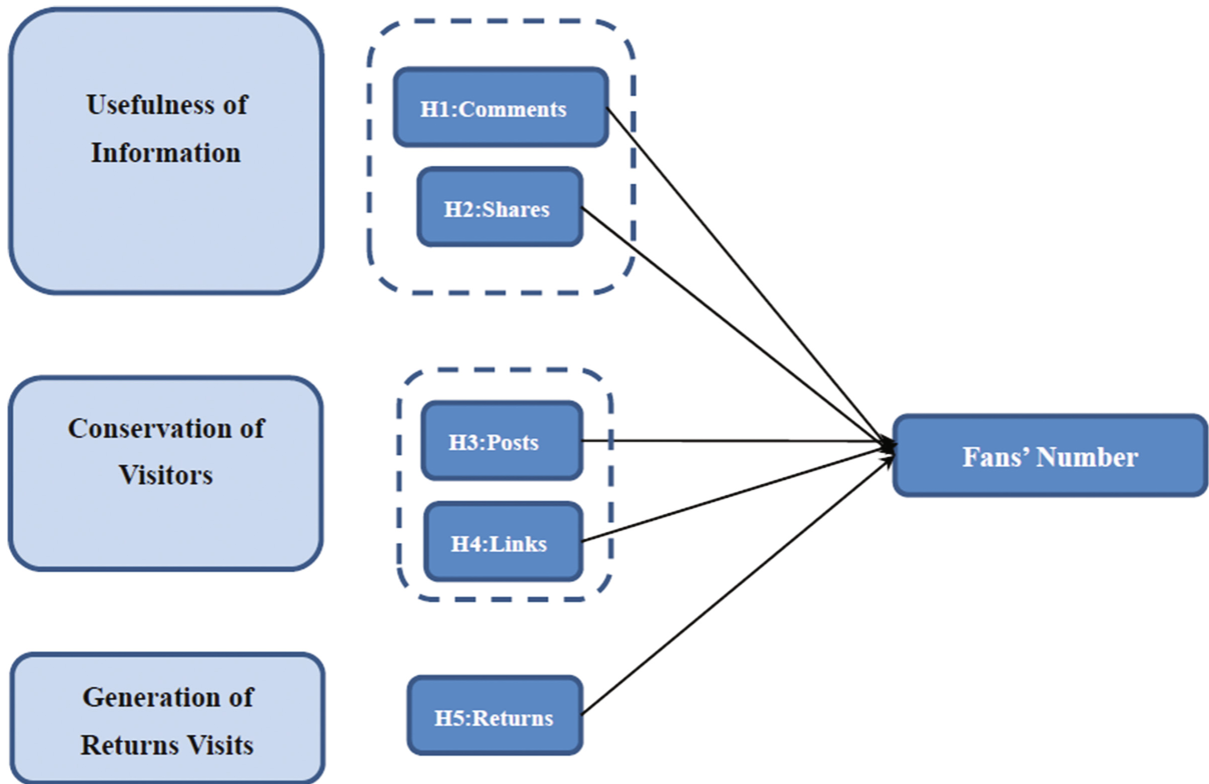 Figure 1: The hypothesized relationship between dialogic factors and total fan count.
Analysis and Key Findings
Using 300 days of data and multiple regression analysis, the study revealed a stark divide between "Interactive" and "Operational" actions.
1. Interaction is King
- Shares & Comments: These factors showed a strong positive correlation with fan growth. "Shares" are particularly powerful because they act as a "word-of-mouth" referral, exposing the brand to the followers' own social networks.
- Return Visits: This was a major finding. Fans who come back to "Like" or "Comment" consistently contribute significantly to the overall health and growth of the page.
2. The Frequency Paradox
Surprisingly, the number of daily posts and the presence of external links did not significantly drive new fan growth.
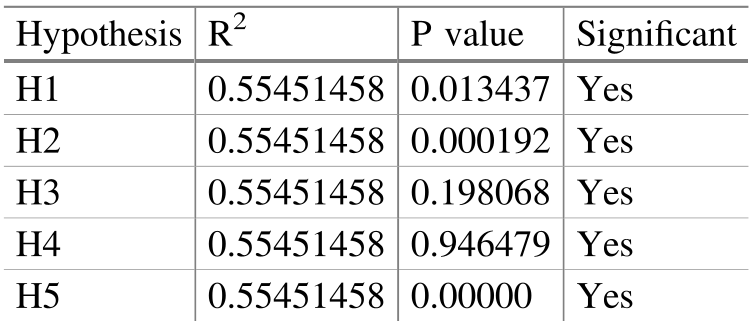 Table 1: Summary of Hypothesis Testing. Note the lack of significance in H3 and H4 compared to the strong significance in H5 (Return Visits).
The authors hypothesize that for a page like iCook, which is in a "Stable Stage" of its life cycle, the priority shifts from quantity to quality. At this stage, external links are better for "conversion" (getting people to a website to buy something) than for "acquisition" (getting new fans).
Critical Analysis & Professional Insights
This paper provides a crucial reality check for social media managers. It highlights that the Inductive Bias toward "more activity = more fans" is often flawed.
- Takeaway for Managers: Stop obsessing over the "post" button. Focus on content that triggers a "Share." A share is a high-magnitude signal; it implies trust and personal endorsement.
- Theoretical Contribution: The study successfully translates 1990s public relations theory (Kent & Taylor) into the 2020s digital ecosystem by substituting human coding with algorithmic data extraction.
Limitations
The study is limited to a single case study of a "Recipe Brand." These results might differ for "News Brands" (where links are vital) or "Luxury Brands" (where exclusivity may discourage high comment volumes). Future research should apply this regression model to diverse industries to create a "Volatility Index" for different fan page categories.
Final Summary
To win the Facebook game, you must close the Dialogic Loop. It is the active participation of fans—their willingness to comment, share, and return—that feeds the algorithm and grows the base. In digital marketing, as in life, the best strategy is to be worth talking about, not just to talk the most.