
AEMOS: Harnessing Emergent Social Networks to Optimize Agent E-Commerce
Exploring Emergent Social Networks to Improve Agent Mediated E-Commerce
This paper introduces an enhanced e-commerce model for the AEMOS platform, utilizing Emergent Social Networks (SN) to facilitate agent-mediated negotiations. By integrating a Social Network intermediary (SN-i), the system improves partner selection and proposal evaluation through proximity relations and trust-based metrics.
TL;DR
The AEMOS platform optimizes Agent-Mediated E-Commerce (AMEC) by moving beyond simple keyword matching. By analyzing the "Digital Footprint" of agent interactions, it builds Emergent Social Networks to predict the likelihood of negotiation success. This reduces failed bids, preserves computational resources, and increases overall market efficiency.
The Bottleneck: Why "Smart" Agents Fail
In the world of automated e-commerce, software agents represent buyers and sellers. While this promises 24/7 efficiency, it faces a massive Trust and Semantic Gap.
Current SOTA methods often struggle with:
- Over-Connection: Market facilitators often suggest every seller who shares a broad ontology, leading to a "spam" of Requests for Proposals (RFPs).
- Hidden Conflicts: Two agents might use the same "Electronics" ontology but differ wildly in "Price Category" or "Reliability."
- Computational Waste: Negotiating an Ontology Alignment (translating between two different data structures) is computationally expensive. Doing this for a deal doomed to fail is a massive drain on system resources.
Methodology: Mapping the Social Fabric of Agents
The core innovation is the Social Network Intermediary (SN-i). Instead of just looking at what an agent sells, the SN-i looks at who the agent is in the context of the market's history.
1. The Proximity Metric
Relationship intensity is calculated using four specific dimensions:
- Profile Similarity: Comparing transaction history and preferences.
- Interaction Patterns: Do these agents talk to the same "people"?
- Historical Success Rate: The ratio of successful deals to total negotiations.
- Satisifaction Scores: A [0,1] value provided by agents after closing a deal.
2. The Credibility Adjustment
A common issue in SN analysis is "Cold Start"—how do you trust a new agent? The authors introduce a Revised Adequacy Formula that weights the adequacy score () against the number of negotiations ().
 The logic is simple: If an agent has few interactions (), their high success rate might be a fluke, and the system adjusts the confidence accordingly.
Experiments & Results: Narrowing the Field
The researchers tested their model using a scenario involving one buyer and six diverse sellers.
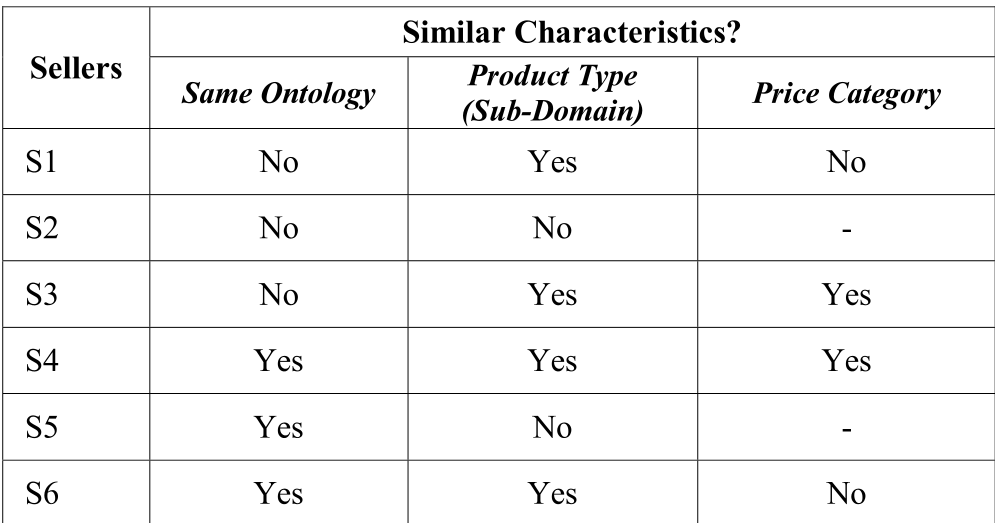
The Outcome: The traditional model would have pushed the buyer to negotiate with all six sellers. AEMOS, however, utilized the SN-i to filter the list:
- S1 & S6 were flagged due to mismatched Price Categories.
- S2 & S5 were excluded because their Product Sub-domains did not align.
- Result: The buyer only engaged with S3 and S4, drastically reducing the need for complex ontology alignments and unsuccessful message exchanges.
Critical Insight: From Transaction to Relationship
The value of this paper lies in its realization that e-commerce is not a series of isolated events, but an evolving ecosystem. By treating agent interactions as an Emergent Social Network, the authors provide a mathematical framework for "institutional memory" in an automated market.
Key Takeaways:
- Filtering is as important as Matching: Reducing the search space for negotiation is the best way to scale AMEC systems.
- Context Matters: Semantic interoperability isn't just about language; it's about business goals and reliability.
- Future Work: The authors aim to test this in larger-scale markets where social network effects (like clustering and small-world phenomena) become even more prominent.
Conclusion
AEMOS demonstrates that for autonomous agents to truly replace human negotiators, they need more than just logic—they need a "social sense" of which partners are worth their time.