
Scaling the Ivory Tower: Optimizing Apache Spark for Educational Big Data
Exploring and Evaluating the Scalability and Eficinecy of Apache Spark Using Educational Datasets
This paper investigates the scalability and efficiency of Apache Spark for educational data mining using KDD Cup 2010 datasets. It evaluates four machine learning algorithms (Logistic Regression, SVM, Random Forest, and Decision Trees) across local YARN and Google Cloud Dataproc clusters to identify optimal resource allocation strategies.
TL;DR
Distributed computing with Apache Spark is essential for modern Educational Data Mining (EDM), but it requires surgical precision in configuration. This paper explores the fine line between "scaling up" and "slowing down," demonstrating that for many common educational datasets, the overhead of data shuffling can quickly negate the benefits of adding more worker nodes.
Context & Positioning
As educational platforms shift to Online Cognitive Learning Systems, the scale of interaction data (KDD Cup style datasets) has outgrown local processing capabilities. This work positions itself as a practical guide for researchers, shifting the focus from "which algorithm is best" to "how do we configure the infrastructure to make these algorithms efficient."
Motivation: The Paradox of Distributed Computing
Most researchers assume that adding more nodes to a Spark cluster linearly improves performance. However, the authors identify a critical pain point: Communication Overhead.
- The Shuffle Bottleneck: Moving data between nodes during stages like 10-fold cross-validation can be slower than the actual computation.
- Resource Misallocation: Assigning too little memory per executor leads to frequent disk spills, while assigning too many small partitions leads to a "death by a thousand cuts" during the aggregation phase.
Methodology: Benchmarking under Pressure
The study utilizes Spark MLlib to deploy four heavy-hitters: Logistic Regression (LR), Support Vector Machines (SVM), Random Forests (RF), and Decision Trees (DT).
Architecture Overview
The experiments were conducted on two primary environments to ensure domestic and cloud-based reliability:
- Lab Cluster: Physical YARN-managed hardware (i7 CPUs).
- Google Cloud Dataproc: A managed environment where GFS (Google File System) automatically handles initial chunking.
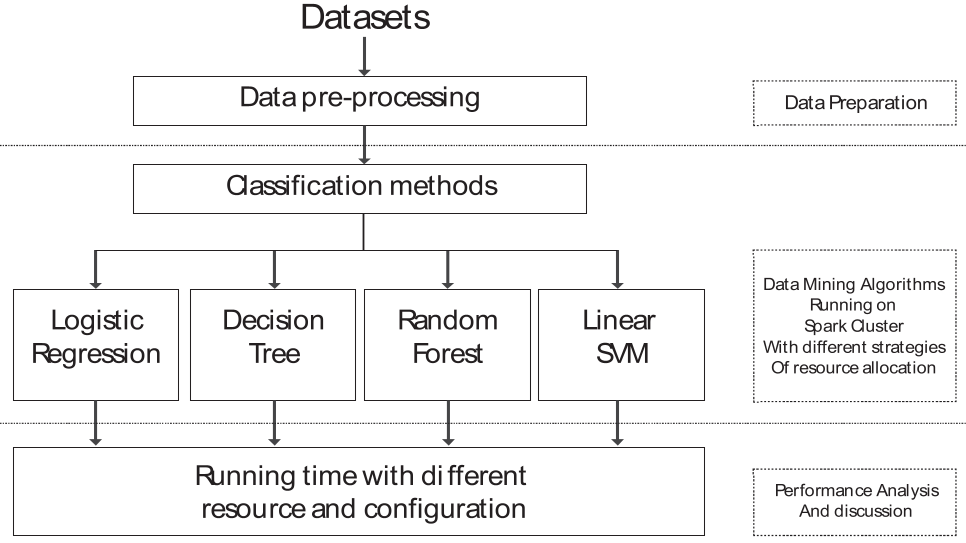 Figure 1: The experimental workflow from KDD data pre-processing to Spark MLlib implementation.
One of the key insights was the use of Sparse Vector LabeledPoints and the Dataset API, which allows Spark's Catalyst optimizer to better manage execution plans compared to the older RDD approach.
Key Findings: When More is Less
The experimental results provide a sobering look at the limits of parallelization.
1. Memory vs. Node Count
The authors found that for a dataset of ~840MB, increasing memory per instance (from 1G to 4G) yielded more significant speedups than doubling the node count from 16 to 32. In fact, after 16 nodes, the speedup ratio plateaus.
2. The Volume-Node Sensitivity
The most striking result came from varying the dataset size. For smaller subsets (half-million cases):
- LR Performance: Peaked at only 2 worker nodes.
- SVM Performance: Actually decreased as more nodes were added (Negative Speedup).
This is because the computation time on each node became so small that the overhead of Spark managing the task distribution and "shuffling" results back to the master became the dominant cost.
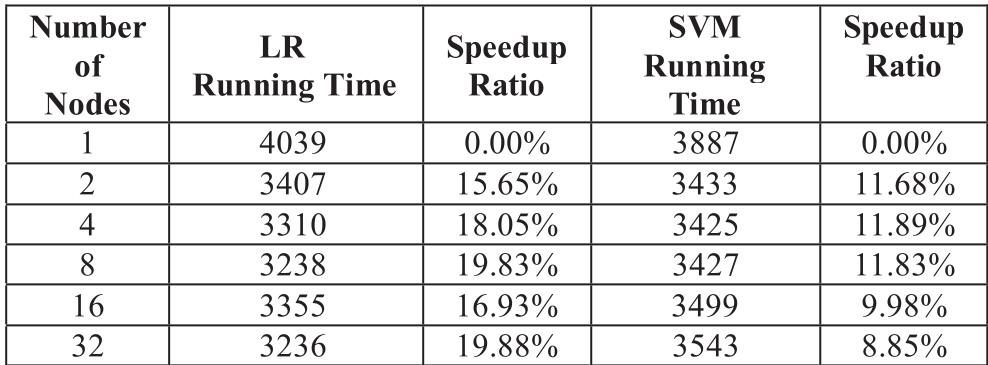 Table 1: Execution times showing the plateau and decline in speedup ratio as node count increases.
Critical Analysis & Takeaways
The paper confirms that Spark’s scalability is not infinite for specific algorithms.
- LR and SVM are particularly sensitive to data locality and shuffling.
- Random Forests and Decision Trees showed slightly better scaling characteristics due to their inherent tree-based parallelization logic.
Recommendations for Practitioners:
- Don't Over-Partition: If your dataset is under 1GB, stick to 8-16 executors.
- Prioritize Memory: Higher memory per executor reduces the need for costly I/O operations during iterative ML training.
- Auto-tuning is limited: While Spark 2.x's
dynamicAllocationis helpful, manual tuning ofspark.sql.shuffle.partitionsremains necessary for peak performance.
Conclusion
This work serves as a vital reminder that "Big Data" does not always require "Massive Clusters." For the educational research community, the sweet spot for efficiency lies in balanced resource allocation—tuning the cluster to match the dataset size rather than throwing hardware at the problem.
Future Outlook: Transitioning these findings to newer architectures like "Serverless Spark" could further automate these optimization strategies, allowing educators to focus on pedagogy rather than partition counts.