
SSB-Ranking: Decoding the Interplay of Social Roles and Latent Item Bundles
Exploring Latent Bundles from Social Behaviors for Personalized Ranking
The paper introduces SSB-Ranking (Personal Social Sequential Behaviors for Personalized Ranking), a novel recommendation framework that integrates social roles, sequential Markov patterns, and latent bundle relationships. It achieves SOTA performance in personalized ranking by modeling how social conformity and product-to-product relationships influence next-item selection.
TL;DR
SSB-Ranking is a sophisticated recommendation framework that bridges the gap between sequential behavior and social influence. By introducing "Social Role Vectors" and "Latent Bundle Relationships," the model explicitly accounts for why we buy things: sometimes it's personal habit, and sometimes it's because our social circle expects it. It effectively outperforms standard Markov-based models (FPMC) and Bayesian Personalized Ranking (BPR) on massive Amazon datasets.
Problem & Motivation: The Identity Crisis in RS
Most Recommender Systems (RS) treat users as static entities with fixed preferences. However, humans are social creatures with multiple roles—a professional at work, a parent at home, or a hobbyist in a community. Each role dictates a different level of conformity.
Furthermore, items don't exist in a vacuum; they form "bundles" (e.g., a camera, a lens, and a tripod). Previous works like FPMC captured the sequence but missed the social context and the relational logic between items (the "why" behind the sequence). The authors realized that to solve the sparsity and cold-start problem, we must model how social roles filter our sequential interests.
Methodology: The Core Architecture
The SSB-Ranking framework operates on two innovative layers:
1. The Role-Aware Transition Model
Instead of a fixed user-item interaction, the model uses a role vector . This vector acts as a probabilistic switch:
- Personal Preference: Driven by the user's latent factors and their specific history.
- Social Conformity: Driven by the average behavior of the user’s social neighborhood ().
The final prediction is a weighted sum where the role determines if you are acting as an "independent trendsetter" or a "social conformist."
2. Latent Bundle Weighting ()
Not all items in a user's history are equally important for the next purchase. SSB-Ranking calculates a personalized weighting factor for each item in the sequence. It uses a logic reminiscent of attention mechanisms but specifically tuned for product relationships like "users who bought X also bought Y."
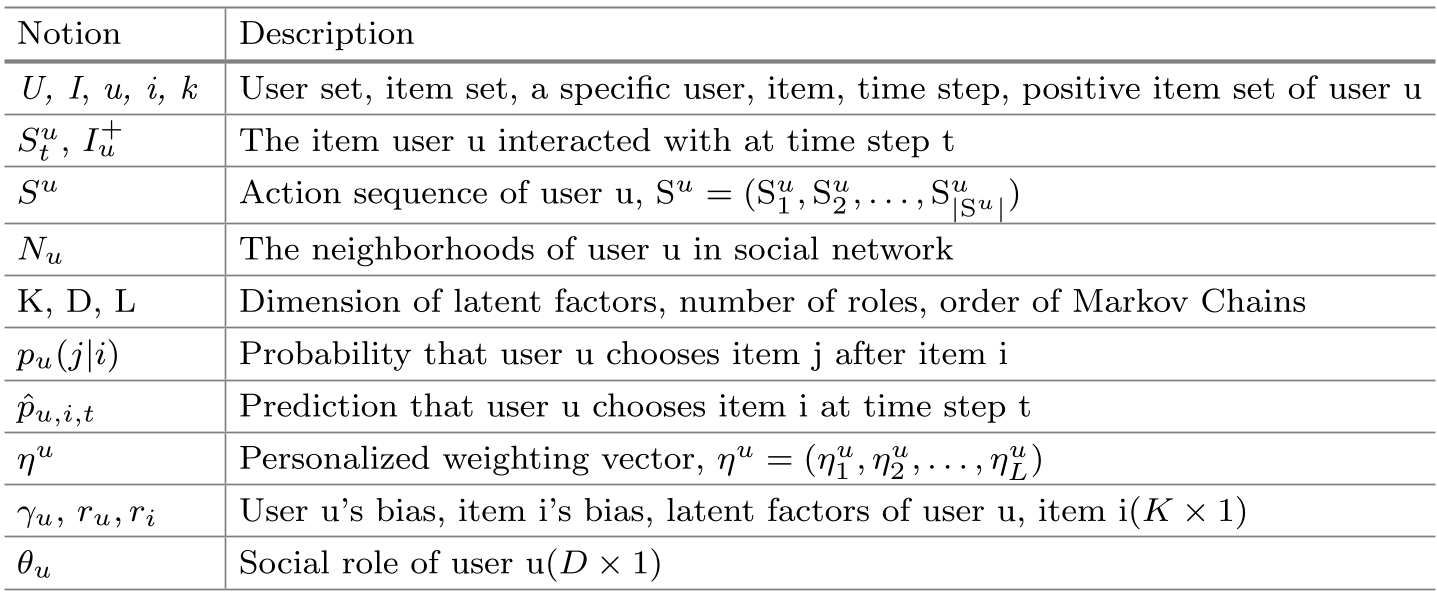 Table 1: Key notions defining the role vectors and transition probabilities.
Experiments & Results: Crushing the Baselines
The framework was put to the test against heavy hitters like BPR-MF and FPMC across four massive Amazon categories.
Performance Gains
- Superior Accuracy: As shown in the results below, SSB-Ranking consistently achieved lower error rates (higher accuracy) than all baselines.
- Cold-Start Resilience: The model shines in cold-start scenarios. Because it can rely on "Social Roles" and "Item Bundles" even when specific user data is sparse, it saw improvements of up to 18.6% over trust-aware models (SocTru).
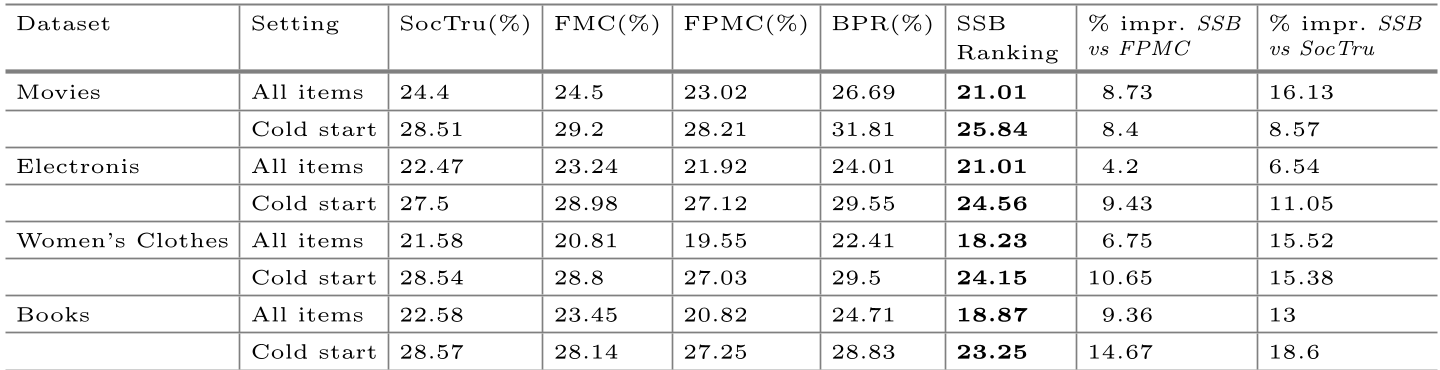 Table 2: Comparative analysis demonstrating SSB-Ranking's dominance in both full-item and cold-start settings.
The Impact of Social Roles
The researchers found that as the number of roles () increases, the model's ability to capture varied nuances improves, although it eventually plateaus. This proves that users are indeed multi-faceted.
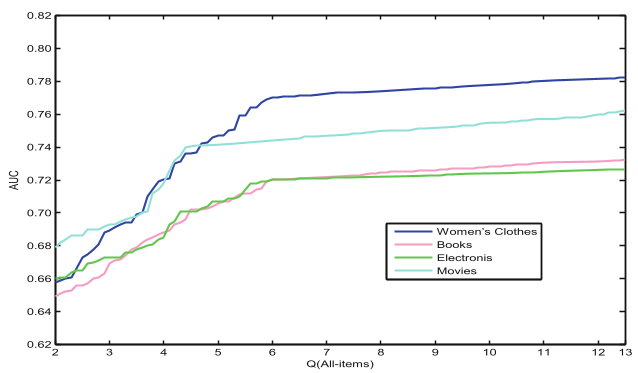 Fig 1: AUC performance relative to the number of social roles ().
Critical Analysis & Conclusion
Takeaway
SSB-Ranking proves that social context is a feature, not a byproduct. By decomposing user behavior into role-based conformity and bundle-based transitions, it provides a much more granular "map" of user intent.
Limitations & Future Work
While the model is robust, it relies on explicit social network data (T), which isn't always available in modern privacy-focused environments. Future iterations could benefit from inferring social connections from behavior alone (Latent Social Graph) or moving from Markov Chains to Transformer architectures to capture even longer-range item dependencies.
In conclusion, SSB-Ranking is a significant step forward for personalized ranking, proving that understanding who the user is acting as is just as important as what they bought last.