
Mining the Digital Pulse: Transforming Ecosystem Activities into Organizational Social Networks
Exploring an Organizational Social Network through Its Digital Ecosystem Activities
The paper introduces a semantic framework to reconstruct organizational social networks by analyzing activities within a "Digital Ecosystem" of Web 2.0 tools. It utilizes the "memorae-core 2" ontology and a modified Edge Rank algorithm to compute both actual and potential collaboration links between organizational entities.
TL;DR
Modern organizations are no longer defined solely by their hierarchy but by their Digital Ecosystems—the web of Wikis, forums, and repositories where work actually happens. This paper presents a semantic methodology to extract a "live" social network from these digital traces, using a specialized ontology and a modified Edge Rank algorithm to visualize both existing collaborations and untapped partnership potentials.
Problem & Motivation: The "Dark Matter" of Organizations
The traditional organizational chart is often a poor representation of how knowledge actually flows. Prior work in Knowledge Management (KM) struggled to unify social interactions (comments, posts) with formal documentation (patents, papers).
The authors argue that when an organization deploys multiple Web 2.0 applications sharing a user base, it forms a Digital Knowledge Ecosystem. The challenge lies in the "silo" effect—data is scattered across tools. To turn this data into actionable insights for decision-makers, we need a way to see the "social dark matter": those informal connections and potential synergies that don't appear in a directory.
Methodology: Semantics and the "Edge Rank" of Collaboration
1. The memorae-core 2 Ontology
To bridge the gap between people and things, the authors developed a semantic model that acts as a pivot. By combining three major standards, they created a unified schema:
- FOAF (Friend of a Friend): For representing people and agent-based relationships.
- SIOC (Semantically-Interlinked Online Communities): For modeling the dynamics of online forums, blogs, and wikis.
- BIBO (Bibliographic Ontology): For rigorous documentation and publication metadata.
This allows the system to treat "Agents" (people/teams) and "Documents" as related resources within a single graph.
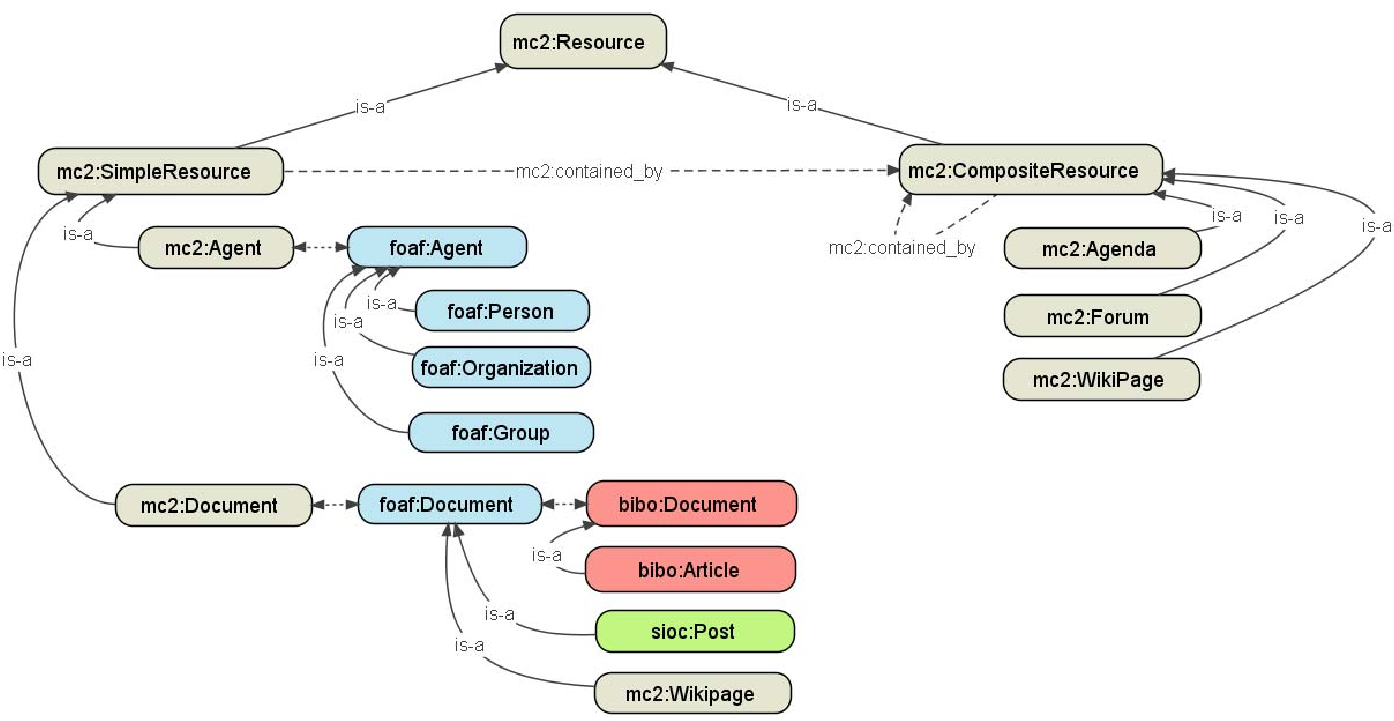 Figure: The semantic structure where users and documents are unified as 'Resources'.
2. Computing the Strenght of Ties
Not all interactions are equal. A joint patent is a "stronger" signal of collaboration than a shared meeting. The authors adapted the Facebook Edge Rank algorithm to calculate a tie score ():
- (Collaboration Type): Weights assigned to activities (e.g., Projects = 4, Academic Papers = 2).
- (Time Depreciation): Ensures recent collaborations carry more weight than those from a decade ago.
- (Subject Importance): Boosts the score if the collaboration matches a specific topic of interest specified by the user.
Experiments: Mapping the French KE Community
The authors tested their model on the French Knowledge Engineering (KE) community using data from the HAL archive. By processing articles from 1998 to 2012, they generated a Force-Directed Graph.
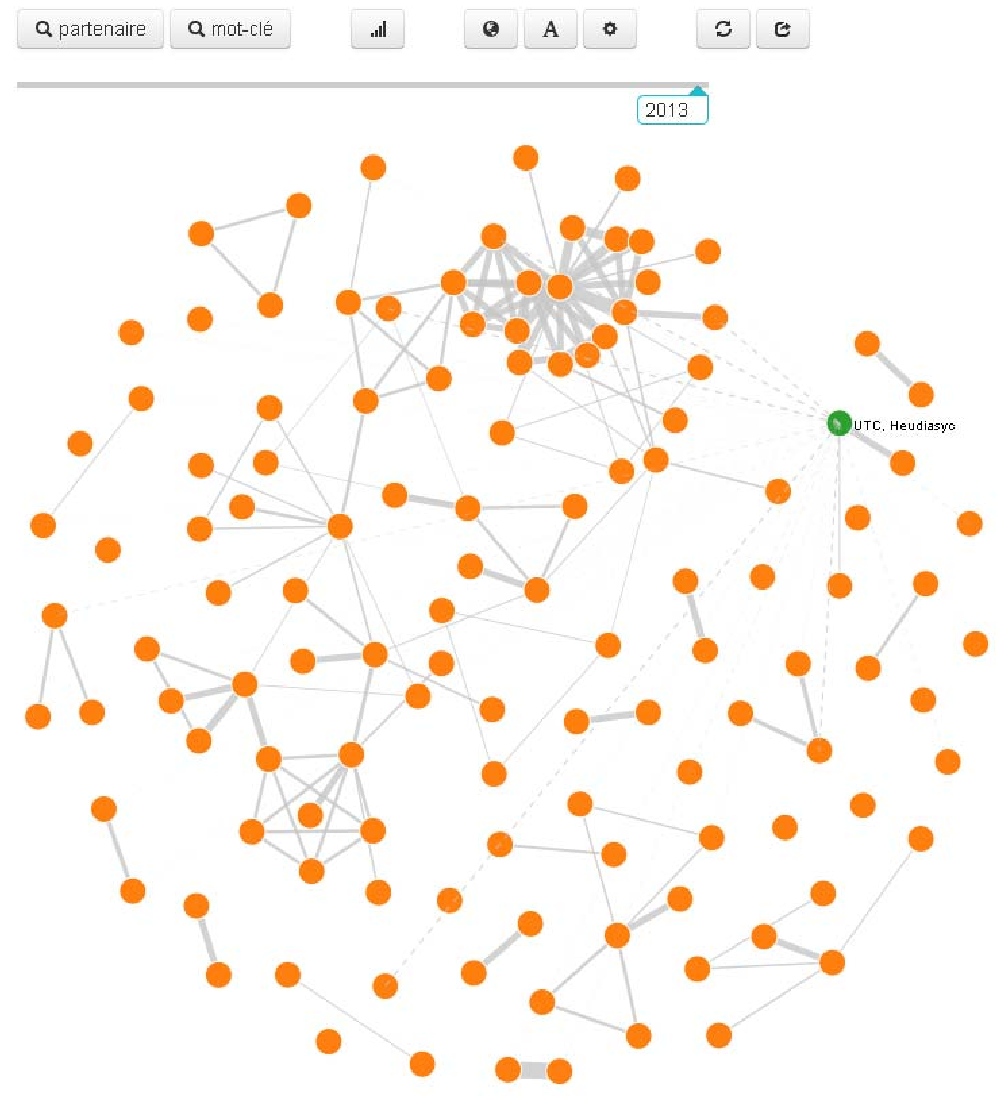 Figure: The resulting collaboration graph. Solid lines show actual joints works; dashed lines indicate potential ties based on shared niche topics.
Key Insights from Results:
- Actual vs. Potential: The inclusion of "Potential" links (dashed lines) allows managers to see "structural holes"—entities like Heudiasyc (UTC) that share significant topic overlaps with others but haven't yet formalized a partnership.
- Affiliation Chains: Rather than standardizing "Departments" or "Divisions" (which vary by company), the system stores complete "Affiliation Chains," allowing for flexible zooming from a high-level corporate view to a granular team-level view.
Critical Analysis & Conclusion
The strength of this work lies in its Semantic Interoperability. By using established ontologies, the system avoids being a "black box" and instead builds a standard-compliant knowledge base.
Limitations:
- Data Quality: The authors admit to redundancy in entities (e.g., "UTC" vs "University of Technology of Compiegne") because they don't yet employ advanced data fusion or entity resolution.
- Privacy: While the paper focuses on team-level data, the extraction of such granular social data in a corporate setting always necessitates ethical considerations regarding surveillance.
Future Outlook: The next step for this tech is Proactive Matching. Imagine an Information System that doesn't just show you who you worked with, but suggests: "You are writing a paper on LLMs; Team X in the Singapore branch has published three similar internal reports this month. Would you like to connect?"