
MALL: Bridging the Rural-Urban Divide in India through Mobile-First Collaborative Learning
Exposing Rural Indian Students to Mobile Assisted Language Learning: A Case Study
This case study investigates the impact of Mobile Assisted Language Learning (MALL) on rural Indian engineering students. By leveraging many-to-many communication and gamified apps like "Quiz Your English" and WhatsApp, the researchers achieved significant improvements in English proficiency and engagement among first-generation learners.
TL;DR
This study explores how Mobile Assisted Language Learning (MALL) can revolutionize English acquisition for rural Indian engineering students. By moving beyond traditional classrooms and utilizing social media and gamified apps, the research demonstrates a statistically significant improvement in language skills and student motivation, highlighting the power of collaborative over individual learning.
Context & Motivation: The Employability Crisis
In India, English proficiency is more than a linguistic skill—it is a gatekeeper for employment and social mobility. However, a staggering 80% of engineering graduates are deemed unemployable primarily due to a lack of communication skills.
For rural students, the hurdle is even higher. As "first-generation learners," they often lack English resources at home and school. The authors suggest "leapfrogging"—skipping the expensive rollout of computer labs and electricity grids—by leveraging the high penetration of low-cost smartphones and mobile data in rural areas.
Methodology: The Flipped Classroom via BYOD
The researchers implemented a Bring Your Own Device (BYOD) strategy. Over six months, 110 students were exposed to six distinct MALL activities, ranging from individual recording tasks to collaborative social media contests.
The Core Strategy: Collaborative vs. Individual
The methodology focused on the "Flipped Classroom" model:
- Individual Tasks: Caption writing, grammar tests, and one-minute video recordings.
- Collaborative Tasks: WhatsApp debates, Facebook collocation contests, and the "Quiz Your English" app (Cambridge University).
 Fig 1. The study shows a direct positive correlation between the time spent on mobile activities and the resulting improvement in test performance.
Key Insights: Why Gamification Won
The results revealed a sharp distinction in how students engaged with the technology.
- The Power of Groups: Collaborative activities like the Collocations Contest saw a massive increase in output, with the number of sentences posted growing from 115 in Contest 1 to 2,448 in Contest 8.
- Gamification: The app "Quiz Your English" was the most successful tool. It reduced "learning anxiety" by turning grammar into a global competition. Some rural students even reached the Global Top 10 rankings, a feat that significantly boosted their confidence.
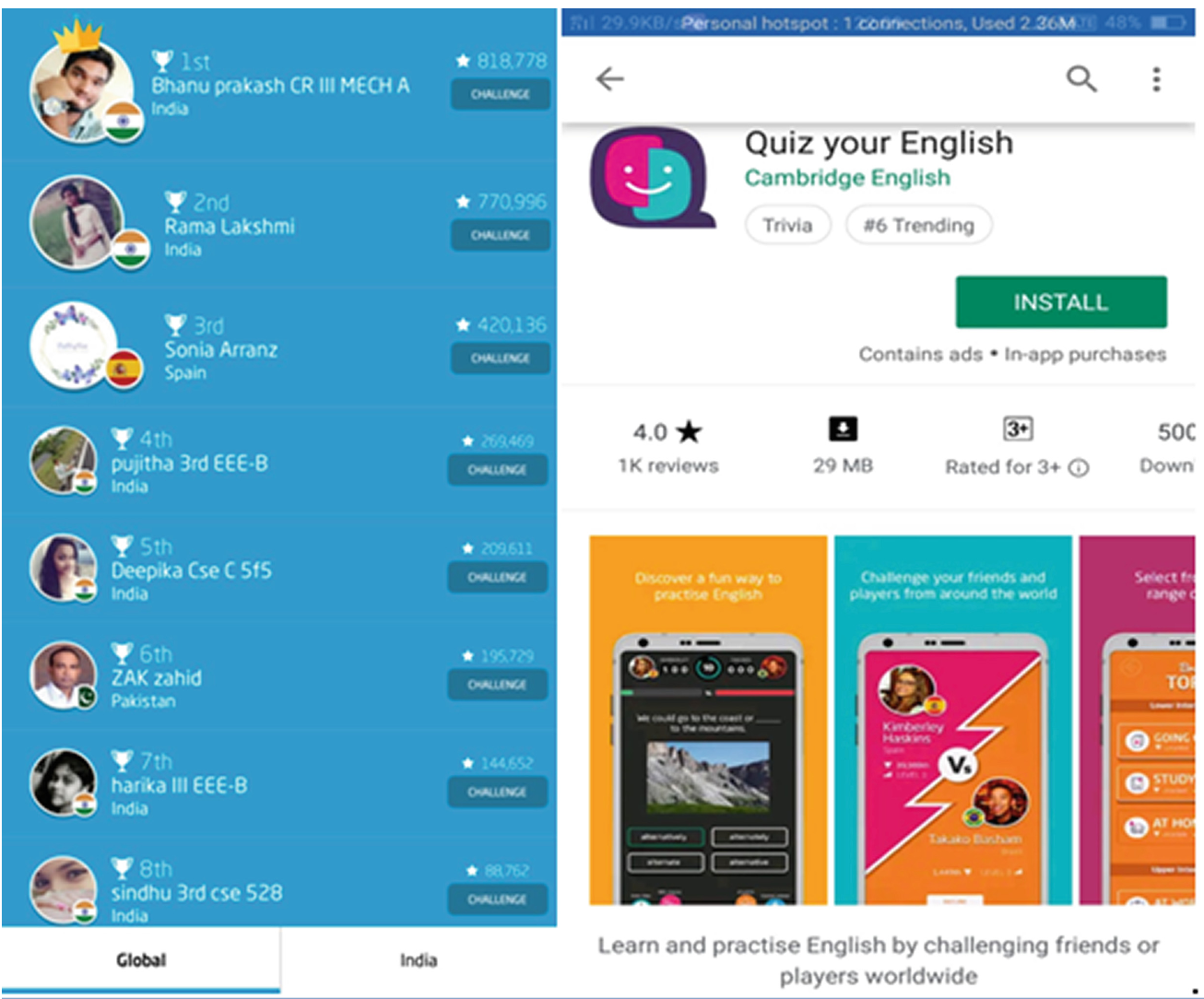 Fig 2. The competitive element of mobile apps allowed students to measure themselves against a global benchmark.
Results & Statistical Significance
To validate the efficacy of MALL, the researchers used a Chi-Square test. The calculated values for the pre-test (1381.07) and post-test (1016.78) were statistically significant (p < .05), leading to the rejection of the null hypothesis.
| Contest | Participants | % Participation | Sentences Posted |
|---|---|---|---|
| Contest 1 | 22 | 21% | 115 |
| Contest 8 | 63 | 57% | 2448 |
Experimental Data: Note the exponential growth in sentence production as students became accustomed to the collaborative mobile environment.
Critical Analysis & Future Outlook
Takeaway
The study proves that MALL is not just a supplement but a vital equalizer. It shifts the burden of learning from a resource-poor classroom to a resource-rich digital social space. Collaborative activities outperformed individual ones because they provided a "low-stakes" environment that reduced performance anxiety.
Limitations
- Mixed Results in Video: While students improved, individual video recording tasks had lower participation, suggesting that "face-to-camera" activities still carry a social stigma or higher barrier to entry for rural learners.
- Connectivity: While mobile penetration is high, the study assumes consistent data access, which can still be a hurdle in deep rural pockets.
Conclusion
For practitioners and course designers, the message is clear: don't just digitize the textbook. To reach rural youth, you must gamify the experience and foster a digital community. MALL offers a path for the millions of rural students to transition from "monolingual" backgrounds to "employable" professionals.