
The Expressive Gaze Model: Infusing Soul into Virtual Eyes through Neuroscience and Warping
13968_The Expressive Gaze Model Using Gaze to Express Emotion.
The paper introduces the Expressive Gaze Model (EGM), a hierarchical framework designed to generate emotionally expressive gaze shifts for virtual characters by combining Gaze Warping Transformations (GWT) with a procedural eye movement model based on visual neuroscience. It enables real-time, believable emotional expression through coordinated eye, head, and torso movements directed at arbitrary targets.
TL;DR
Static or purely functional gazes often lead to the "uncanny valley" in virtual characters. The Expressive Gaze Model (EGM) solves this by decoupling the style of a gaze shift from its function. Using a combination of Gaze Warping Transformations (GWT) and a neuroscientifically accurate eye-movement model, the EGM allows characters to look at any target while expressing complex emotions like sadness or pride through coordinated head and torso posture.
The Problem: Why Functional Gazes Feel "Dead"
In modern interactive environments—from AAA games like World of Warcraft to healthcare simulations—characters must react in real-time. Hand-animating every possible gaze shift for every possible emotion is an economic impossibility.
Prior procedural methods focused on the "Where": simply pointing the eyes at the target. However, human observers are acutely sensitive to the "How." If a character looks at you without the subtle head tilt of curiosity or the slumped shoulders of sadness, the illusion of life is instantly shattered. The challenge is: how do we mathematically "layer" emotion onto a functional movement without creating manual overhead?
Methodology: The Hierarchical Approach
The EGM operates on a hierarchical principle, separating the fast-acting eyes from the slower, heavier head and torso.
1. Gaze Warping Transformation (GWT)
The core "magic" lies in the GWT. It represents the difference between a neutral gaze shift and an emotional one.
- Temporal Scaling (): Adjusts the timing of the movement (e.g., making it faster for anger or slower for grief).
- Spatial Offset (): Captures postural changes (e.g., a bowed head or a tilted neck).
By extracting these as a lightweight library of parameters, the system can apply the "Sadness" warp to a neutral gaze shift targeting any point in 3D space.
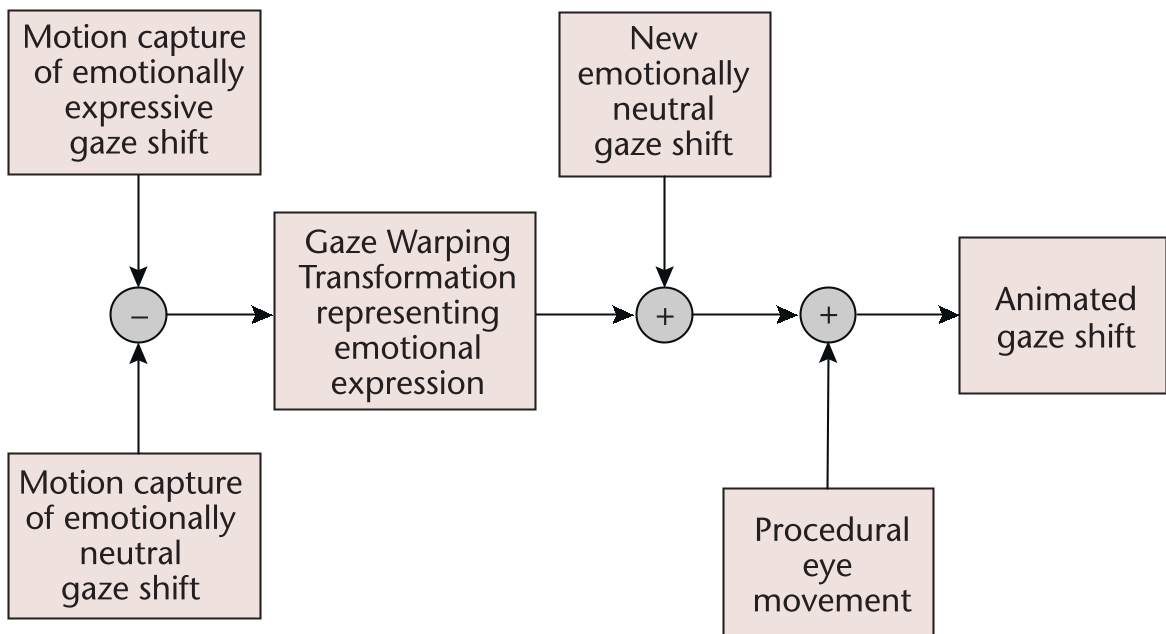 Figure 1: The EGM pipeline — from motion capture to deriving GWTs and layering them onto new targets.
2. The Neuroscience of the Eye
To prevent the eyes from feeling like mechanical balls, the EGM implements:
- Saccades: High-speed jumps to the target that follow the "main sequence" (speed is proportional to displacement).
- Vestibulo-Ocular Reflex (VOR): The mechanism that keeps your eyes locked on a target even while your head is moving, providing the "counter-rotation" necessary for realism.
Experiments: From Behavior to Emotion
The authors explored a combinatorial approach. Instead of capturing a single "Sad" animation, they captured specific behaviors:
- Head Tilted vs. Bowed
- Torso Unbowed vs. Bowed
- Fast vs. Slow velocity
Results and Insights
By composing these low-level behaviors, the EGM can dynamically transition a character into and out of emotional states. For instance, a character can "enter" sadness by performing a gaze shift that ends in a bowed-head posture, remain there for several shifts, and then "exit" by raising the head during a subsequent gaze.
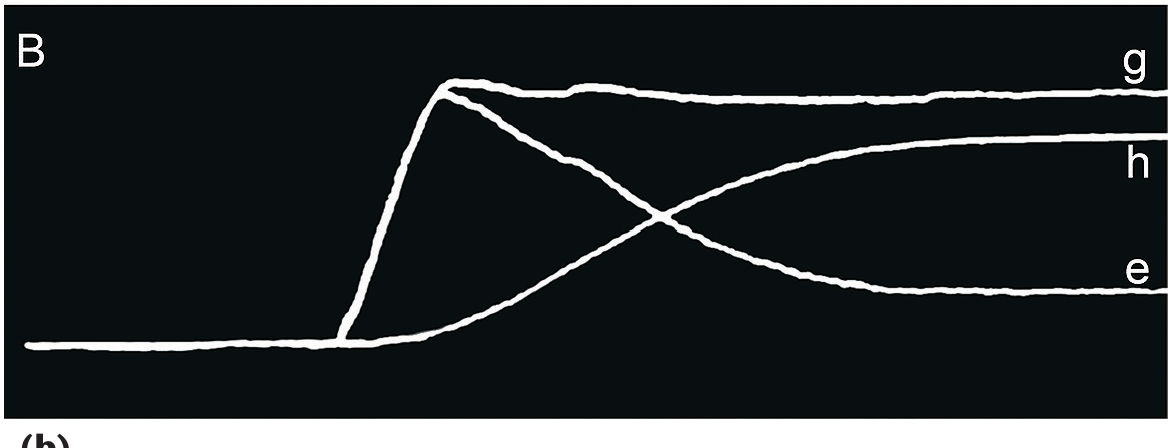 Figure 2: Comparison of model-generated eye-head coordination (a) against actual human movement data (b), showing a high degree of fidelity in the "VOR" lock-on phase.
Academic Insight: Why it Works
The brilliance of the EGM is its use of Inductive Bias. It assumes that emotional expression is a transformation applied to a functional base. By using cubic spline interpolation between sparsely placed keyframes, the model maintains a smooth, naturalistic "arc" to the movement that linear interpolation would lack. Furthermore, by basing the eye model on saturation limits ( degrees), it avoids the unnatural "extreme-eye-corner" look often seen in lower-quality rigs.
Critical Analysis & Future Outlook
While highly effective, the EGM has its limitations:
- Inverse Kinematics (IK): Since GWT is a geometric transformation, extreme warps can occasionally cause "neck-breaking" angles that require IK to clean up.
- Context-Agnostic: Gaze meaning changes with context. A "stare" can be romantic or threatening depending on the relationship between characters, which the model does not yet compute.
Takeaway: The EGM provides a roadmap for "Behavioral Composition." Future research will likely integrate these warping techniques with Generative AI, allowing NPCs to not only say emotional things but to "look the part" automatically.
Note: For researchers interested in the mathematical derivation of the warping parameters, please refer to the Algorithm 1 and 2 sidebars in the original text.