
Beyond the OFF State: Redefining HTTP Models for the Social Network Era
Extending HTTP Models to Web 2.0 Applications: The Case of Social Networks
This paper proposes an extension to traditional HTTP behavioral models to accommodate the unique traffic patterns of Web 2.0 and Social Networks (SNs). It introduces the "looping layer" to account for autonomous, repetitive data exchanges (e.g., AJAX/Comet) and validates this model through a comprehensive traffic characterization of Facebook.
TL;DR
The traditional understanding of web browsing—where a user requests a page and then sits silently reading it—is obsolete. This paper introduces the Looping Layer, a critical extension to HTTP behavioral models that captures the "chatter" of Web 2.0 applications. By analyzing Facebook's traffic, the research proves that Social Networks (SNs) maintain a constant, autonomous heartbeat of data even when the user is idle, significantly impacting network load and device CPU.
The Death of the "Quiet" OFF State
For decades, network engineers relied on a simple ON/OFF model: the user downloads a page (ON), then reads it (OFF). During the OFF state, the network was assumed to be at rest.
However, the rise of AJAX and Comet technologies has turned web pages into living applications. Social Networks require real-time updates for "Likes," notifications, and instant messages. The author argues that existing models are "blind" to this latent traffic, leading to poor network performance evaluation and inaccurate power consumption estimates.
Methodology: Introducing the Looping Layer
The core contribution of this work is the transition from a 3-layer to a 4-layer model.
- Session Layer: Manages the start/end of the user's interaction.
- Page Layer: The retrieval of the main HTML object.
- Object Layer: The concurrent retrieval of in-line images, CSS, and scripts.
- Looping Layer (New): An autonomous entity that executes within the viewer's "OFF" state to fetch updates.
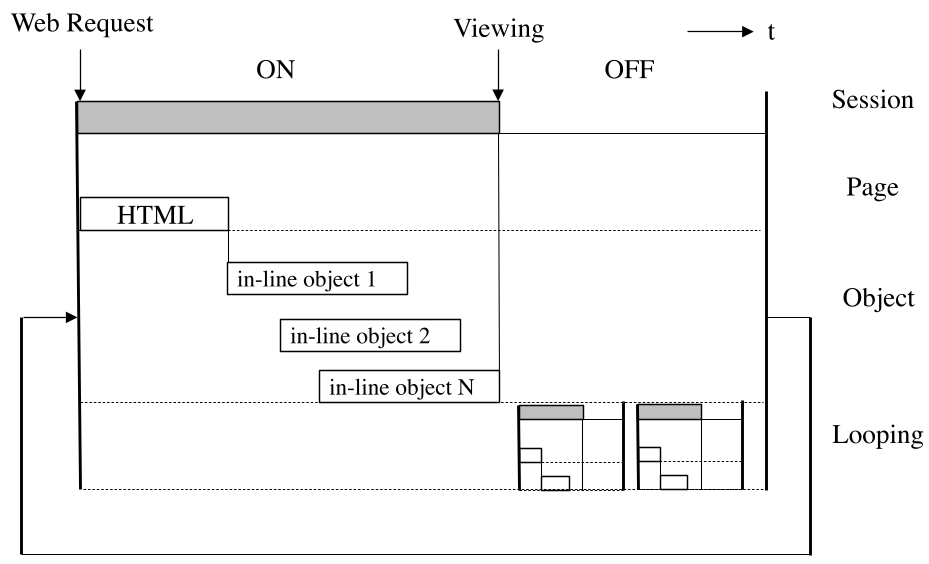
The looping layer acts as a repetitive cycle. Even when the user is not clicking anything, the browser is fetching "news feeds" and "presence information." The author mathematically expresses this as: where is the classic traffic and is the periodic looping contribution.
Experimental Insights: The Facebook Case Study
The author tested this model against Facebook, using a profile with 1,000 friends to simulate a high-load environment.
1. Traffic Breakdown
Surprisingly, during periods where the user was technically "idle," the looping layer generated 1.88 Mbytes of HTTP traffic across nearly 1,400 requests. This is not "noise"; it is a substantial portion of the overall network footprint.
2. The Frequency of Social Life
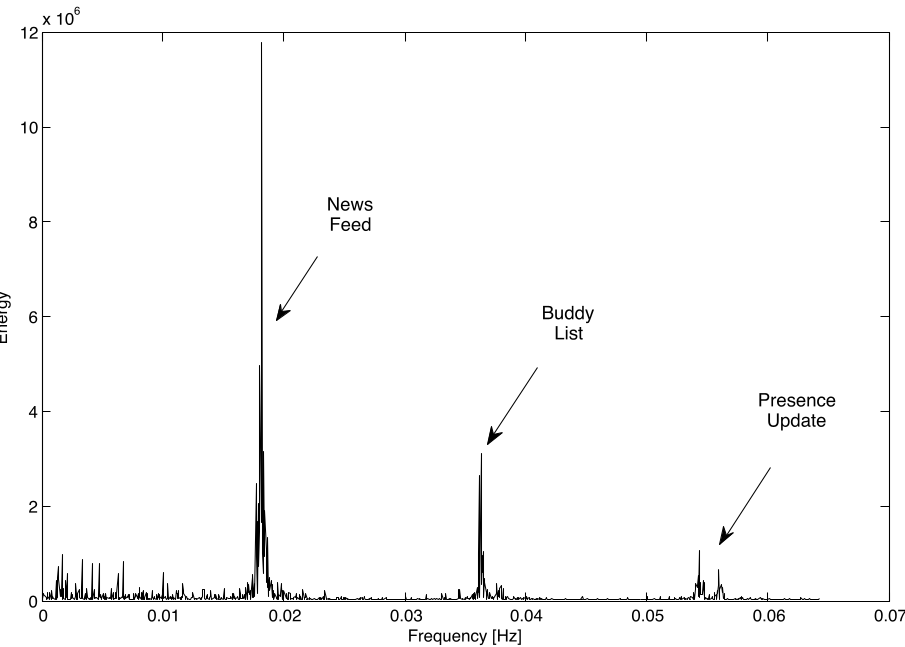
By using Power Spectral Density (PSD) analysis, the research identifies three clear energy peaks in the traffic. These correspond to the "news feed," the "buddy list" (IM), and "presence updates." This periodicity makes Web 2.0 traffic highly predictable but also creates a constant base load on the network.
3. CPU and Energy Costs
The "looping" isn't free for the local device. The study measured a significant CPU usage overhead across major browsers:
- Firefox: +21.87%
- Opera: +25.38%
- Chrome: +15.08%
This suggests that Social Networks are a primary driver of battery drain on mobile devices, even when running in the background.
Critical Analysis & Conclusion
Takeaway
The paper successfully bridges the gap between old-school request-response modeling and the modern "Always-On" web. The looping layer provides a necessary abstraction for researchers to simulate realistic traffic in an era of interactive cloud services.
Limitations
- Single-Site Focus: While Facebook is a great archetype, the "looping" behavior of other apps (like Twitter/X or real-time trading platforms) might differ in periodicity and payload.
- Encryption: While the author notes HTTPS doesn't change the behavior, it significantly complicates the ability of network middleboxes to identify these loops without Deep Packet Inspection (DPI).
Future Outlook
As we move toward WebSockets and HTTP/3, the "looping" will likely become even more seamless and harder to decouple from the main session. This model serves as the foundational first step in characterizing the pulse of the "Internet of People."