
Social Internet of Energy: Balancing the Grid via Human-Agent Interaction
Extending the internet of energy by a social networking of human users and autonomous agents
This paper presents a Cyber-Physical System (CPS) architecture that integrates Multi-Agent Systems (MAS) and social networking to manage the "Internet of Energy." The authors propose a multi-objective optimization framework specifically for E-car charging schedules, balancing user convenience with grid efficiency through a prototype leveraging XMPP, SPADE2, and Genetic Algorithms.
TL;DR
As the adoption of Electric Vehicles (EVs) accelerates, charging infrastructure faces a "herd effect" where users flock to the nearest stations, causing long queues while distant stations remain idle. This paper introduces a Cyber-Physical System that models cars and humans as a social network, using intelligent agents and a multi-objective genetic algorithm to recommend charging schedules that balance global energy efficiency with individual cost savings.
Problem & Motivation: The Chaos of Uncoordinated Charging
The "Internet of Energy" is often limited by the lack of synergy between human behavior and machine intelligence. Most current systems rely on simple heuristics—drivers go to the closest station. This leads to two critical failures:
- Grid Imbalance: Some stations are overwhelmed, increasing waiting times and degrading local grid stability.
- Pareto Inefficiency: There is no mechanism to trade off a slightly longer drive for a significantly cheaper or faster charging experience.
The authors' insight is to create a Social Internet of Things (SIoT) where cars, stations, and humans communicate as "social peers," allowing the system to "nudge" behavior through price adjustments rather than rigid mandates.
Methodology: Social Agents and Pareto Optimization
The architecture is built on a multi-layered CPS (Cyber-Physical System) framework.
1. The Social Architecture
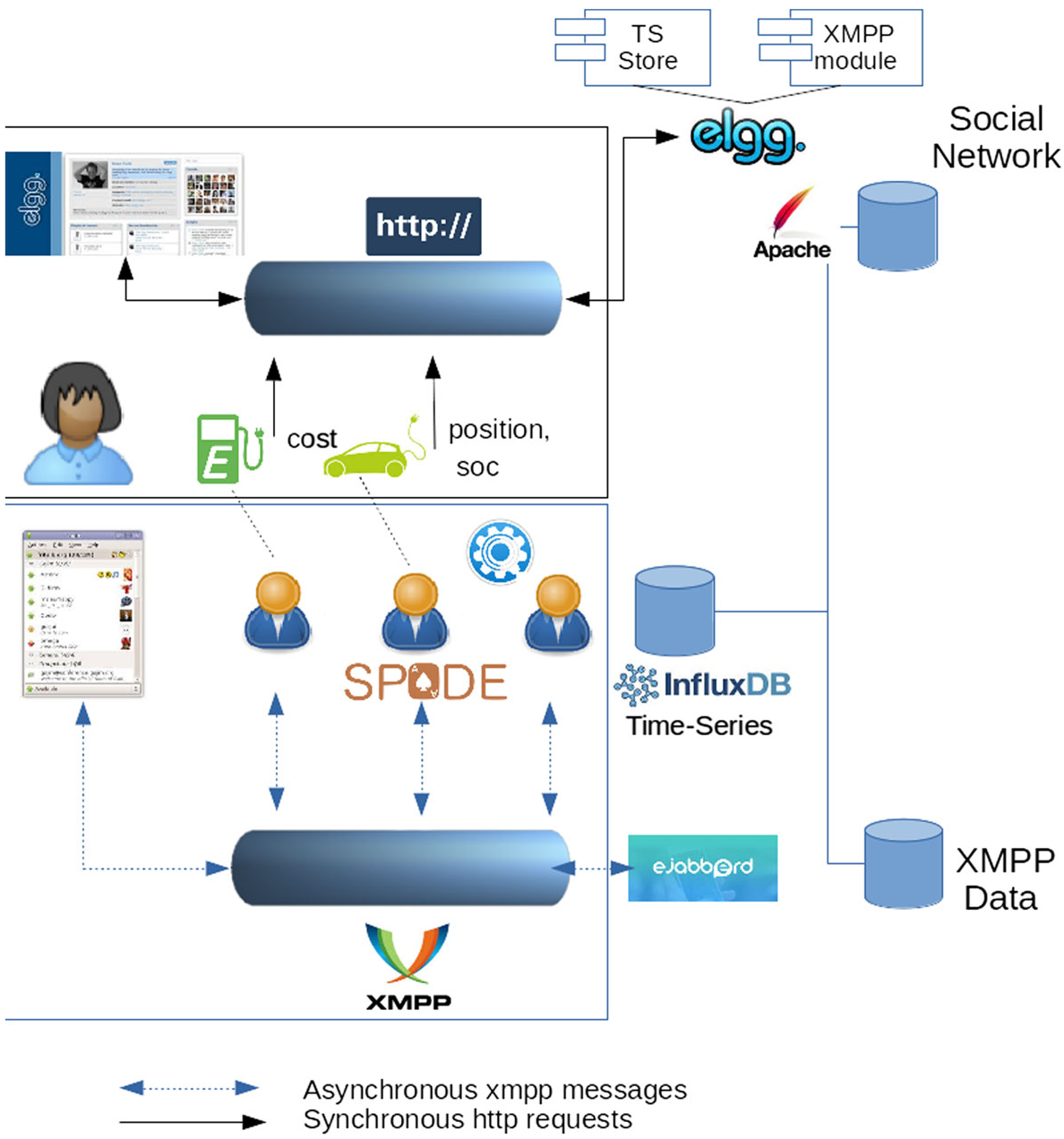
The system uses the SPADE2 library to create software agents for cars and stations. These agents interact over XMPP (standard instant messaging), effectively "chatting" to negotiate charging slots. The Elgg social platform provides a human-readable interface, treating a car as a "friend" in a user's social circle.
2. Multi-Objective Optimization
The core "brain" of the system solves a 2-objective problem:
- Minimize (Distance): Reducing the total energy spent traveling to stations.
- Minimize (Variance): Ensuring a fair, uniform distribution of cars across all stations to eliminate queues.
The authors employ NSGA-II (Non-dominated Sorting Genetic Algorithm) to find the Pareto Front—a set of solutions where you cannot improve distance without worsening the queue variance.
3. The Dynamic Pricing Nudge
To bridge the gap between "Global Optimum" and "User Choice," the system calculates a price adjustment (). If a station is underutilized in the "Minimum Variance" solution compared to the "Shortest Distance" one, it offers a discount to entice users.
Experiments & Results: Flattening the Curve
The researchers tested the system using real-world data from fuel stations and traffic flow in Florence, Italy.
Performance Comparison
In the "Big" experiment (300 cars, 76 stations):
- Closest Station Choice: Variance was 37.75, with some stations being swamped by 29 cars while others had 0.
- Recommended (Cheapest) Choice: Variance plummeted to 0.656, with the maximum load per station dropping to just 6 cars.
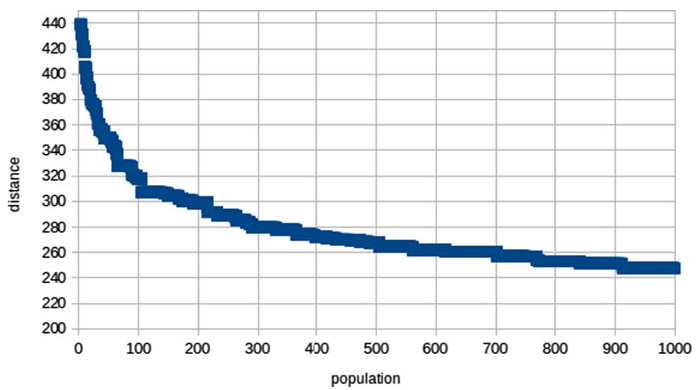
The tradeoff is clear: to achieve this perfect load balance, the total distance covered by all cars increased from 420km to 1375km. However, the system allows the user to choose their preferred point on the Pareto curve, balancing their own "annoyance" against cost savings.
Critical Analysis & Conclusion
This work successfully demonstrates that Social Networking for Things isn't just a gimmick—it's a viable communication protocol for decentralized optimization. By using XMPP and social metaphors, the system makes complex grid balancing accessible to everyday drivers.
Limitations & Future Outlook
- Data Silos: Currently, car manufacturers do not provide open APIs for Battery State of Charge (SoC), which the authors admit is a hurdle for real-world deployment.
- Static vs. Dynamic: The current model uses the Vincenty formula for distance rather than real-time traffic maps, which could drastically change the "optimal" route in a congested city.
Final Takeaway: The future of the Smart Grid lies in "soft" coordination. Instead of controlling every car, the system should act as a specialized social network, providing recommendations that make "doing the right thing for the grid" the cheapest and easiest option for the user.