
Extortion and Cooperation: Re-Engineering Incentives in Competitive Crowdsourcing
Extortion and Cooperation in Rating Protocol Design for Competitive Crowdsourcing
This paper introduces a novel rating protocol for competitive crowdsourcing that integrates binary ratings with differential pricing to resolve the "crowdsourcing contest dilemma." The methodology utilizes a game-theoretic framework to maximize requester utility while simultaneously enforcing worker cooperation and extorting selfish behaviors, achieving superior social welfare compared to existing benchmarks.
TL;DR
In the dog-eat-dog world of competitive crowdsourcing, workers often find it more profitable to sabotage rivals than to provide quality solutions. This paper proposes a Game-Theoretic Rating Protocol that uses binary social status and differential pricing to maximize the requester's profit while forcing selfish workers to cooperate. By treating the contest as a two-stage dilemma, the authors provide a mathematical blueprint for "extorting" maximum utility from the platform without losing worker participation.
Background: The Crowdsourcing Contest Dilemma
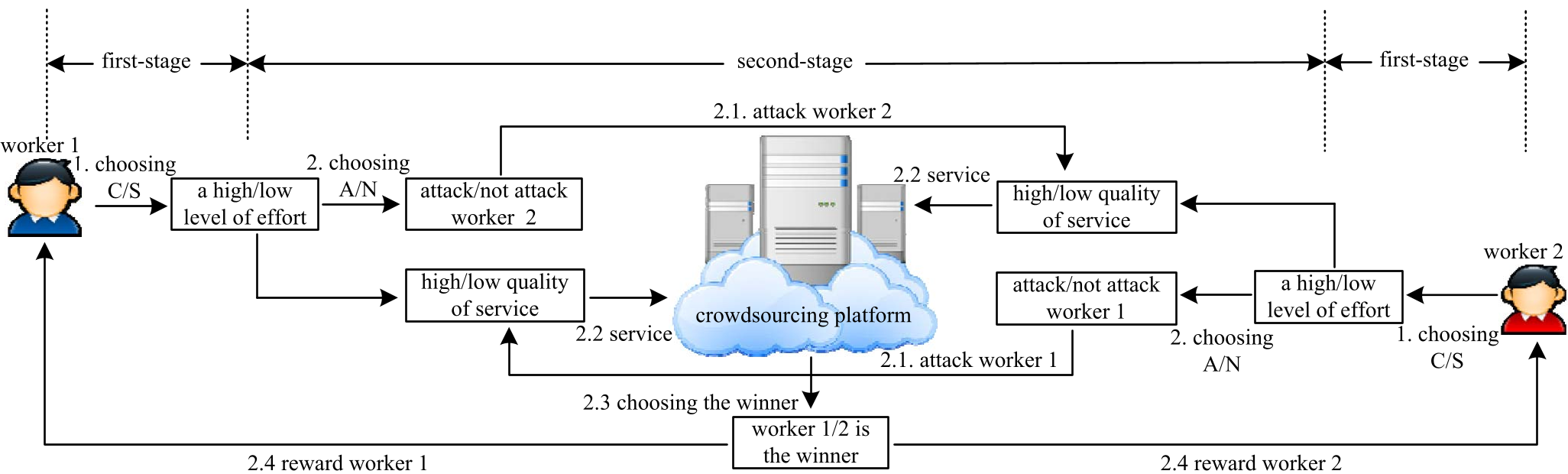
Crowdsourcing is often modeled as a simple exchange, but in reality, it is a high-stakes competition. Influenced by the DARPA Red Balloon Challenge, researchers identified a "contest dilemma":
- Stage 1 (Effort): Workers weigh the cost of high effort vs. free-riding.
- Stage 2 (Attack): Workers decide whether to sabotage their opponent's solution to win the prize.
Without a robust punishment system, the Nash Equilibrium is grim: probabilities of attack approach 100%, and effort levels drop. The problem is exacerbated by imperfect monitoring (errors in judging who did what) and worker heterogeneity (divergent skill levels and costs).
Methodology: The Rating Protocol Design
The authors move beyond simple "pay-for-performance" schemes. They introduce a protocol consisting of a quadruple: .
1. The Binary Rating ()
Workers carry a rating of 1 (Good) or 0 (Bad). This status follows a Markov chain where "Good" behavior (high effort, no attack) maintains or earns a high rating, while "Bad" behavior leads to a rating collapse.
2. Differential Pricing ()
Instead of a flat reward, the platform pays to winners with a high rating and (usually much lower) to those with a bad rating. This "Differential Punishment" is the key—it redistributes the reward pool to favor long-term "Good" citizens, effectively forcing the selfish to subsidize the cooperative.
3. Optimization via Algorithm 1
The protocol isn't just about fairness; it's about Requester Revenue. The authors formulated an optimization problem to find the exact values of reward strength (), punishment strength (), and prices () that keep workers compliant while keeping the requester's costs at an absolute minimum.
Critical Insight: Why Does It Work?
The genius of the paper lies in its handling of Imperfect Monitoring. In real-world systems, a good worker might be misidentified as a saboteur. Standard mechanisms would punish them, causing them to quit. This protocol calculates a sustainable threshold (Proposition 1) that ensures a worker's Long-term Expected Utility remains positive even with occasional system errors, making the platform resilient.
Experimental Validation
The authors tested their protocol against various "Intrinsic Parameters" like worker patience () and sensing costs ().
- Heterogeneity: Even when worker A is much more "efficient" than worker B, the protocol adjusts the reward structure to prevent either from falling into a "sabotage-only" strategy.
- Requester Utility: Compared to previous models that focused purely on worker welfare (WO), this new "Extortion-Cooperation" (EC) model significantly boosts the requester's bottom line.
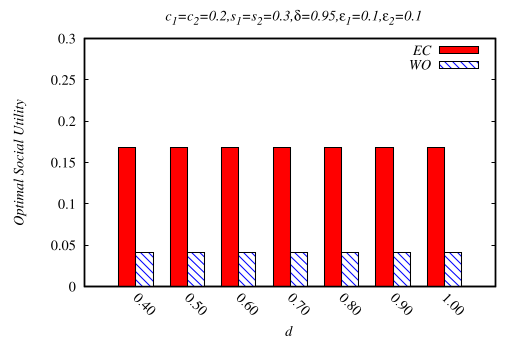
In the chart above, as workers become more patient (), the requester can actually lower rewards while maintaining cooperation, leading to higher system utility.
Conclusion and Takeaways
The paper shifts the focus of crowdsourcing research from "How do we pay workers?" to "How do we design a social norm?"
Key Takeaway: For practitioners building crowdsourcing platforms, the lesson is clear: Ratings are not just for trust—they are for pricing. By linking reputation directly to differential payout scales, platforms can stabilize competitive environments that would otherwise devolve into chaos.
Limitations
The model assumes "complete rationality," which may not hold for human workers subject to emotional biases or irrational spite. Future work using real-world datasets will be critical to see if these game-theoretic equilibria hold in the "messy" reality of human behavior.