
EBATA: Bridging the Gap for Remote Tasks in Spatial Crowdsourcing
Extra-Budget Aware Task Assignment in Spatial Crowdsourcing
This paper introduces the Extra-Budget Aware Task Assignment (EBATA) problem in Spatial Crowdsourcing (SC). It proposes two improved greedy algorithms—Greedy Algorithm with Fewer Workers First (G-FWF) and Greedy Algorithm with Incremental Search (G-IncSearch)—to maximize task-worker matches while minimizing extra travel costs for remote tasks using subsidized budgets.
TL;DR
Spatial Crowdsourcing (SC) platforms like Uber or Grubhub often struggle with "remote tasks"—requests that fall outside a worker's typical preferred radius. This paper proposes EBATA (Extra-Budget Aware Task Assignment), a framework that uses supplemental budgets provided by requesters to subsidize extra travel. By employing a clever Incremental Search greedy strategy, the authors achieve high matching rates with significantly lower latency than optimal flow-based solvers.
Context & Positioning
In the coordinate system of SC research, most works fall into two camps: Range-constrained matching (maximizing utility within a fixed boundary) and Dynamic Pricing (like Uber’s surge pricing). This paper occupies a unique niche by treating the "extra budget" as a property of the task itself to solve the "remote task starvation" problem, moving from fixed-boundary logic to a flexible, budget-aware radius.
The Problem: The "Remote Task" Dilemma
Existing methods often assume a hard limit for travel distance (). If a task is at distance , it simply never gets assigned.
- Worker's Logic: Travel cost outweighs reward.
- Platform's Failure: Tasks in low-density areas are ignored, decreasing user satisfaction.
- The Solution: Allow the task to carry an extra budget to cover the cost of the "extra mile."
Methodology: From Optimal Flow to Incremental Greed
The authors define the problem as a bipartite matching challenge: Maximize the number of pairs , then minimize total extra cost .
1. The Optimal Baseline
They first prove that EBATA can be reduced to a Minimum-Cost Maximum-Flow problem. By constructing a network where edge costs represent extra travel distances, they can find the theoretical upper bound of performance. However, with a complexity of , it is too slow for real-time city-scale applications.
2. G-FWF: Fewer Workers First
The core insight here is priority. Tasks with the fewest available candidate workers (the "hard" tasks) are assigned first. This prevents "easy" tasks from "stealing" the only worker available to a remote task.
3. G-IncSearch: The Refined Approach
G-IncSearch improves upon G-FWF by adding a two-step process:
- Step 1: Satisfy all tasks possible within the fixed (no-cost) range using G-FWF logic.
- Step 2: For remaining tasks, increase the search radius incrementally (in rounds) until the extra budget is exhausted.
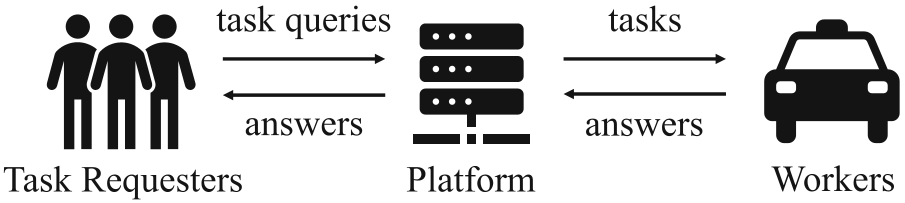 Figure 1: Visualizing the budget and range constraints in the EBATA framework.
Experiments & Results
Using the Didi Chuxing dataset, the authors compared their algorithms against Optimal (OPT) and Simple Greedy (G-Simple) baselines.
- Efficiency: OPT’s running time spikes as the range increases due to repeated Dijkstra calls. G-IncSearch maintains a near-linear growth, making it suitable for production.
- Effectiveness: G-IncSearch consistently matches more pairs than G-Simple and stays very close to the OPT performance.
- Cost Control: As shown in the figures below, G-IncSearch effectively minimizes the "Average Extra Travel Cost" compared to other greedy variants.
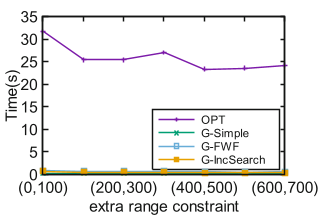 Figure 2: Impact of range constraints on performance metrics. G-IncSearch (blue line) shows superior cost-efficiency.
Critical Analysis & Conclusion
Takeaways
The Incremental Search strategy is a powerful heuristic for spatial problems. By "layering" the search—satisfying the cheapest matches first before dipping into the extra budget—it naturally approximates the global minimum cost without needing expensive global optimizations.
Limitations
- Static Assumption: The paper assumes a static snapshot of workers and tasks. In reality, workers move, and "future" tasks are unknown.
- Budget Source: It assumes the requester provides the budget. Future work could investigate "Platform-subsidized" budgets where the SC platform sacrifices commission to maintain service coverage in remote areas.
Future Outlook
This work lays the foundation for "Service-Level Agreements" (SLA) in crowdsourcing. By quantifying the relationship between "Extra Budget" and "Completion Probability," platforms can provide users with real-time suggestions on how much extra to pay to guarantee a pickup in remote locations.