
Structuring Chaos: The 5W Framework for Real-Time Societal Risk Perception
Extracting 5W from Baidu Hot News Search Words for Societal Risk Events Analysis
The paper introduces a structured 5W (Who, When, Where, Why, What) extraction framework for analyzing societal risk events using Baidu Hot News Search Words (HNSW). It utilizes Conditional Random Fields (CRFs) for risk classification and an enhanced TextRank algorithm to synthesize risk-labeled keywords, providing a real-time perception of social stability in China.
TL;DR
As social transformation in China accelerates, "societal risk events" (hazards affecting stability) spread visibility via Baidu search trends. This paper presents a machine learning pipeline to turn messy Baidu Hot News Search Words (HNSW) into structured 5W summaries (Who, When, Where, Why, What). By combining Conditional Random Fields (CRFs) and TextRank, the authors achieve a 78% classification accuracy, offering a high-speed radar for social management.
Background: The Limits of Traditional Surveying
Societal risk perception—the public's subjective evaluation of hazards—was historically measured through time-consuming questionnaires. In the Web 2.0 era, this is "too little, too late." Search engines like Baidu record the collective "pulse" of the nation in real-time. However, HNSW data is notoriously difficult to analyze: it is incredibly short, lacks punctuation, and follows a highly unbalanced distribution (over 50% are risk-free).
Methodology: Building the 5W Extraction Engine
The authors decompose a complex "wicked problem" into five manageable machine learning tasks:
1. The "Why" (Risk Classification)
Instead of simple keyword matching, the authors treat risk classification as a Sequence Labeling problem. They employ Linear Chain Conditional Random Fields (LCCRF).
- The Insight: CRFs capture the relationships between terms in short search strings better than Support Vector Machines (SVM).
- Benefit: It generates "state features"—weights assigned to terms (e.g., "house price") that indicate their contribution to a risk category (e.g., "daily life").
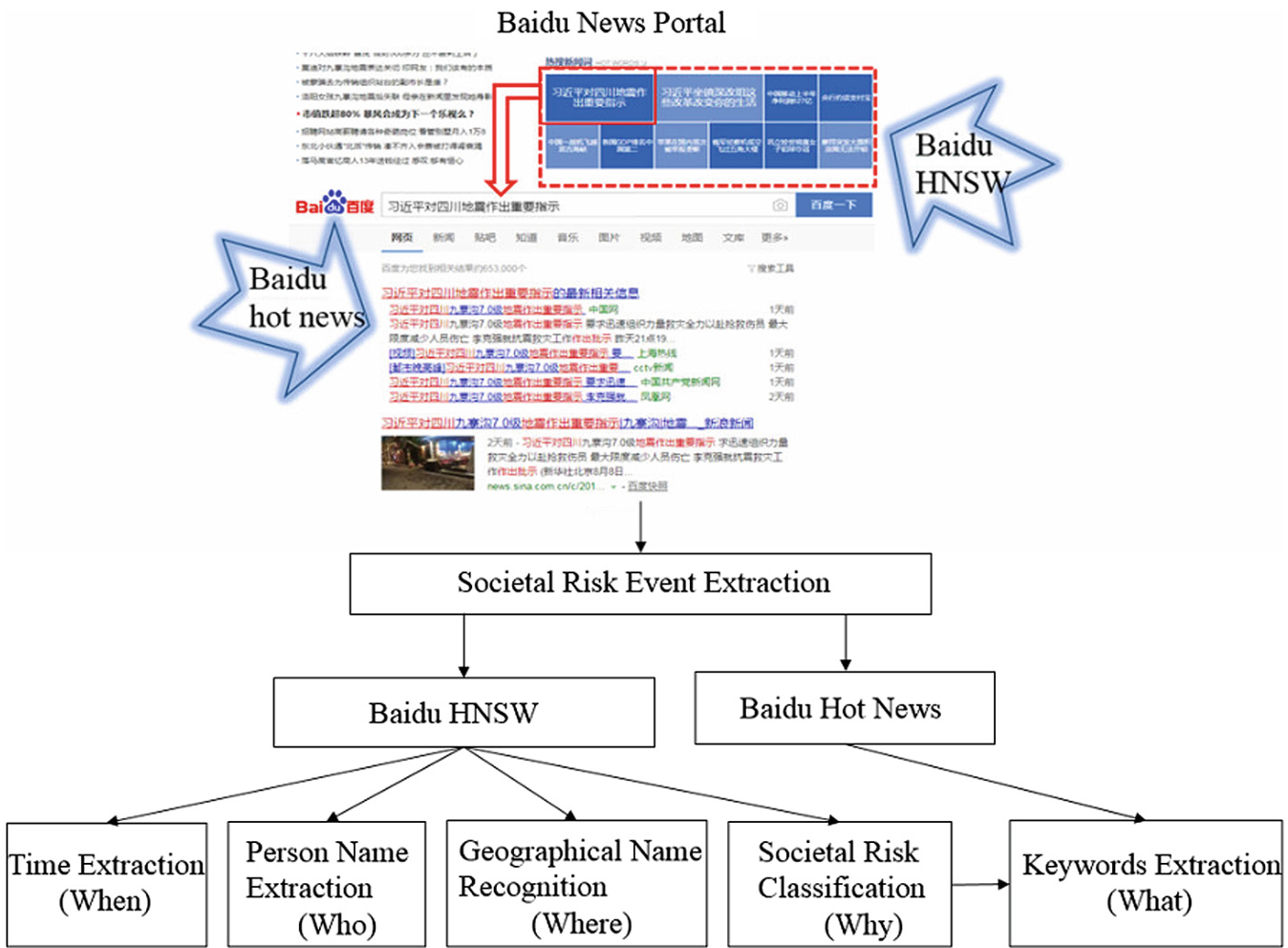
2. The "Where" (Geographical Normalization)
A major challenge in HNSW is ambiguity. "Sichuan Gansu Earthquake" involves two provinces, while "Shandong Laizhou" refers to a specific hierarchy.
- The Solution: An algorithm based on the National Bureau of Statistics area codes. By mapping locations to a 6-digit hierarchy (Province-City-County), the system automatically normalizes "Laizhou" to "Shandong Province."
3. The "What" (Risk-Labeled Keywords)
To describe the event details, the authors use an unsupervised TextRank-based method.
- The Twist: They don't just count frequencies. They inject the weights learned from the CRF model into the ranking process. If a word is a known "risk factor," its importance score is boosted, ensuring the "What" reflects the "Why."
Experiments & Performance
The model was tested on a massive dataset of 56,233 hot search words and nearly 550,000 news articles spanning 2011 to 2016.
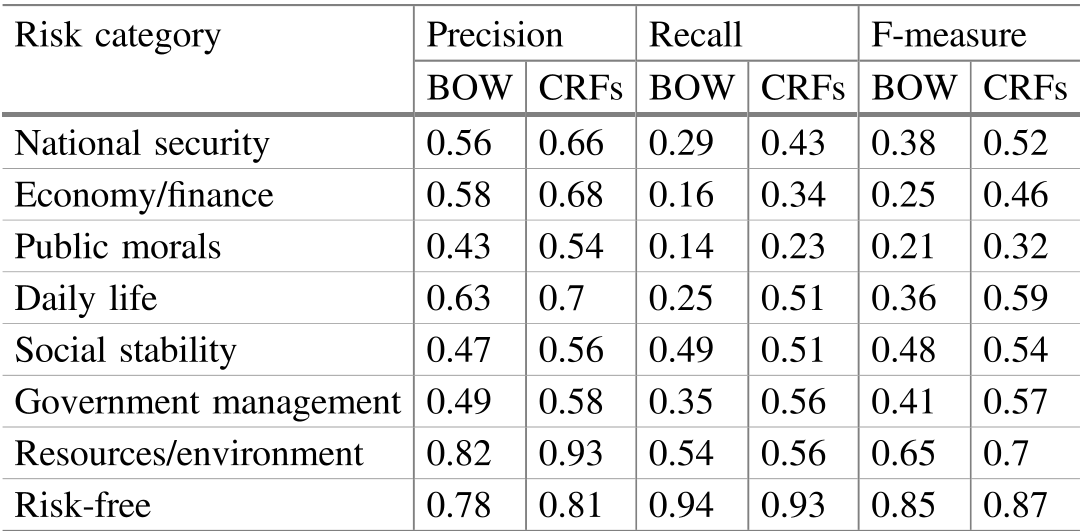
- CRF vs. SVM: The CRF model achieved an accuracy of 0.78, significantly outperforming the Bag-of-Words SVM baseline (0.74).
- Recall Dominance: In high-stakes areas like National Security and Economy, the CRF's recall was vastly superior, proving it is better at "catching" risky words in short, sparse texts.
- Geographical Precision: The hierarchical encoding reached 99% accuracy.
Case Study: From Raw Text to 5W
Consider the search word: "The orange alarm for heavy pollution in Beijing." The framework extracts:
- Where: Beijing
- When: December 2, 2016
- Why: Resources/Environment (Risk Category)
- What: pollution, early warning, air quality, Beijing-Tianjin-Hebei...
Critical Insight & Future Outlook
This work represents a vital bridge between sociopsychology and computational linguistics. While modern LLMs (like GPT-4) might handle these tasks today with fewer custom algorithms, this paper’s use of CRF-derived risk factors to steer a TextRank engine demonstrates an elegant, interpretable way to fuse supervised and unsupervised learning.
The next logical step? Building a Societal Risk Knowledge Graph where these 5W nodes are connected over time to predict "cascading risks" before they destabilize the social fabric.