
Extracting Elite Pairwise Constraints: A Conflict-Free Paradigm for Semi-Supervised Clustering
Extracting elite pairwise constraints for clustering
This paper introduces "Elite Pairwise Constraints" (EML and ECL) for semi-supervised clustering, which are constraints that must be satisfied in every optimal partition. To address the NP-hardness of identifying these constraints, the authors propose "Limit Crossing," a heuristic method utilizing Lagrangian relaxation to extract high-quality, non-conflicting supervisory information.
TL;DR
Semi-supervised clustering usually fails when expert-provided constraints conflict. This paper proposes Elite Must-Link (EML) and Elite Cannot-Link (ECL) constraints—relationships that must exist in every optimal partition. By using a "Limit Crossing" heuristic based on mathematical programming, the authors extract these high-certainty links that guarantee zero conflicts and superior clustering accuracy.
Contextualizing the Problem: The Curse of Noisy Constraints
In the landscape of semi-supervised learning, pairwise constraints (Must-Link and Cannot-Link) are the standard "bridge" between unsupervised data and human intuition. However, the academic community has long ignored a critical flaw: experts are human, and they disagree.
Current SOTA methods often struggle when:
- Expert A says and are a pair, while Expert B says they are not.
- Forcing these noisy constraints pushes the clustering algorithm away from the global mathematical optimum of the objective function (e.g., minimizing the sum of squared distances).
- The task of finding a feasible partition under conflicting cannot-links is itself NP-hard.
The Insight: Searching for the "Structural Backbone"
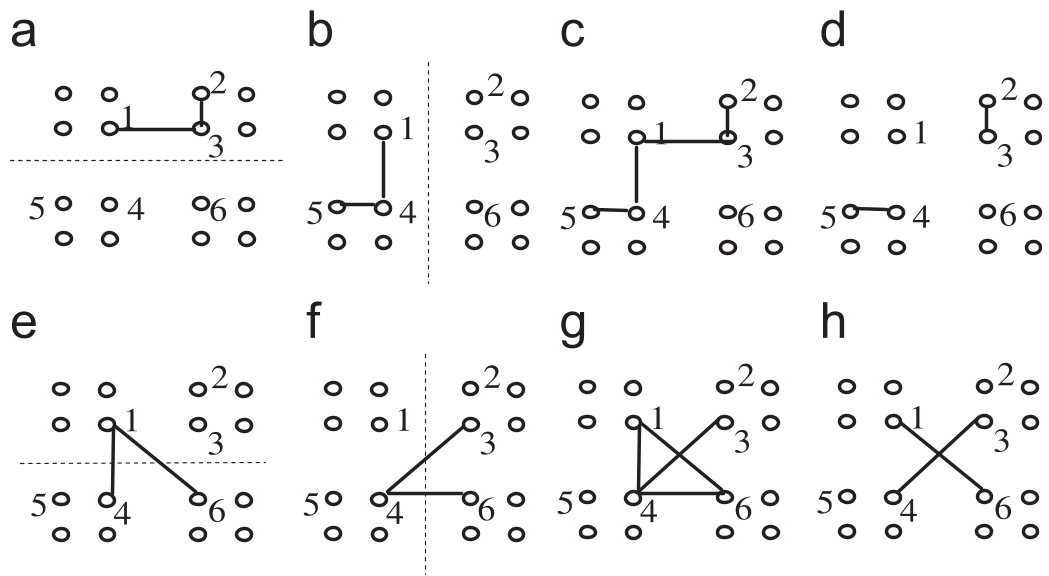
Instead of relying on external (and noisy) labels, Jiang et al. propose a "Self-Supervised" flavor of constraint extraction. They define Elite constraints as pairs that are invariant across all optimal partitions. If a link must be there for the solution to be optimal, it's "Elite."
 In the figure above, (a) and (b) are optimal. (c) shows how combining non-elite constraints creates a scenario where no optimal partition exists, while (d) shows how EML constraints always lead to good partitions.
Methodology: The Limit Crossing Algorithm
Since finding the set of all optimal partitions is NP-hard, the authors use Limit Crossing. The physical intuition is simple:
- Upper Bound (): The best clustering score we currently have.
- Lower Bound (): The absolute theoretical minimum score if we force (or forbid) a specific connection.
If the Lower Bound of a partition that violates a link is higher than our Upper Bound for the optimal partition, then that link must be an Elite constraint. It is mathematically impossible for an optimal solution to exist without that specific link.
Mathematical Machinery: Lagrangian Relaxation
The paper formulates clustering as an Integer Programming (IP) problem. To calculate the Lower Bounds (Steps 3.3 and 3.4 in the algorithm), they use Lagrangian Relaxation. This converts the hard constraints of the IP into penalties in the objective function, allowing for a polynomial-time estimation of the lower bound via subgradient optimization.
 The logic flow: Use mathematical bounds to 'prove' that certain links are essential for optimality.
Experimental Validation: Perfect Purity
The authors tested their method using COP-KMedoids. The most striking results came from synthetic datasets (Group 1 and Group 2).
- Purity & NMI: While unsupervised (U) and noisy (M/D) methods hovered at lower quality levels, the Limit Crossing (L) approach achieved 100% Purity and 1.0 NMI across all SynK datasets.
- Convergence: By providing high-quality "anchor" constraints, the algorithm converged significantly faster, requiring fewer iterations to reach stability.
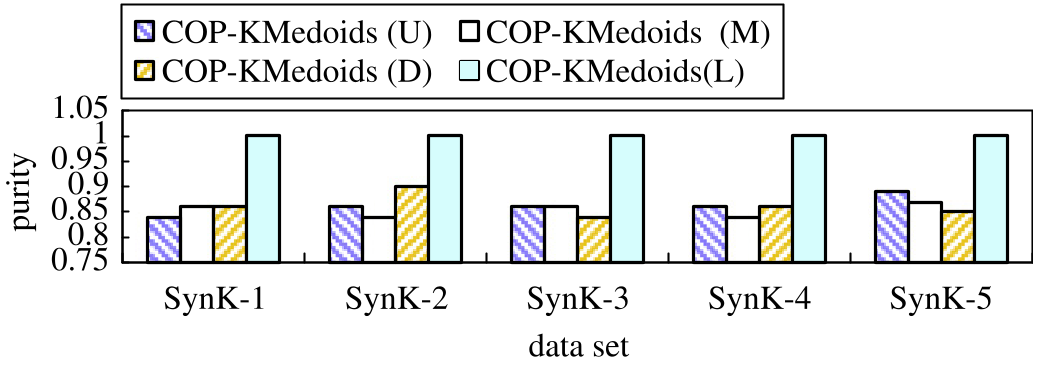 Fig 8: Purity comparison. The Elite constraints generated by Limit Crossing (L) consistently hit the 1.0 ceiling.
Critical Insight & Future Outlook
This work represents a shift from "expert-guided" to "structure-guided" semi-supervision.
Successes:
- Conflict-Free: By definition, EML/ECL sets cannot contain contradictions.
- Robustness: It effectively handles the NP-hardness of the underlying clustering problem by using bounds rather than exact solutions.
Limitations:
- Computational Cost: Calculating Lagrangian relaxations for every pair () is expensive for large-scale datasets.
- Objective Dependency: "Elite" constraints are only as good as the criterion function (e.g., K-Medoids objective). If the objective doesn't capture the real-world ground truth, the "Elite" constraints will be mathematically correct but practically useless.
Future Directions: The authors suggest using Limit Crossing to verify human experts. If an expert provides a constraint that contradicts a mathematically proven EML, we can automatically flag that expert's input as noisy.