
Spectrograms as Images: Rethinking Speech Emotion Recognition via Bag-of-Visual-Words
Extracting emotions from speech using a bag-of-visual-words approach
This paper introduces a novel approach for Speech Emotion Recognition (SER) by treating audio spectrograms as visual images and applying a Bag-of-Visual-Words (BoVW) framework. By extracting SURF features from spectrograms and quantizing them into a visual vocabulary, the method achieves language-independent emotion classification across Italian, English, and German datasets.
Executive Summary
TL;DR: This paper explores a fascinating cross-domain application: treating sound as a picture. By converting speech into spectrograms and applying the Bag-of-Visual-Words (BoVW) model—a staple of classic computer vision—the authors develop a language-independent emotion recognition system. The approach successfully classifies emotions like anger, fear, and sadness across three different languages (Italian, English, and German) by focusing purely on paralinguistic visual patterns rather than spoken words.
In the landscape of affective computing, this work represents an innovative pivot from traditional acoustic signal processing toward visual feature engineering for audio tasks.
Problem & Motivation: The Language Barrier in Speech AI
Recognizing human emotion through voice is notoriously difficult because "how" we speak is often buried under "what" we say. Conventional methods usually fall into two traps:
- Linguistic Dependency: Relying on Automatic Speech Recognition (ASR) which fails when switching between languages (e.g., German to Italian).
- Feature Overload: Hand-crafting statistical spectral features (pitch, jitter, shimmer) that might not capture the holistic "texture" of an emotional outburst.
The authors' insight was simple yet profound: If an expert can "see" an emotion in a spectrogram, a computer vision algorithm can learn to classify it. By moving to the visual domain, they bypass the need for complex phoneme alignment or language-specific tuning.
Methodology: The BoVW Pipeline
The core of the method lies in the translation of audio into a structured visual vocabulary.
1. Spectrogram Generation
The raw audio is processed using Short-Time Fourier Transform (STFT) with a 40ms window, resulting in a 227x227 image representing the frequency distribution over time.
2. Feature Extraction (The "Visual Words")
Instead of using standard interest point detectors which might find too few points in smooth spectrograms, the authors used a dense grid-based sampling. They extracted SURF (Speeded-Up Robust Features) descriptors from these grid points. SURF is favored here for its robustness to intensity changes and its balance between speed and descriptive power.
3. Vocabulary Construction
Using k-means clustering on the training features, the system builds a "dictionary" of visual patterns. Each spectrogram is then represented as a histogram counting how many times each "visual word" appears.
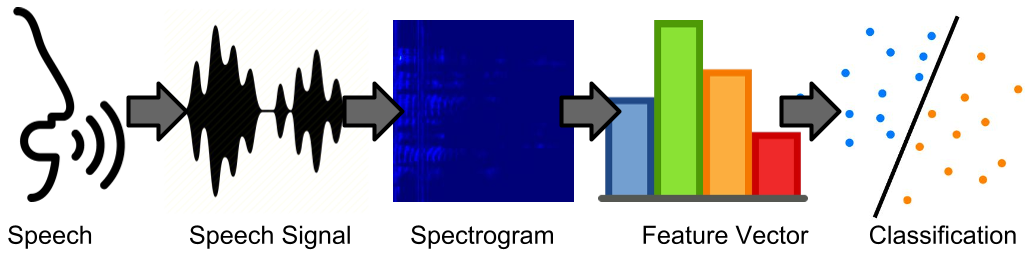 Fig 1: The proposed workflow from raw audio to SVM classification.
Experiments & Results
The authors tested their model on three major datasets: EMOVO (Italian), SAVEE (English), and EMO-DB (German).
Key Findings:
- Vocabulary Size Matters: The performance (F1-score) varies significantly with the number of visual words (N). For instance, in EMO-DB, increasing the vocabulary to 600 words yielded the highest performance (0.618).
- Emotion Sensitivity: "Sadness" and "Anger" were generally easier to detect across languages compared to "Happiness," which often struggled with lower recall numbers.
- Comparison with Baselines: The BoVW approach was compared against standard visual features like HOG (Histogram of Oriented Gradients) and LBP (Local Binary Patterns).
 Table 1: Comparison of the proposed BoVW method against the baseline.
The results show that while the performance is comparable on average, the BoVW method offers a more flexible and potentially robust framework for diverse acoustic environments.
Critical Analysis & Conclusion
Takeaway
The primary contribution of this work is the validation of the BoVW model as a viable alternative for audio analysis. It breaks the "audio-only" silo and invites the use of sophisticated vision techniques for paralinguistic tasks.
Limitations
- Temporal Layout: By the very nature of "Bag-of-Words," the temporal sequence of sounds is discarded. A visual word at the start of the clip is treated the same as one at the end.
- Language Specificity: While the method is language-independent, the models in this study were trained separately for each language. Cross-language generalization remains a challenge.
Future Outlook
As deep learning continues to dominate, the logical next step for this line of research is the transition from BoVW to Convolutional Neural Networks (CNNs) or Vision Transformers (ViTs) trained directly on these spectrograms—a trend that has indeed gained massive traction in recent years. This paper serves as a foundational step in proving that the "audio-as-image" metaphor is not just poetic, but computationally powerful.