
Mining the Wisdom of the Crowd: Extracting Social Lists from the Twitter Chaos
Extracting Social Lists from Twier
The paper introduces the first system designed to identify and extract "Social Lists" from Twitter hashtags and tweets. It utilizes a recall-optimized Logistic Regression classifier trained on novel linguistic, search-based, and temporal features to achieve 75.5% precision at a high recall of 95.3% for SL-hashtag discovery.
TL;DR
Search engines are great at telling you the temperature in Tokyo, but they struggle with "social" questions like "what should I ask on a first date?" This paper presents a novel system that identifies Social List (SL) hashtags (e.g., #5TipsForYoungJournalists) on Twitter and extracts the underlying list items. By using a recall-optimized classifier, the authors achieved a 95.3% recall, paving the way for search engines to provide "instant answers" for non-factual, social queries.
Background Positioning
In the landscape of social media mining, most research focuses on sentiment analysis or trend prediction. This work sits in a niche but highly valuable intersection of Information Retrieval (IR) and Social Network Analysis (SNA). It is a pioneering effort to turn the unstructured stream of Twitter into a structured knowledge base for subjective content.
Problem & Motivation: The Gap in Search
Users are increasingly asking for lists of advice, ideas, and experiences. While platforms like Twitter are overflowing with these "social lists," they are nearly invisible to standard search crawlers because they are:
- Sparse: SL-hashtags are a tiny minority of all hashtags.
- Noisy: Tweets contain URLs, slang, and non-ASCII characters.
- Unstructured: There is no standard format for a "list" on Twitter; one user might use numbers, while another uses bullet points or just line breaks.
The authors' insight is that hashtags act as anchors. If you can identify a hashtag as a "Social List" anchor, you've found the key to unlocking all the advice contained in the tweets using that tag.
Methodology: Identifying the Anchors
The core of the paper is the SL-Hashtag Detection system. The researchers broke this down into three feature sets to train their classifier:
1. Language Features
Since hashtags are often smashed-together words (e.g., #bestanniversarymessages), the system first uses a Viterbi-based segmentation to split them into readable words. They then look for:
- POS Tags: The presence of nouns, plural nouns (e.g., "tips"), and verbs.
- Regex Patterns: Matching structures like "how to...", "top X...", or "...in 5 words".
2. Search Features
This is a clever "out-of-the-box" feature. They query Google with the hashtag. If search results show different numbers (e.g., a search for "#10GiftIdeas" brings up pages with 14 or 44 ideas), it confirms the topic is a general "list" topic rather than a specific entity like a movie title.
3. Tweet Features
They analyze how the hashtag behaves. Unlike news events (#ParisShooting) which have a sharp spike and die down, social topics often have different temporal signatures and different co-occurrence patterns with other tags.
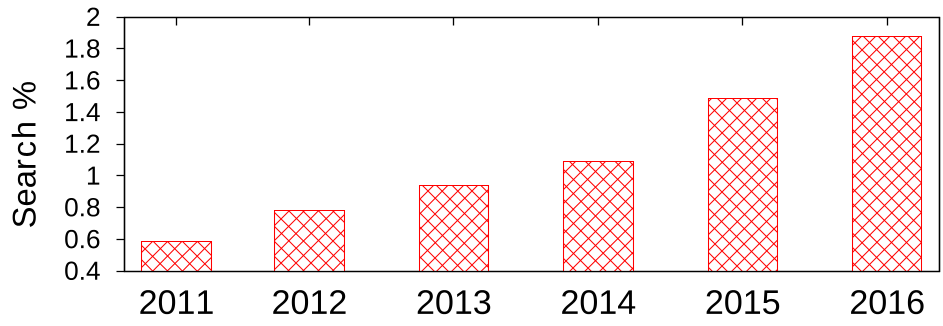 Fig 1: The growth of social list queries on search engines like Bing highlights the demand for this system.
Experiments & Results: Precision vs. Recall
The researchers tested various models, including SVMs and Gradient Boosted Trees, but Logistic Regression (LR) emerged as the winner.
In the context of search, "Recall" is king. It is better to capture all possible social lists and filter them later than to miss them entirely. The authors tuned their LR model to reach a Recall of 95.3%, with a Precision of 75.5%.
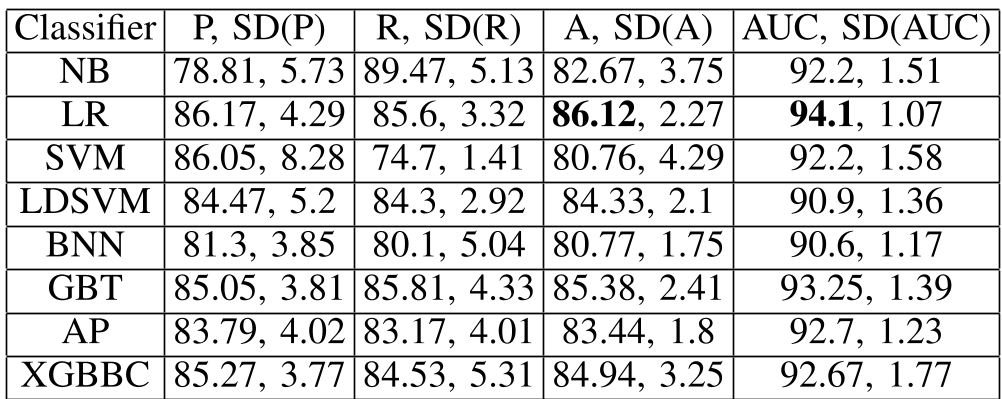 Table 1: Logistic Regression (LR) provided the highest AUC and the most balanced performance across the board.
Key Ablation Insights:
- Hashtag Length and POS Entropy (the variety of word types in a tag) were the strongest predictors.
- Adding Search and Tweet features consistently improved the performance over just using linguistic patterns.
Critical Analysis & Conclusion
Takeaway
This paper provides a robust framework for mining "subjective" knowledge. By moving beyond simple keyword matching and looking at the linguistic intent of a hashtag, the authors show how social media can fill the gaps in traditional Knowledge Graphs.
Limitations & Future Work
The paper focuses heavily on identifying the hashtags. While it briefly mentions extracting list items (ranking by follower count and frequency), this remains the harder task. In 2024, the logical next step would be to feed these identified Sl-hashtags into a Large Language Model (LLM) to perform the final cleanup and summarization of the tweet content, potentially solving the "noise" problem the authors highlighted.
Ultimately, this work serves as a foundational step toward turning the chaotic stream of consciousness on Twitter into a structured, readable manual for everyday life.