
Beyond the Thread: Decoding Social Interactions in Web Forums through Content Analysis
Extracting Social Networks to Understand Interaction
The paper proposes a novel multi-relational social network extraction framework for web forums, integrating structural links with content-based analysis. By moving beyond simple reply-to metadata, the authors implement an automated system to extract "Name Quotations" and "Text Quotations" to accurately map interpersonal interactions and eventually identify social roles.
TL;DR
Researchers have moved beyond simple "who-replied-to-whom" metadata to map social networks. By analyzing forum content for Name Quotations and Text Quotations, this paper presents a system that captures hidden interactions, overcoming the "noise" of informal writing with fuzzy matching and linguistic tools.
The Missing Links: Why Structure Isn't Enough
In the world of online forums, the HTML structure tells only half the story. While a user might click "reply" to a specific post, they often mention multiple participants by name or quote specific sentences from deep within a thread to address them directly.
Current SOTA methods often ignore these content-level cues, leading to sparse or inaccurate social graphs. The challenge lies in the data's "dirtiness": users misspell pseudonyms, ignore quotation marks, and use slang. This paper argues that without capturing these "implicit" links, we cannot truly understand the social roles (like the Influencer or the Troll) that individuals play.
Methodology: The content-aware extraction engine
The authors propose a framework that treats a social network as a set of three distinct relationships: Structural (), Text Quotation (), and Name Quotation ().
1. Extracting Name Quotations
To handle the variety of ways users refer to each other, the system employs Algorithm 1, which uses:
- Normalized Levenshtein Distance: Allows for minor typos in long pseudonyms.
- TreeTagger Dictionary: Filters out common words, targeting "unknown" terms which are highly likely to be unique user handles.
2. Extracting Text Quotations
Detecting quotes is difficult because users often omit standard markers (like "quotes"). The authors implemented a similarity check that flags overlapping word sequences. Their experiments determined that a threshold of 6 words is the "sweet spot" for balancing recall and precision.
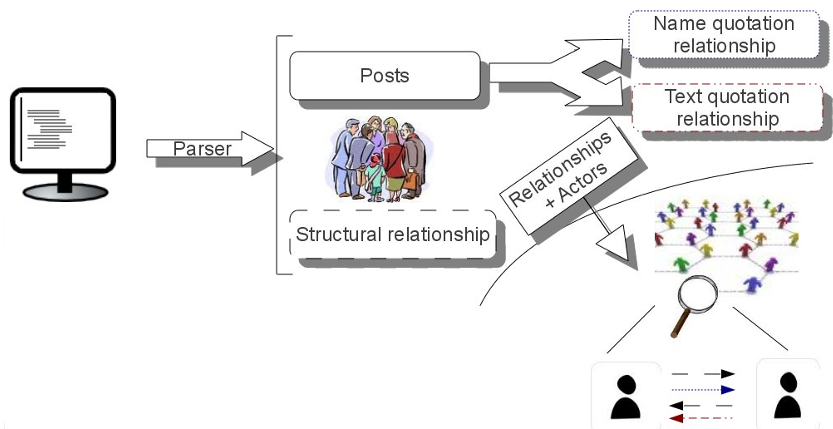 Fig 1: The system architecture from raw HTML to social network visualization.
Proving the Value: The Validation Protocol
A major contribution of this work is the Adjusted Validation protocol. Since forum data lacks gold-standard labels, the authors used human raters. However, human attention flags over long threads (350+ posts). By re-presenting system-found links to humans to verify if they missed them initially, the authors significantly increased the reliability of their metrics.
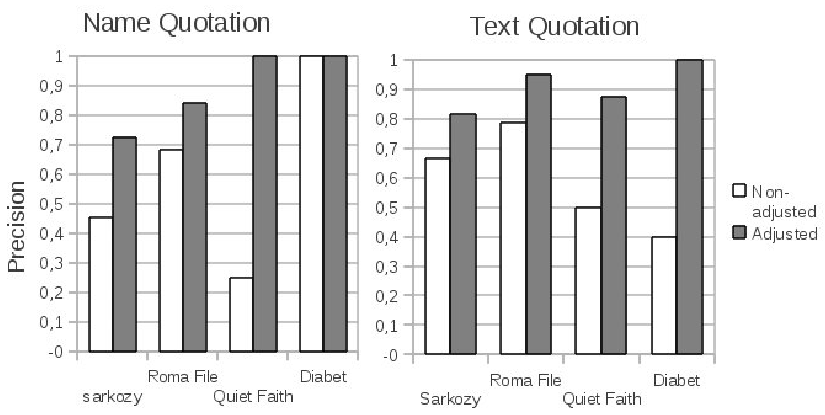 Fig 2: Precision increases across all forums using the adjusted validation protocol, proving the system is often more vigilant than human raters.
Experimental Results
The system was tested on four diverse forums (Sarkozy's policy, Roma people file, Faith, and Diabetes).
- Name Quotations: Reached precision levels between 0.81 and 1.0.
- Text Quotations: Achieved an F-measure of 0.92 in the "Roma" forum, demonstrating that comparing post content significantly outperforms simple quotation mark detection.
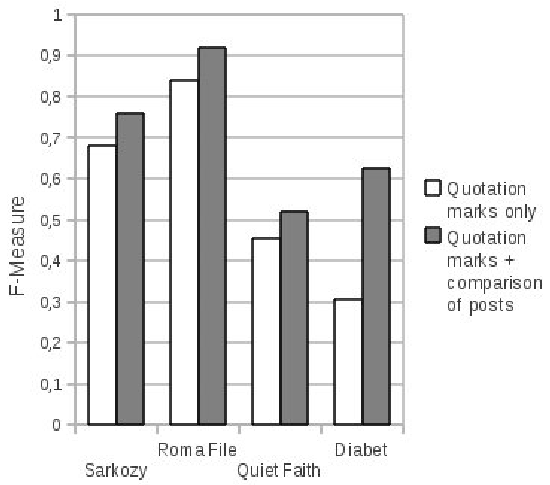 Fig 3: The significant jump in F-measure when adding content comparison to the baseline.
Deep Insight: Toward Social Roles
The ultimate goal of this interaction modeling is Social Role Discovery. By knowing who is being quoted and who is doing the quoting, we can move a step closer to identifying community pillars:
- Discussion Catalysts: Those who spark widespread text-quoting.
- Experts: Those referred to by name for their specialized knowledge.
- Newbies vs. Celebrities: Differentiating users by how the community "interacts" with their content, not just their post counts.
Conclusion & Future Outlook
This work demonstrates that "reading" post content is essential for high-fidelity social network analysis. While the methods used (Levenshtein, sliding windows) are computationally accessible, they provide a strong foundation.
Future Work: The authors suggest that adding Ontologies or Semantic Similarity (TF-IDF or embedding-based) would further solve the issue of diminutive names or paraphrased quotes that current fuzzy matching might still miss.