
Cultural Algorithms: Decoding the Urban DNA of Monte Albán
Extracting Urban Occupational Plans Using Cultural Algorithms
This paper presents an evolutionary framework using Cultural Algorithms (CA) to reconstruct and analyze the high-level structural functional models of ancient urban centers, specifically Monte Albán. By integrating Data Mining (Decision Trees, MDS, and k-means), the system evolves abstract city plans that achieved high fitness scores (up to 93%) in identifying functional zones.
TL;DR
Researchers have developed an evolutionary computing framework that uses Cultural Algorithms (CA) and Data Mining to reconstruct the urban planning of Monte Albán, one of the world's first cities. By simulating "planners" who learn from archaeological "knowledge," the system discovered that this ancient capital utilized a sophisticated sector-based model, mirroring the efficiency of modern urban centers.
The Mystery of Archaic Urbanization
How did a hilltop in Mexico become a bustling state capital 2,500 years ago? For decades, archaeologists have mapped thousands of residential terraces, but turning this "micro-level" data into a "macro-level" understanding of city planning is a Herculean task.
The core challenge lies in complexity. Urban centers are complex systems with emergent properties. Traditional manual analysis often fails to see the "forest" (the city plan) for the "trees" (the individual houses). This paper asks: Can we use artificial intelligence to evolve an ancient city's blueprint?
Methodology: The "Dual-Inheritance" of Culture
The authors employ Cultural Algorithms (CA), a socially motivated extension of Genetic Algorithms. Unlike standard EAs, CA maintains a Belief Space—a shared repository of knowledge that guides the population's evolution.
Multi-Scale Data Mining
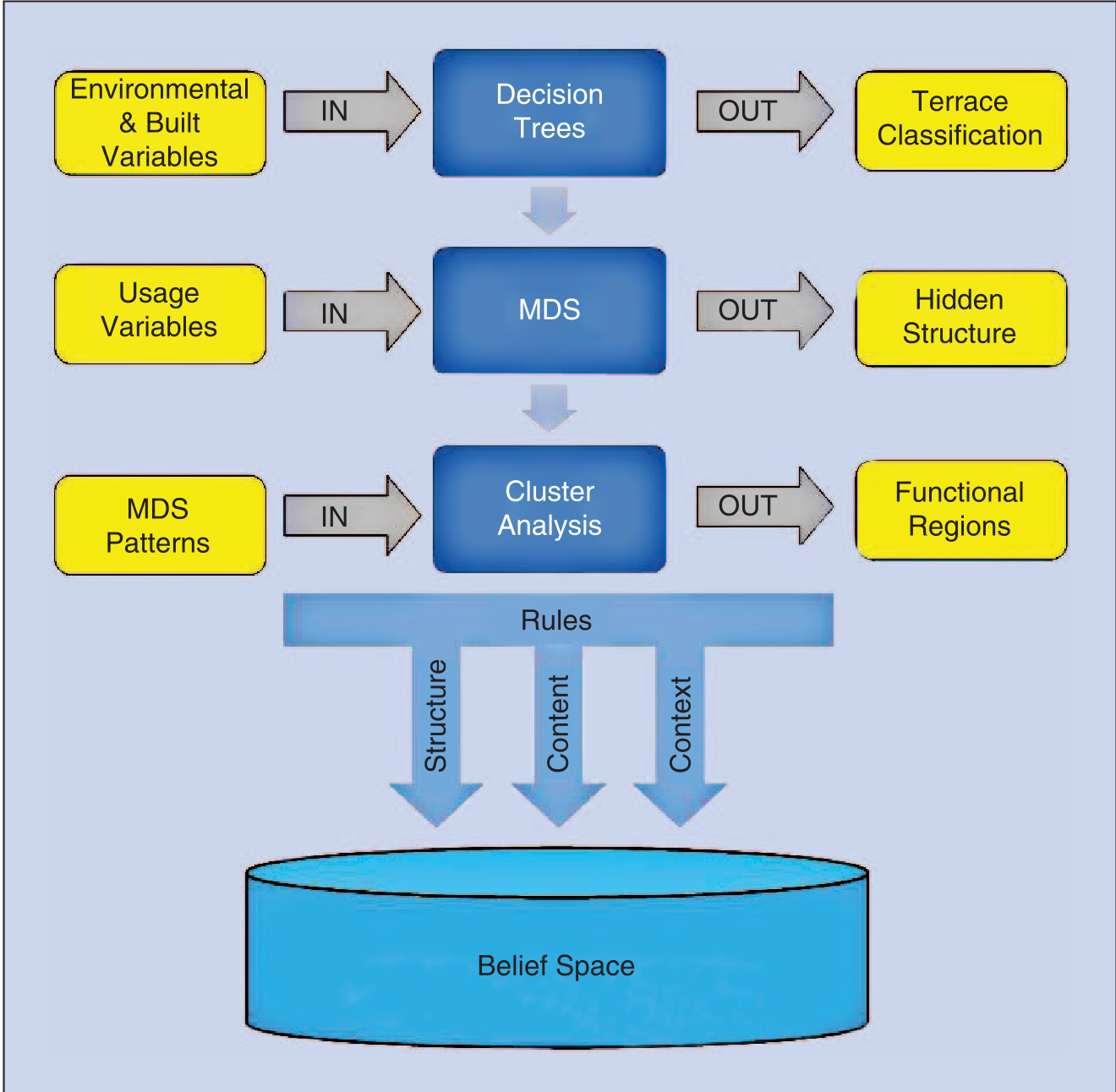
Before the evolution begins, the authors use data mining to "prime" the algorithm:
- Macro-Level: Decision trees (J48) identified that proximity to the Main Plaza was the primary driver for site selection.
- Meso-Level: Multi-Dimensional Scaling (MDS) revealed three functional classes: Craft production, Elite residential, and Non-elite residential.
- Micro-Level: K-means clustering defined the "building blocks" of terraces.
The Evolutionary Planner
The population consists of "agents" representing urban planners. These agents combine building blocks into regional plans, which are then evaluated against three rule sets in the Belief Space:
- Content Rules: Does the region have the right mix of obsidian, shell, and ceramics?
- Context Rules: Is it the correct distance from "attractors" like roads and the reservoir?
- Structural Rules: Is the geographic expanse of the region logical?
Insights from the Evolved Plan
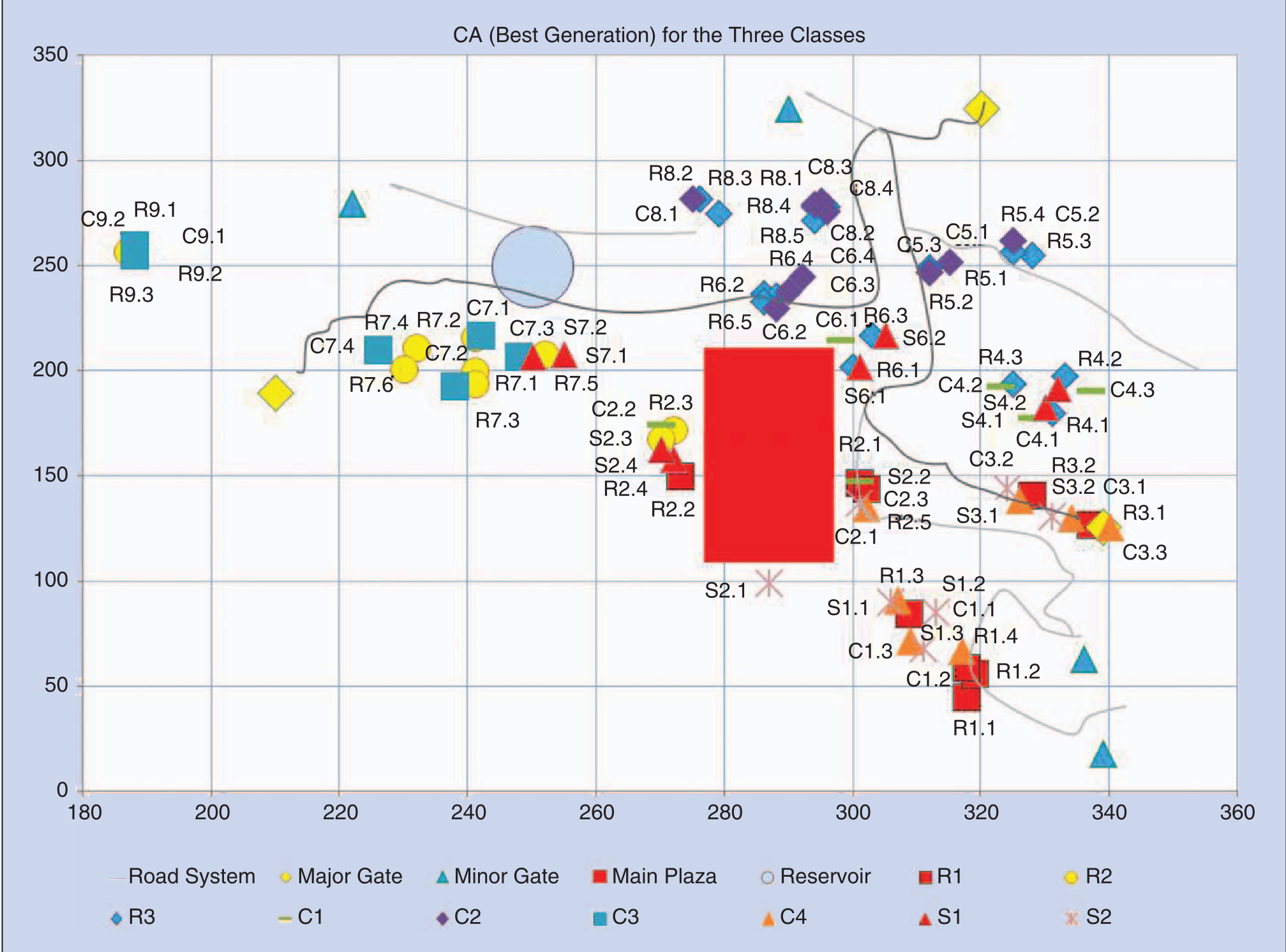
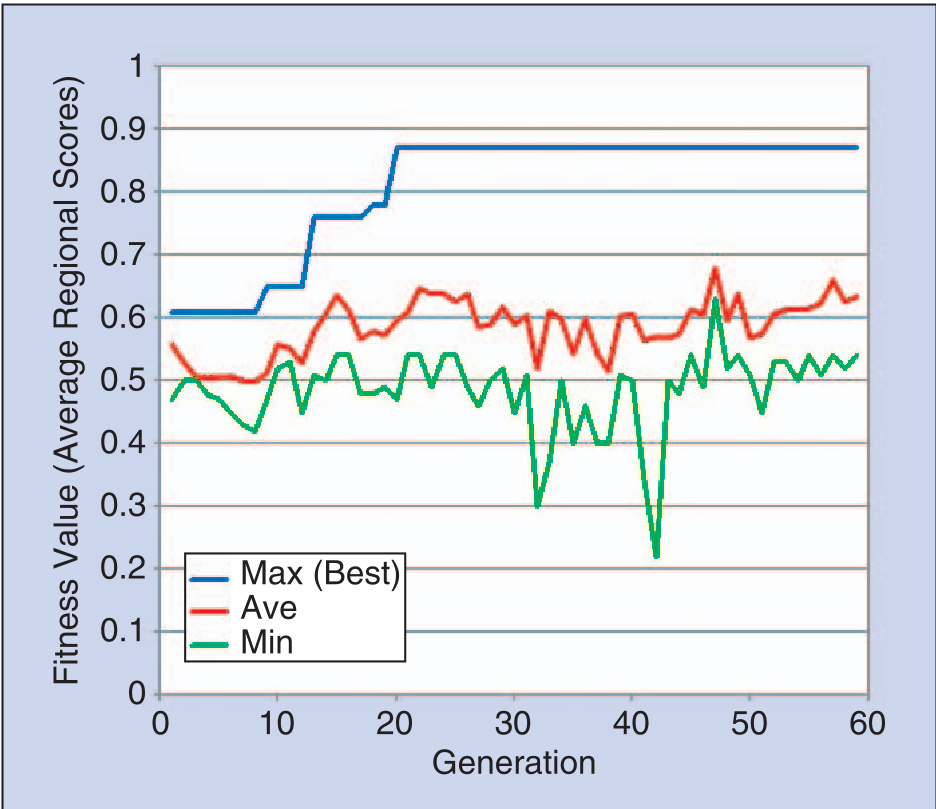
The Cultural Algorithm achieved a stunning 93% fitness in identifying craft regions. By the 20th generation, the noise of individual houses had cleared, revealing a coherent sector-based morphology.
Machine vs. Human Expert
When compared to a manually generated plan by a site expert, the CA-generated model was found to be more generalized and efficient:
- Dimensionality Reduction: The algorithm identified 9 key clusters, whereas the human expert identified 12.
- Environmental Logic: The CA discovered "hidden" logic, such as placing ceramic production (which requires smoky kilns) to the east of the plaza. Since prevailing winds blow west-to-east, the elite residents were protected from pollution—a level of nuance the algorithm picked up from the data that demonstrates functional planning.
Why This Matters
This work proves that ancient urbanization wasn't accidental; it followed rigorous functional and social rules. For the AI community, it demonstrates that Cultural Algorithms are uniquely suited for sparse-data environments—situations where we know the "ending" (the ruins) but need to evolve the "process" (the planning).
Future Directions
The next step is to evolve "Phase II" and "Phase III" of Monte Albán to see how the city plan reacted as space became scarce and the state became more centralized. This approach could eventually be applied to modern urban "chaos," helping us understand how our own cities might evolve in the face of climate or social shifts.
Final Takeaway: Whether 500 B.C. or 2026 A.D., city planning is driven by the flow of resources, information, and the "Social Fabric"—and AI is finally helping us weave the patterns together.