
Eye Knowledge Network: Merging Social Media Dynamics with Clinical Precision
Eye Knowledge Network: A Social Network for the Eye Care Community
The Eye Knowledge Network (EKN) is a specialized Web 2.0 social framework designed for eye care professionals to share clinical cases and multimedia data. It leverages a custom ophthalmology ontology and a hybrid recommendation system (combining content-based and collaborative filtering) to facilitate expert discussion and diagnostic peer review.
TL;DR
The Eye Knowledge Network (EKN) is a sophisticated collaborative platform specifically engineered for the ophthalmology community. Unlike generic social networks, EKN integrates a specialized medical ontology and a hybrid recommendation engine to transform clinical case sharing into a structured, searchable, and authoritative knowledge base. Its standout feature, "RichImages," allows doctors to annotate and discuss ocular scans in real-time without altering the source data.
Problem & Motivation: Beyond the Digital Watercooler
In the medical field, the rapid circulation of clinical methodologies is a matter of patient outcomes. However, eye care professionals have historically faced two extremes:
- Static Databases: Reliable but slow and lacking interactive peer-review mechanisms.
- General Social Platforms: High engagement but zero semantic structure, poor technical tools, and a lack of medical authority.
The authors recognized that for a social network to be useful to a surgeon, it must understand the meaning of the data being shared. A picture of a retina isn't just an image; it is a collection of anatomical markers and pathological indicators that require semantic tagging to be discoverable by the right specialists.
Methodology: The Semantic Engine of EKN
The core innovation of EKN lies in its Tag Extractor and Ontology-driven Weighting.
1. The Ophthalmology Ontology
The system uses a specialized vocabulary where each term is assigned an Absolute Weight (AW). Common terms (e.g., "Retina") have low weights (0.2), while specialized terms (e.g., "Cone dystrophy") have high weights (0.8), ensuring that expert content receives higher visibility in specialized searches.
2. Weighted Tag Extraction Formula
The system calculates the importance of a topic using the formula:
- TW (Text Weight): Importance based on formatting (bold, italic).
- RW (Relative Weight): Relationship distance in the ontology (Synonyms = 0.9, Similar = 0.6).
- AW (Absolute Weight): Domain specificity.
3. RichImage Interactivity
EKN bypasses the limitations of static attachments. Users can drag and drop landmarks, speech bubbles, and highlight regions on clinical images. This data is stored in a separate database layer, preserving the original image while enabling a "multichannel" discussion on specific anatomical areas.
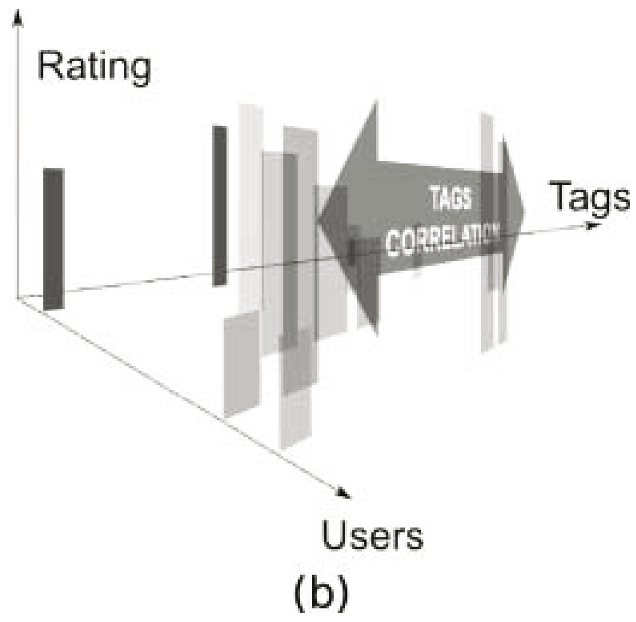 Fig 1: The dual correlation approach used to refine user profiles (a) and tag relationships (b).
Experiments & Results: Scoring for Trust
To ensure professional reliability, EKN implements a unique Scoring Mechanism.
- Thread Score (TS) and User Score (US) are normalized using a Gaussian distribution.
- Authority Metrics: "Community Managers" are elected by the community based on their scores. They can mark a diagnosis as "Assessed," giving it higher search priority.
- Hybrid Recommendation: Using Pearson correlation, the system matches users not just by what they say, but by the "sparsity-filled" profile created through their interaction with specific ontological tags.
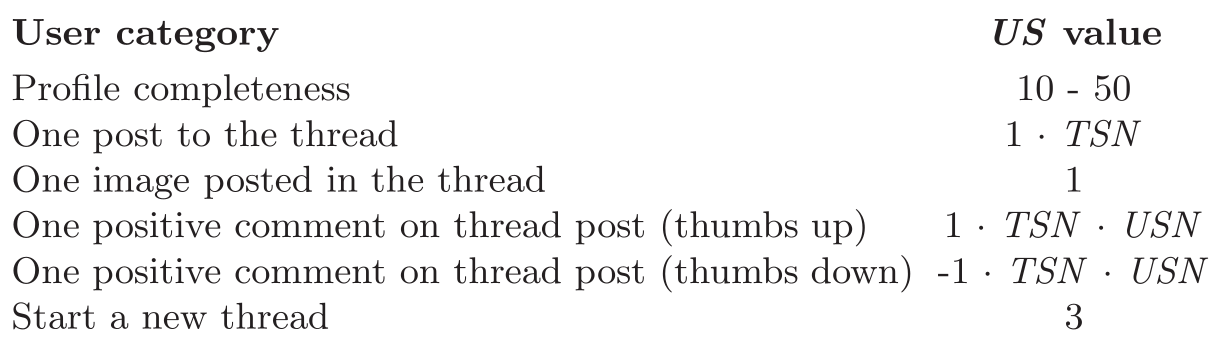 Table 1: Quantitative triggers for User Scores, showing how engagement translates into platform authority.
Critical Analysis & Conclusion
EKN is a pioneer in what the authors call "Web 3.0" for medicine—a semantic, intelligent network. By leveraging a tag-centric approach, they successfully eliminate "artificial barriers" like static forum categories, allowing dynamic channels to form around emerging clinical topics.
Takeaway: The success of professional social networks depends on Semantic Integration. For the medical community, a platform must provide tools that respect the nuances of their specific field (like RichImages) and provide a governance model that balances "social" speed with "clinical" authority.
Limitations: The current system relies heavily on a manually refined ontology. As medical terminology evolves, the platform will need more automated, unsupervised learning methods to keep the ontology current without constant human intervention.