
From Pixels to Peers: Fusing Face Networks for Sociological Surveillance
Fusion of face networks through the surveillance of public spaces to address sociological security recommendations
The paper introduces a surveillance framework that constructs "Face Co-occurrence Networks" by fusing data from multiple public spaces. Using a novel Minimized Face Co-occurrence Network (MFCN) algorithm, the system extracts sociological parameters to recommend circles of associates for individuals of interest.
TL;DR
This research moves beyond simple face recognition by treating public spaces as sensors for social connections. By constructing a Minimized Face Co-occurrence Network (MFCN), the system identifies "circles of associates," providing security personnel with sociological recommendations rather than just identity tags.
Background: The Social Gap in Surveillance
Most modern surveillance systems are experts at the "What" and "Where": detecting a person in a subway or tracking a car on a road. However, they lack the "Who with." Human behavior is inherently social. If two people appear together repeatedly across different cameras (e.g., a lab and a cafeteria), there is a high probability of a social bond. Bridging Face Recognition with Social Network Analysis (SNA) allows investigators to uncover hidden networks that traditional real-time tracking might miss.
The Problem: Noise and Fragmentation
Individual scenes are noisy. A random person walking behind a target shouldn't be labeled an "associate." Furthermore, data is often stuck in silos; a person seen at an airport might not be cross-referenced with their appearance at a train station. The challenge lies in fusing these fragmented sightings into a coherent, weighted graph that filters out "coincidental" occurrences from "intentional" associations.
Methodology: The Face Co-occurrence Graph
The authors propose a graph-based approach to represent human presence:
- Node Initialization: Every unique face recognized via PCA (Principal Component Analysis) becomes a vertex (V).
- Edge Weighting: An edge (E) is formed if two people appear in the same photo. The weight increases every time they are seen together.
- Threshold Filtering (MFCN): To remove "background noise" (accidental co-appearances), a threshold is applied. Only edges with weights are kept, revealing the core social group.
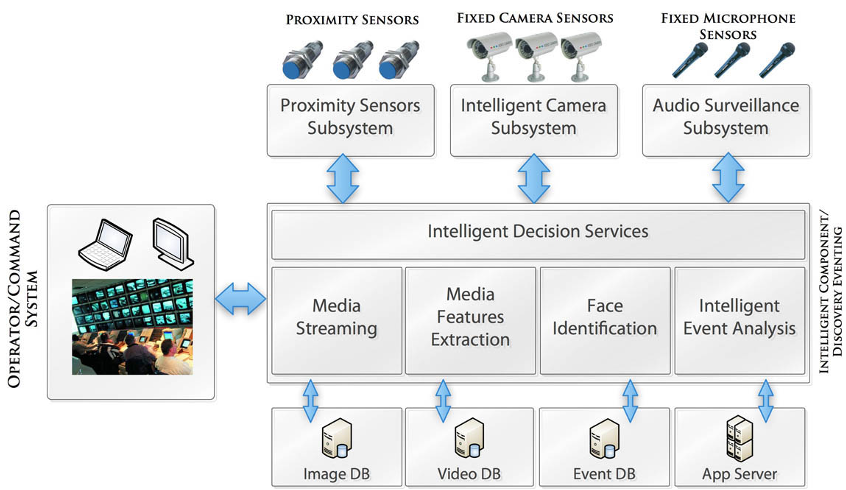 Figure 1: The system architecture utilizing SOA (Service Oriented Architecture) to handle multi-sensor data streams.
Experiments and Discovery
The system was tested in a laboratory setting with 15 volunteers over three days. The dataset was substantial, involving 24,560 photos and 17,452 detected faces.
Key Finding: Thresholding Matters
The MFCN algorithm proved essential. When the threshold was set appropriately, the system could collapse a massive, messy web of coincidences into a clear map of associates.
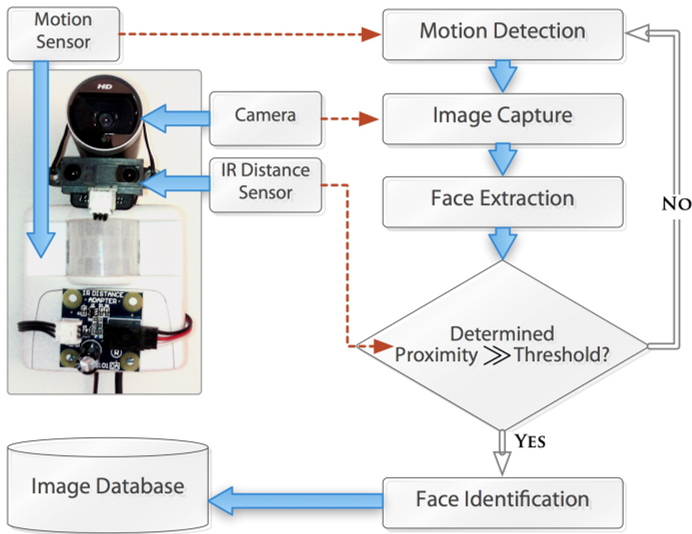 Figure 2: Example of how individual photos (a, b) evolve into a complex fused network (c) that tracks associate frequency.
Performance Challenges
The study honestly highlights the gap between manual human logic and automated systems. The prototype generated more "unique faces" (16) than actually existed (10) due to PCA errors under varying light and postures. This led to a higher number of edges than manual calculations predicted, suggesting that the accuracy of the underlying Face Recognition engine is the primary bottleneck for reliable sociological mapping.
Critical Insight: The Future of Investigative Security
The real value of this work is the Sociological Recommendation. Instead of just identifying "Subject A," the system tells the officer: "Subject A is frequently seen with Subjects B and C; search for Subject B if Subject A is missing."
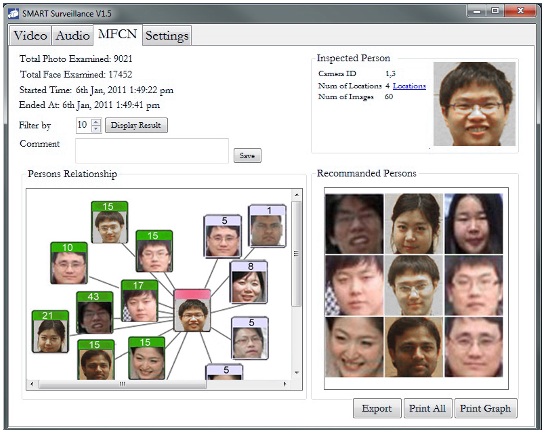 Figure 3: The prototype UI showing the visualization of social clusters.
Conclusion
While the system struggles with high-density crowds (where "false co-occurrences" skyrocket), it is highly effective for medium-to-low traffic areas like schools, offices, or transit lounges. By treating a surveillance camera not just as a recording device, but as a social sensor, we can build a much more comprehensive view of public security. Future work involving deep learning (instead of PCA) will likely solve the recognition errors, making these social maps even more surgical in their precision.