
Decoding the Digital Self: High-Dimensional Personality Recognition via Facebook Activities
Analyzing Facebook Activities for Personality Recognition
This paper presents an Automatic Personality Recognition (APR) model that predicts BIG5 personality traits from Facebook "likes" using the LASSO regression algorithm. Utilizing a substantial dataset of 92,255 users, the study demonstrates that digital footprints can effectively map to psychological profiles, achieving significant predictive accuracy for traits like Openness and Extraversion.
TL;DR
Researchers from Southern Illinois University have developed a model that translates your Facebook "likes" into a psychological profile. By applying the LASSO (Least Absolute Shrinkage and Selection Operator) algorithm to a massive dataset of over 92,000 users, the study successfully predicts BIG5 personality traits, proving that our digital footprints are mirrors of our internal character.
Personality in the Age of Social Data
How much does a "Like" really say about you? In the realm of psychology, the BIG5 model (Openness, Conscientiousness, Extraversion, Agreeableness, and Neuroticism) has long been the gold standard for describing human personality. Traditionally, capturing these traits required long, tedious surveys.
However, as we move through digital spaces, we leave behind a "digital breadcrumb trail." The authors argue that these unintentional self-disclosures are more than just data—they are behavioral records that can be mined to improve everything from ad targeting to academic teaching strategies and dating compatibility.
The Technical Challenge: High Dimensionality
Previous attempts at Automatic Personality Recognition (APR) often failed due to "small data" problems—using fewer than 200 participants—or simplified binary data.
The authors tackled two specific technical hurdles:
- Feature Sparsity: With 600 distinct topic categories, not every user interacts with every topic.
- Interpretability: The model needs to identify which specific "likes" actually correlate with personality without falling into the trap of over-fitting.
Methodology: Why LASSO?
Instead of standard linear regression, the team utilized LASSO. The "magic" of LASSO lies in its penalty term (L1 regularization), which forces the coefficients of less important features to zero. This effectively performs automated feature selection, narrowing down 600 potential predictors to the most statistically significant ones.
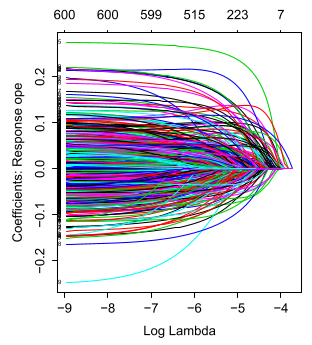 Figure 1: As the regularization parameter (lambda) increases, the model simplifies, discarding less relevant predictors to focus on core personality markers.
Results: What Your Likes Reveal
The model was trained on 75% of the data and tested on the remaining 25% using 10-fold cross-validation. The results showed a clear hierarchy in "predictability":
- Openness & Extraversion: These traits are the most "visible" through digital likes, showing the highest correlation scores (r = 0.38 and 0.34).
- Agreeableness: This remains the most "hidden" trait (r = 0.22), likely because being "agreeable" is a social lubricant that manifests more in direct interaction than in static content consumption.
Performance Summary
| Personality Trait | Pearson Correlation (r) | Mean Squared Error (MSE) |
|---|---|---|
| Openness | 0.38 | 0.024 |
| Extraversion | 0.34 | 0.038 |
| Neuroticism | 0.27 | 0.038 |
| Agreeableness | 0.22 | 0.030 |
Critical Insight: The Value for Product Design
The most profound application of this research lies in Recommender Systems. A classic problem in AI is the "Cold Start"—how do you recommend a product to a brand-new user with no history?
By using APR, a system can analyze a few initial digital signals (like Facebook connections or public likes) to build a psychological profile. If the system knows you are high in "Openness," it can immediately suggest novel, niche products rather than just popular mainstream items, significantly enhancing the user experience from day one.
Looking Ahead: Fuzzy Logic and Complexity
The authors acknowledge that human personality is rarely "black and white." Future work involves integrating Fuzzy Logic to convert these numerical scores into natural language terms, making the AI's output more intuitive for human researchers and marketing experts.
While the correlation coefficients (r ≈ 0.4) suggest we haven't perfectly "solved" the human psyche yet, the study confirms that our digital preferences are a powerful window into who we are—whether we realize it or not.