
Sophie: Bridging the Gap Between Social Networks and Virtual Humans
Let’s keep in touch online: a Facebook aware virtual human interface
This paper introduces a "Facebook-aware" virtual human interface that integrates social networking data into real-time human-agent interaction. By leveraging user profiles, likes, and sentimental analysis of status updates, the autonomous virtual human, Sophie, achieves more personalized and empathetic conversational capabilities compared to traditional interfaces.
TL;DR
This research pioneers the integration of social networking sites (SNS) with autonomous virtual humans. By allowing a 3D agent named Sophie to "read" a user's Facebook profile and status updates, the system transforms static interaction into a dynamic, socially-aware experience. The result? Users feel significantly more rapport and are more likely to trust the agent's recommendations.
Context: Why Social Awareness Matters
In the early 2010s, virtual humans were often restricted to rigid scripts or limited knowledge bases. They were "islands" of interaction, disconnected from the user's digital life. The authors identified a massive opportunity: Facebook. As a repository of our likes, friendships, and daily moods, Facebook provides the perfect "cheat sheet" for a virtual human to become a more engaging companion.
The "Sophie" Architecture: How It Works
The system connects three worlds: the physical (via webcam/mic), the 3D virtual (the rendered agent), and the Internet (Facebook API).
1. Dialogue Planning via Behavior Trees
Instead of simple state machines, the authors used Behavior Trees (BT). BTs offer hierarchical abstraction, allowing the agent to switch between "Greeting," "Answering Questions," or "Giving Suggestions" based on social triggers.
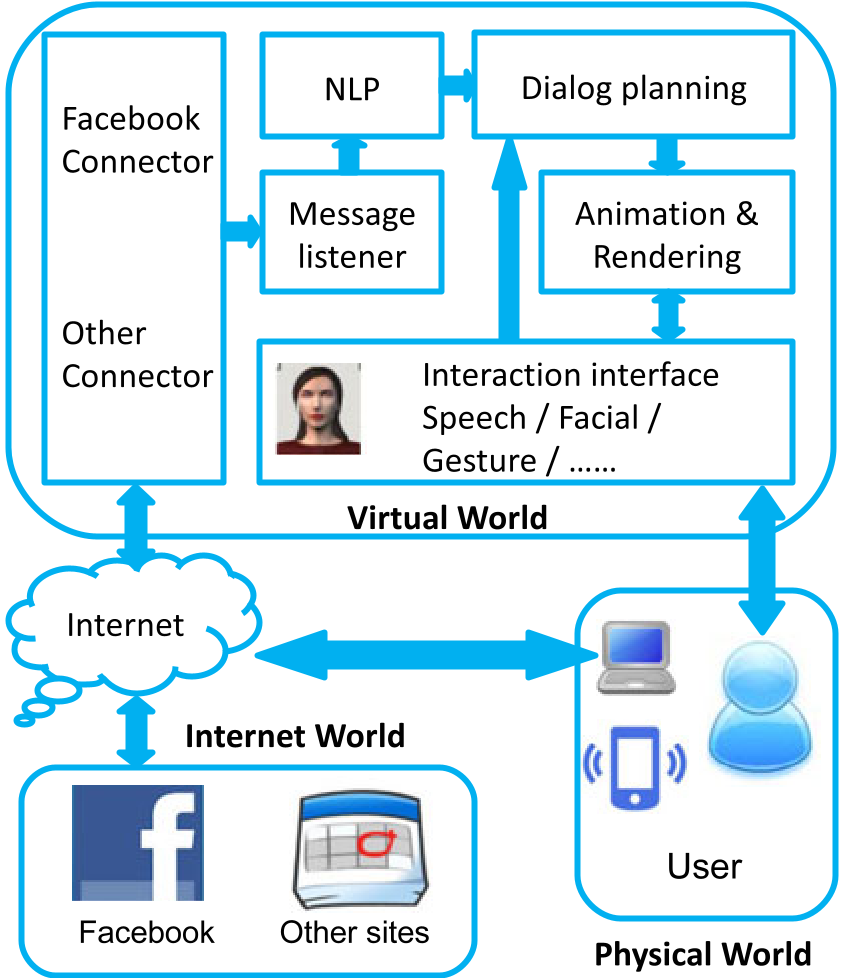 Figure: The framework connecting the physical world, virtual world, and social networking sites.
2. Emotional Intelligence
Sophie doesn't just read text; she senses mood. Using a Multinomial Naive Bayes classifier trained on datasets like ISEAR, the system categorizes status updates into five states: neutral, anger, fear, joy, and sadness. If a user posts something sad, Sophie is programmed to show empathy, perhaps suggesting a comedy movie to cheer them up.
Experiments: Does it Actually Work?
The researchers conducted two primary studies. In Study I, they compared a "Facebook-aware Sophie" against a "Standard Sophie."
Key Results:
- Rapport: Users felt a significantly stronger bond when Sophie mentioned their friends or specific movie likes retrieved from their profile.
- Trust in Recommendations: The "Social" Sophie had a much higher success rate in recommending movies. Because she knew the user liked Quentin Tarantino, her suggestion of Django Unchained felt personalized rather than random.
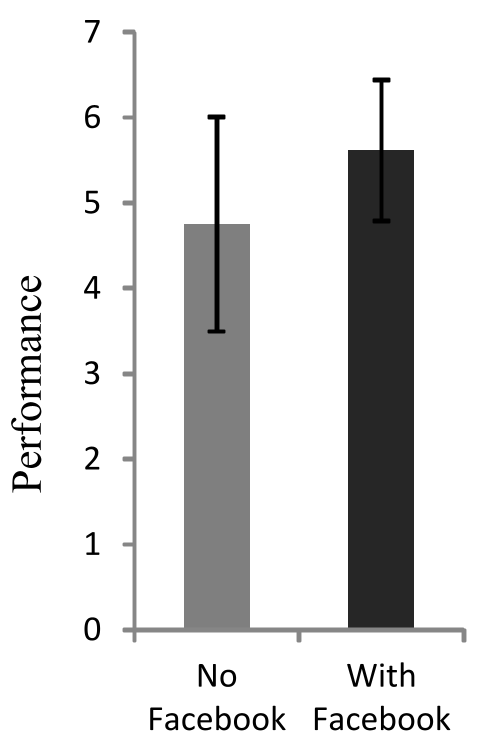 Figure: Comparative analysis showing higher scores for Rapport, Impression, and Recommendation acceptance in the Facebook-aware group.
Critical Insight: The Digital Mirror
The brilliance of this work lies in treating social media as a sensor. Just as a camera senses a user's face, Facebook senses a user's "social state." By weaving this data into Communication Primitives, the agent moves from being a tool to being a "modern human" interface.
Limitations and Future Outlook
While groundbreaking for its time, the study noted that Sophie’s voice (TTS) remained somewhat robotic. Additionally, the sentiment analysis (at ~74% accuracy) has been vastly surpassed by modern Transformers (like BERT or GPT-4).
The takeaway for today's developers is clear: Context is King. As we move into an era of LLM-powered NPCs and digital twins, the ability to pull in a user's real-world history and "social graph" will be the deciding factor in creating truly believable virtual entities.
Summary
"Let’s Keep in Touch Online" isn't just a title; it's a blueprint for the future of HCI. By linking our 2D social footprints with 3D virtual avatars, the researchers proved that empathy and personalization are the keys to overcoming the "Uncanny Valley" of social interaction.