
Beyond Technology: The Psychological Drivers of Facebook Continuance
A study of the social networking website service in digital content industries: The Facebook case in Taiwan
This study proposes a modified DeLone and McLean (D&M) Information Systems success model to investigate the drivers of continuance usage on Social Networking Services (SNS), specifically Facebook. It confirms that system quality, information quality, and privacy protection services are significant predictors of user satisfaction and social interaction benefits.
TL;DR
Why do we keep coming back to Facebook despite constant technical shifts? This research reconstructs the classic DeLone and McLean (D&M) IS Success Model to prove that for Social Networking Services (SNS), psychological "stickiness" is driven more by Privacy Protection and Social Interaction Benefits than by technical features alone.
Background: The Shift from Utility to Interaction
In the early days of Information Systems (IS), success was measured by how well a tool helped a worker complete a task. However, in the era of Web 2.0, systems like Facebook serve a different master: the human need for connection. The authors identify a gap in existing literature: while we know why people join a network, we are less certain about why they stay, especially when faced with privacy concerns and information overload.
The Research Insight: Trust and Social Capital
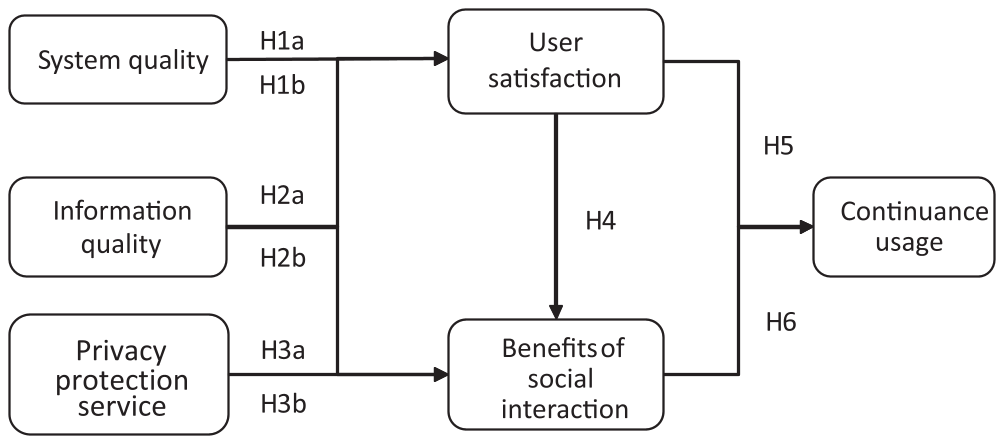
The core innovation of this study is the modification of the D&M model to include:
- Privacy Protection Service: Moving beyond just "reliability" to "trustworthiness."
- Benefits of Social Interaction: Measuring the "Net Benefits" not in terms of productivity, but in terms of social capital gained.
The Conceptual Framework
Historically, the D&M model focuses on System, Information, and Service Quality. This paper repositions Privacy as a critical service quality component.
Methodology and Findings
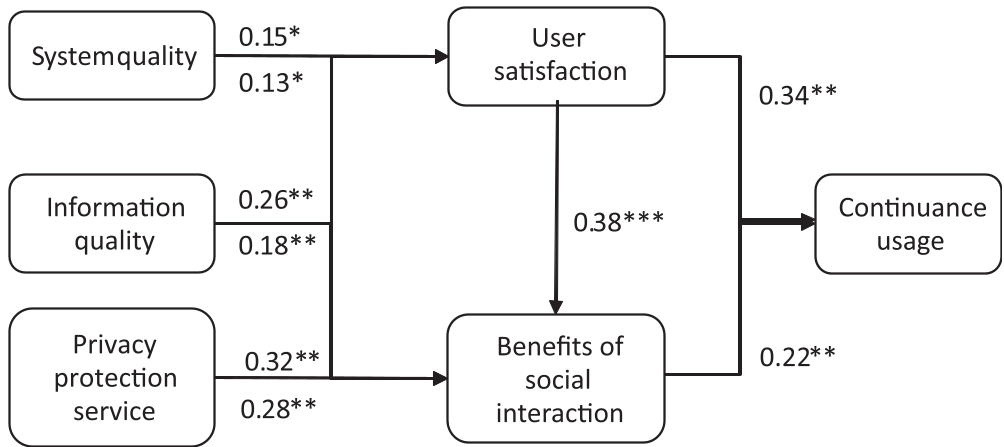
The study utilized Structural Equation Modeling (SEM) to analyze data from 346 participants in Taiwan. The results reveal a clear hierarchy of influence:
- The Power of Privacy: Privacy protection service had a stronger impact on user satisfaction ( = 0.32) than either system quality or information quality. If users don't feel safe, they don't feel satisfied.
- Social Interaction is the "Hook": User satisfaction strongly predicts the perceived benefits of social interaction. These benefits, in turn, are what keep users from abandoning the platform.
- The Quantitative Evidence: The structural model fit indices (CFI = 0.886, GFI = 0.887) validate that this modified framework accurately captures the complexities of modern digital content consumption.
Critical Analysis: Psychological vs. Technical
The most striking takeaway is the authors' assertion that "psychological rather than technical factors are more important in digital content industries."
While developers often obsess over "System Quality" (loading speeds, UI smoothness), this study suggests that a platform with minor lag but superior privacy controls and high "social utility" will likely outlast a faster competitor that fails to foster meaningful human connection.
Limitations and Future Horizons
The study is cross-sectional, providing a snapshot in time (Taiwan, 2012). Since then, we've seen:
- The rise of algorithmic feeds which change "Information Quality."
- The introduction of Short-form Video (TikTok) which shifts "Social Interaction" from active to passive.
Future research should apply this model to these "attention-economy" platforms to see if privacy still holds the same weight when users are seeking entertainment over connection.
Conclusion: Design for People, Not just Users
For practitioners, the message is clear: To ensure Continuance Usage, you must design for the human psyche.
- Enhance Trust: Standardize and simplify privacy settings.
- Maximize Interaction: Create "dynamic loops" (like social games or interactive features) that reward users for connecting with others.
Privacy is not just a legal hurdle—it is a cornerstone of the modern user experience.