
Facebook Meets the Virtualized Enterprise: The Dawn of Social Cloud Computing
Facebook Meets the Virtualized Enterprise
The paper proposes an IT model merging Web 2.0 social networking with internal "Cloud Computing" to modernize enterprise application access. It introduces a system where legacy applications are hosted as Virtual Appliances on scalable virtualized infrastructure and accessed via a social interface similar to the Facebook Platform.
TL;DR
This paper explores a visionary IT model that combines the intuitive, social nature of Web 2.0 (specifically Facebook) with the scalable power of Cloud Computing. By wrapping legacy applications into "Virtual Appliances" and exposing them through a social networking interface, the authors demonstrate how enterprises can improve employee productivity and resource utilization without sacrificing security or control.
Context: Released in 2008, this work sits at the critical intersection where enterprise IT began to feel the pressure of "consumerization"—the demand for professional tools to be as easy to use as personal social media.
Problem & Motivation: The Enterprise "Wall"
In the mid-2000s, a massive gap opened between the home computing experience (blogs, wikis, social networks) and the workplace. Enterprise IT was:
- Static and Fragmented: Every application had its own siloed infrastructure.
- Underutilized: Servers sat idle because they were provisioned for peak loads that rarely occurred.
- User-Unfriendly: Legacy "green-screen" or complex GUI applications required intensive training.
While social platforms like Facebook were exploding, companies were busy blocking them. The authors argue that instead of blocking the technology, we should adopt its mechanisms—the "Platform" model and "Social Connectivity"—to solve business problems.
Methodology: The Social-Cloud Architecture
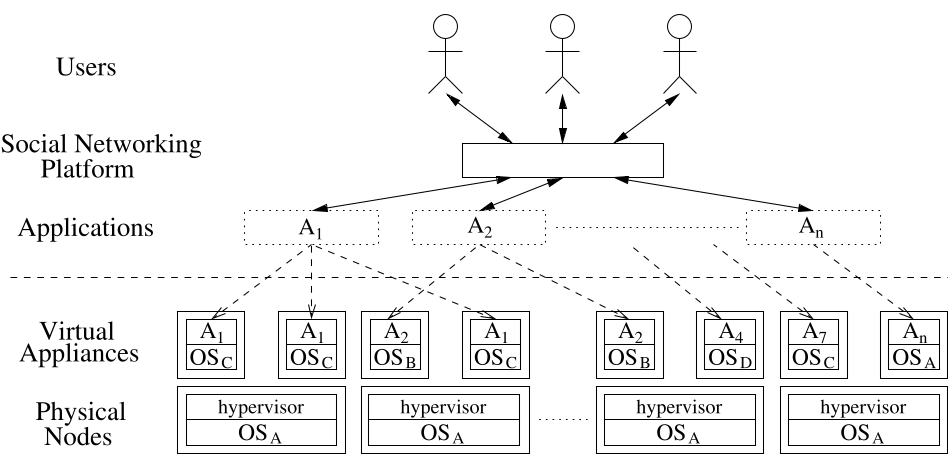
The researchers proposed a two-part architecture designed to bridge the gap between user flexibility and IT control.
1. The Social Front-End (Web 2.0)
Instead of a traditional portal, they used a social networking platform (Facebook) as the gateway. This allowed for Collective Intelligence: employees could rate applications, share simulation results, and collaborate on discussion boards, reducing the need for formal training.
2. The Internal Cloud Back-End (Virtualization)
To host applications, they proposed an Internal Cloud. Key components included:
- Virtual Appliances: Encapsulating the OS, application, and dependencies into a single VM image.
- UPO (Utility Provider Orchestrator): A management layer that dynamically launches or shuts down VMs based on real-time user demand.
- Legacy Bridging: Using VNC (Virtual Network Computing) to render existing desktop-based GUIs directly into the browser.
Case Study: The Fire Dynamics Simulator (FDS)
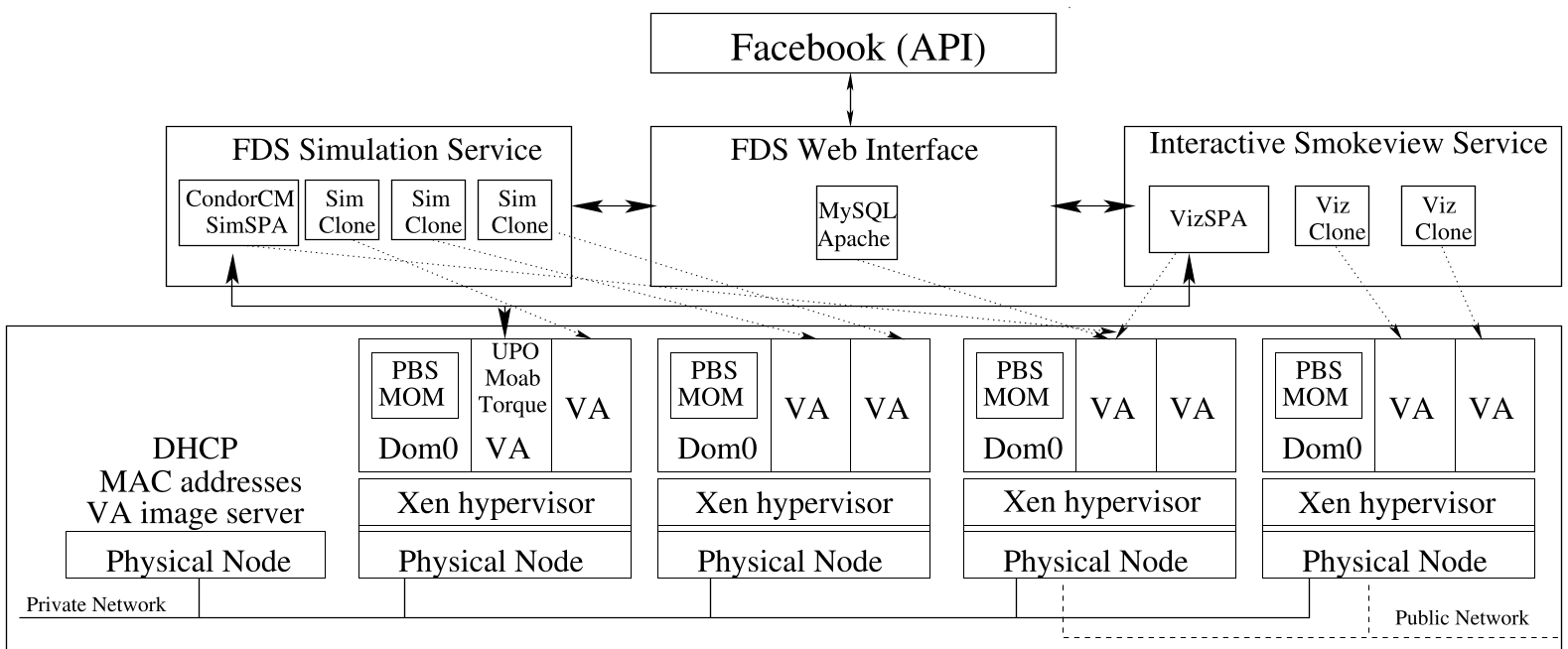
To prove the concept, the authors integrated FDS, a legacy NIST simulation tool, into Facebook.
- Scaling: When a user submitted a fire simulation, the Service Provider Agent (SPA) requested a new "SimClone" VM from the cloud.
- Visualization: Using a tool called Smokeview, users could interact with 3D renderings of fire and smoke directly inside their Facebook feed.
Experimental Insights & Results
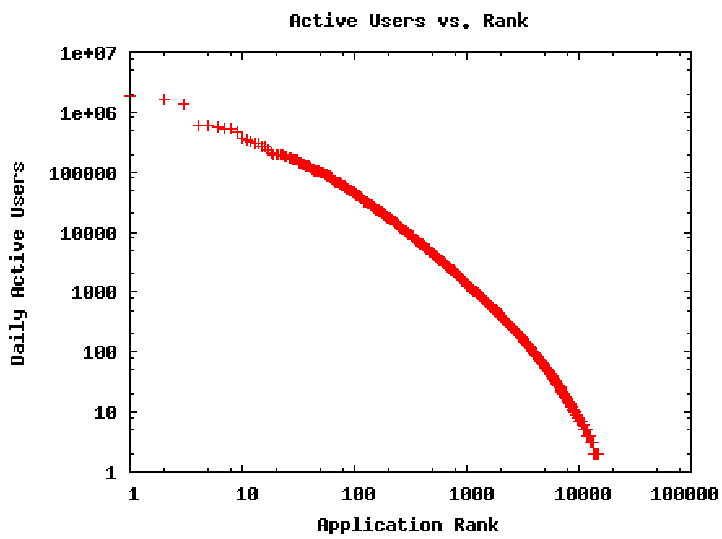
The paper highlights a crucial trend in application popularity (The "Long Tail"). As shown in the data below, most applications have fewer than 1,000 users, while a few have millions.
Key Results:
- Efficiency: By sharing a homogeneous physical resource pool among various applications, the "Internal Cloud" significantly reduced hardware costs.
- Management: IT no longer had to patch individual applications; they managed the physical hardware while developers provided updated Virtual Appliances.
- User Experience: Integrating simulation, results downloading, and 3D visualization into a "one-stop shop" (Facebook interface) removed technical friction for researchers.
Critical Analysis & Conclusion
This paper was a precursor to what we now know as SaaS (Software as a Service) and Private Cloud.
Takeaways:
- Consumerization is Inevitable: Employees work better when they use tools that feel like their personal social media.
- Virtualization is the Great Enabler: By decoupling the software from the hardware via Virtual Appliances, IT can stay "static and homogeneous" at the physical level while being "dynamic and heterogeneous" at the service level.
Limitations: The paper acknowledges that the specific use of public Facebook for enterprise apps was a security hurdle. However, it correctly predicted the rise of enterprise platforms like Slack, Microsoft Teams, and Workplace by Meta, which implemented these exact social-cloud principles years later.
Conclusion: The "Facebook Meets Enterprise" model represents a shift from "IT as a gatekeeper" to "IT as a platform provider," a fundamental evolution that defines the modern digital workspace.