
A Familiar Face(book): Why Your Profile High School Matters More Than Your Favorite Movie
A familiar Face(book): Profile elements as signals in an online social network
This seminal HCI paper investigates how profile elements on Facebook serve as social signals to articulate friendships. Using a dataset of over 30,000 users, it demonstrates that "referent" fields (like high school or hometown) are more predictive of social connectivity than personal taste or preference fields.
TL;DR
In this classic 2007 study from Michigan State University, researchers analyzed 30,773 Facebook profiles to determine what actually drives "friending" behavior. The verdict? Verifiable offline links (where you went to school, your hometown) are the heavy hitters of social signaling, significantly outperforming personal interests like music or movies in predicting a user's number of friends.
The "Cues Filtered In" Problem
Early internet theory suggested that online interactions were doomed to be impersonal because we couldn't see a person's dress, accent, or body language. However, Ellison, Lampe, and Steinfield argued that users simply adapted by "filtering cues back in" through their profiles. The real question was: Which cues actually matter?
The authors posited that profiles aren't just about self-expression; they are tools for reducing transaction costs. If I see you went to the same high school as me, the "cost" of verifying who you are and finding common ground drops to near zero.
Methodology: The Three Pillars of Profile Signaling
The researchers categorized Facebook's profile fields into three distinct indices based on their psychological and economic functions:
- Referents (Assessment Signals): Hard-to-fake data points that link you to the physical world, such as High School, Concentration (Major), and Residence Hall.
- Interests (Conventional Signals): Self-reported preferences like "Favorite Books" or "Political Views." These are "cheap" to produce and easier to fabricate.
- Contact Index: Functional data like AIM handles or email, signaling a willingness to move the connection off-platform.
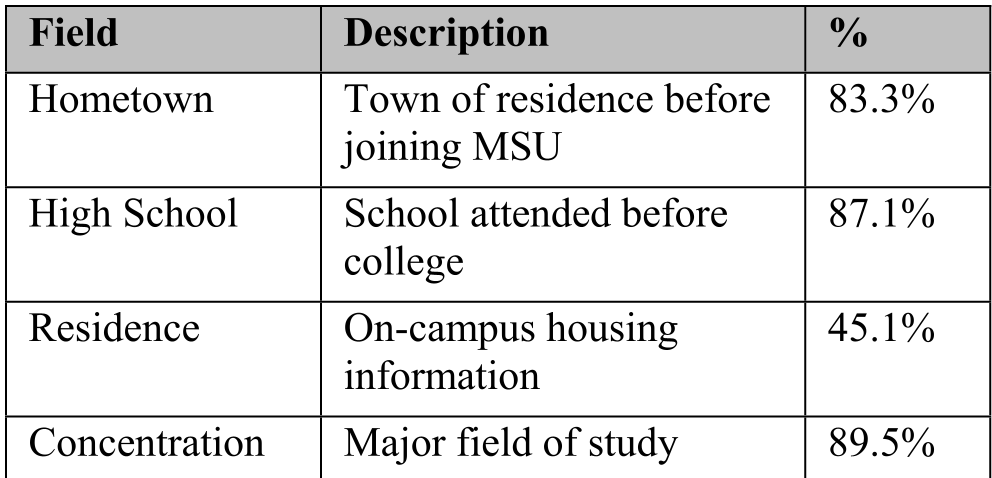
Key Results: The Power of Verifiability
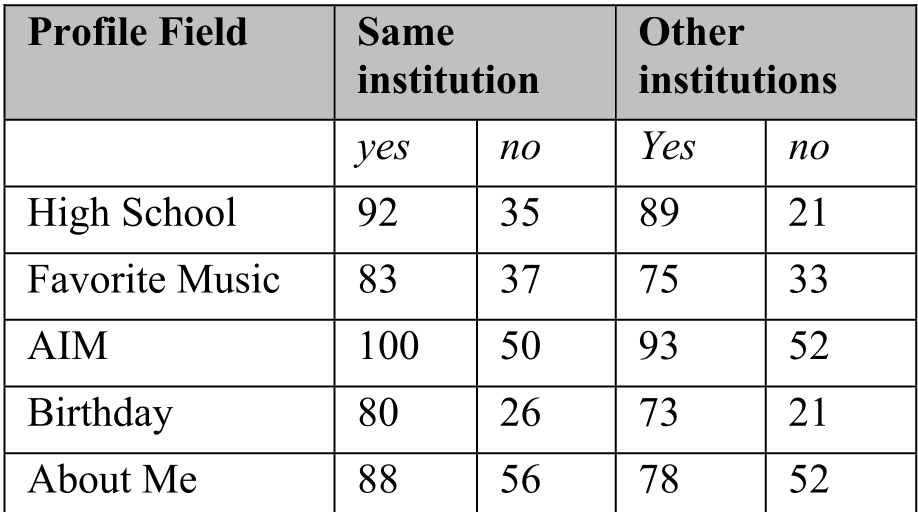
The most striking finding was the massive delta in social success based on the High School field. Users who listed their high school had a median of 92 friends at the same institution, compared to only 35 for those who left it blank.
Quantitative Impact:
- Undergraduate Dominance: Undergraduates naturally hold the highest friend counts (Median: 87 same-school friends) compared to alumni or faculty.
- The "Presence" Effect: Simply filling a field is more important than the amount of content within it. Once a user populates the "About Me" or "Interests" field, adding 50 more items provides diminishing returns for friend counts.
- Regression Rankings: In their OLS model, the Referents Index was the strongest predictor of friend count, followed by the Contact Index, with the Interests Index being the weakest.
Deep Insight: Signaling vs. Expression
Why did referents win? The authors lean on Signaling Theory. In an environment like Facebook in 2007 (which required a .edu email), the system was optimized for "social searching"—finding people you already knew or had "latent ties" with.
Referent fields function as Assessment Signals because they are indirectly verifiable by the shared community. If you lie about your dorm or major, someone in your network will likely notice. This verifiability builds the trust necessary to click the "Add as Friend" button. Interests, being Conventional Signals, are primarily used for playfulness or "image crafting," providing less functional utility for forming the initial link.
Critical Analysis & Future Outlook
This paper captured Facebook at its most "pure" institutional stage. Today, as platforms move toward algorithmic discovery (the "For You" page), the role of "Referents" is being replaced by behavioral data. We no longer need to see that someone likes "Citizen Kane" in their profile; the algorithm already knows and connects us through content loops.
Limitations: The study is a snapshot in time. It doesn't account for why users chose to keep profiles private (19% of the population) or the quality of the friendships articulated.
Conclusion for Designers: If you want to build a sticky social network, don't just ask users what they like. Ask them where they've been. The most powerful social glue isn't a shared hobby; it's a shared history.