
Mining the Spark: Sentiment Classification of Tunisian Facebook Statuses During the Arab Spring
Social Networks' Facebook' Statutes Updates Mining for Sentiment Classification
This paper presents a sentiment classification framework tailored for Facebook status updates, specifically focusing on Tunisian users during the "Arab Spring" (2011). The authors propose a machine learning pipeline using Support Vector Machines (SVM) and Naive Bayes, supported by a custom-built sentiment lexicon of emoticons, acronyms, and interjections.
TL;DR
This research investigates the digital pulse of the Tunisian Revolution by classifying the sentiments of Facebook status updates from late 2010 to early 2011. By testing SVM and Naive Bayes against various n-gram combinations and a custom-built informal lexicon, the study identifies that SVM with unigrams yields the most reliable results for understanding public emotion during periods of intense social upheaval.
Background: The Digital Frontline
The "Arab Spring" was not just a series of physical protests but a digital phenomenon. In Tunisia, Facebook served as a "magic tool" for freedom of speech. However, analyzing this data is notoriously difficult due to the brevity of posts and the heavy use of informal language—acronyms, emoticons, and interjections that traditional NLP toolkits often overlook.
The Core Insight: Lexicon vs. Complexity
The author's primary intuition is that in high-emotion, short-form text, the "standard" vocabulary is only half the story. To solve this, the study introduces a specialized preprocessing layer:
- Lexicon Development: Manually annotated tables for acronyms (e.g., LOL, CU), emoticons (e.g., :), :'( ), and interjections (e.g., Wow, No way).
- Binary Presence over Frequency: Instead of counting how many times a word appears (TF), the model simply marks if it exists (0 or 1), a technique proven more effective for short status updates.
Methodology & Architecture
The researchers followed a five-step workflow: raw data collection, lexicon development, feature extraction (including stemming and stop-word removal), model training, and comparative evaluation.
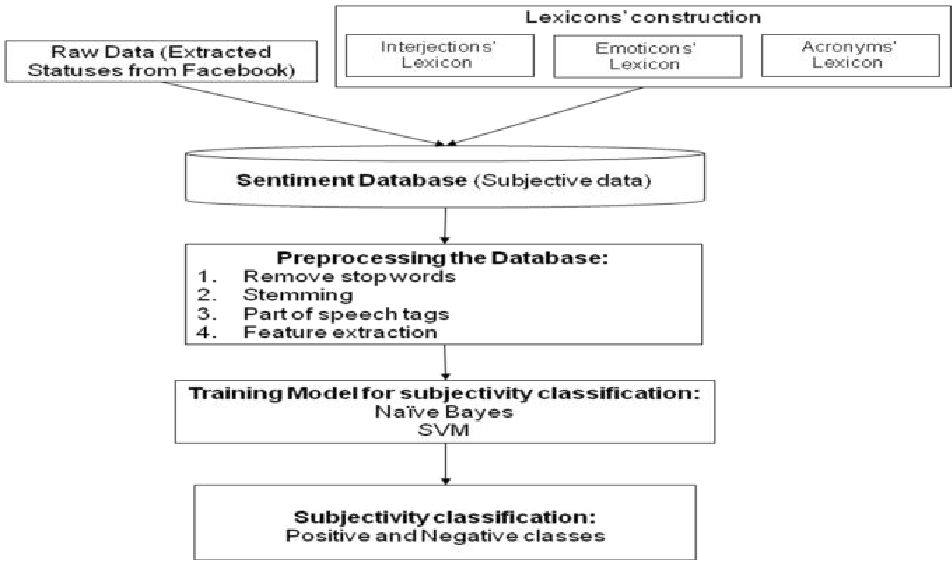
The study specifically tested seven feature sets, ranging from simple unigrams to a full combination of unigrams, bigrams, and trigrams, seeking to find the "sweet spot" where linguistic context meets computational efficiency.
Experimental Analysis: SVM vs. Naive Bayes
Using the WEKA toolkit and 10-fold cross-validation, the results revealed a clear discrepancy between the two algorithms:
| Feature Set | NB Accuracy | SVM Accuracy |
|---|---|---|
| Unigrams | 68.35% | 72.78% |
| Bigrams | 69.42% | 66.87% |
| Trigrams | 64.33% | 57.32% |
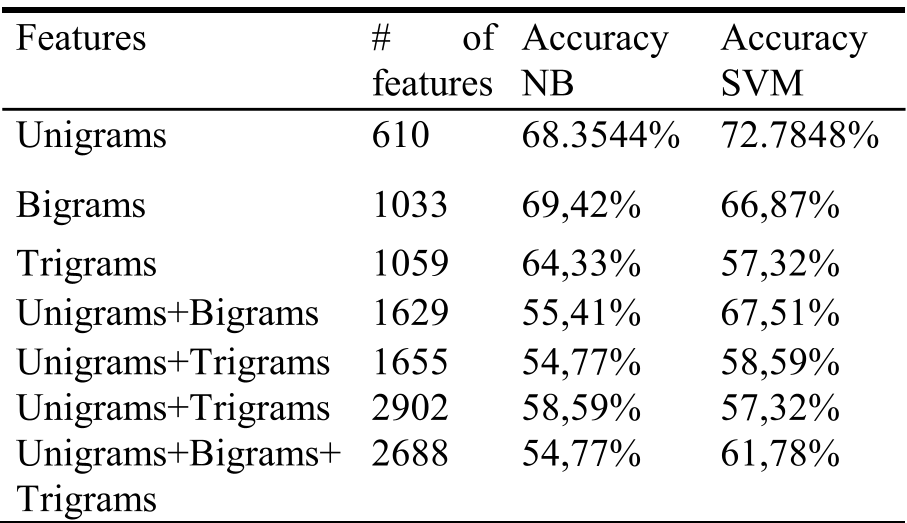
Why did SVM win with Unigrams?
SVM (Support Vector Machines) excels at finding the optimal hyperplane in high-dimensional spaces. In the case of unigrams, it effectively isolated sentiment-heavy keywords. As the feature set grew more complex (Unigrams+Bigrams+Trigrams), the accuracy of both models tended to fluctuate or degrade, likely due to the "curse of dimensionality" and the relatively small size of the specialized dataset (approx. 260 statuses).
Critical Insight & Future Outlook
While the paper demonstrates the effectiveness of classical Machine Learning in high-stakes social mining, it also highlights the informality gap. Traditional stemming and stop-word removal can sometimes strip away the very "soul" of a social media post.
Takeaway for Practitioners:
- Context is King: In regional sentiment analysis, building a custom lexicon of emoticons and local slang is more impactful than simply increasing model complexity.
- Simplicity Scales: For short-form text, increasing n-gram size often introduces noise rather than signal.
Limitations: The dataset size is relatively small, which prevents the application of modern Deep Learning techniques. Future work should integrate temporal features to track how sentiment shifts dynamically hour-by-hour during a crisis.
Conclusion
This work provides a foundational look at how technology can be used to decode the collective state of mind of a nation in revolt. By combining machine learning with human-annotated sentiment lexicons, we can transform a chaotic wall of text into actionable insights for sociologists and policy makers alike.