
Facebook vs. Twitter: How Personality and Affect Shape Our Digital Footprints
Facebook vs. Twitter: An Examination of Differences in Behavior Type and Substance Based on Psychological Factors
This study investigates behavior differences between Facebook and Twitter users (n=662) by correlating platform activity types and topics with Big Five personality traits and trait affect (PANAS-X). It provides a direct comparison of how psychological profiles influence digital engagement across the two dominant social networks.
TL;DR
In this exploratory study, researchers from the University of Washington reveal that our behavior on Facebook and Twitter is not just a choice of platform, but a reflection of our deep-seated psychological traits. While Facebook tends to attract more agreeable, socially conformist interactions, Twitter serves as a significant outlet for individuals with high "Negative Affect" and Hostility, likely due to its anonymity and structural dissociation.
The "Why" Behind the Post: Problem and Motivation
Why do some people use Twitter to vent frustrations while others use Facebook to share "heartwarming" family updates? Existing literature has long linked social media to depression and well-being, but the mechanistic link between a user's stable psychological profile (trait affect and personality) and their specific platform behaviors (liking, sharing, commenting) has been fuzzy. The authors argue that the structural differences—Facebook's "stay-in-touch" culture versus Twitter's "anonymous broadcast" nature—create distinct environments that attract and shape different psychological expressions.
Methodology: Beyond just the "Big Five"
The study recruited 662 participants via Amazon Mechanical Turk. Instead of just looking at the standard Big Five personality traits, the authors integrated the PANAS-X (Positive Affect Negative Affect Schedule - Expanded form). This allowed them to measure not just broad "happiness" or "sadness," but lower-order dimensions like Hostility, Guilt, Joviality, and Fear.
To ensure the topics being discussed were categorized accurately, they used the Delphi Technique, a consensus-building method that identified seven core content categories: Funny, Heartwarming, Informational, Political, Controversial, Happy, and Sad.
Key Insights: The Psychological Divide
The analysis yielded several striking findings that highlight the "personality" of the platforms themselves:
1. The Twitter Venting Machine
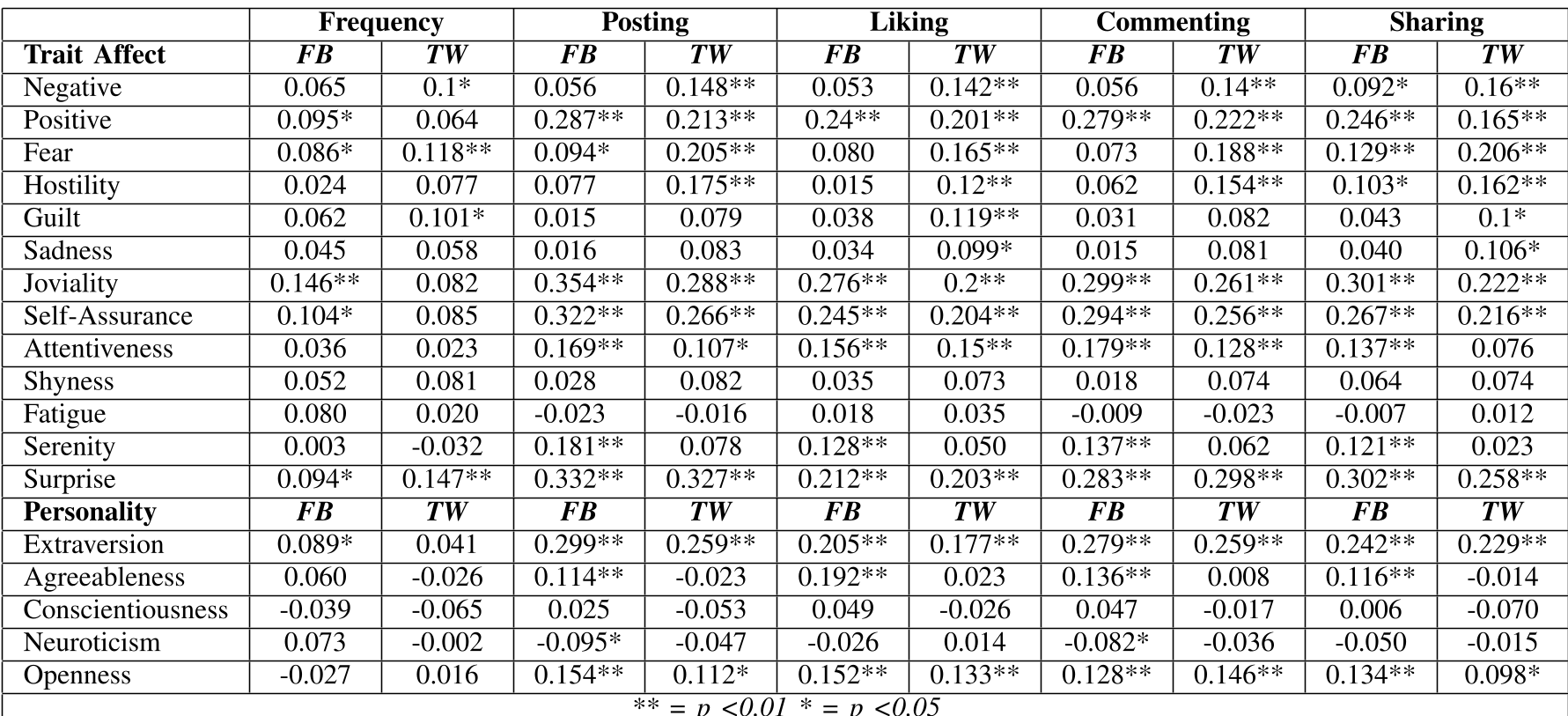
The data shows that individuals with high Trait Negative Affect, Hostility, and Fear are significantly more active on Twitter. Unlike Facebook, where these traits might be dampened by social pressure from family and friends, Twitter's anonymity allows these users to "comment," "like," and "share" at a much higher frequency (p < 0.01).
2. Facebook: The Agreeable Bubble
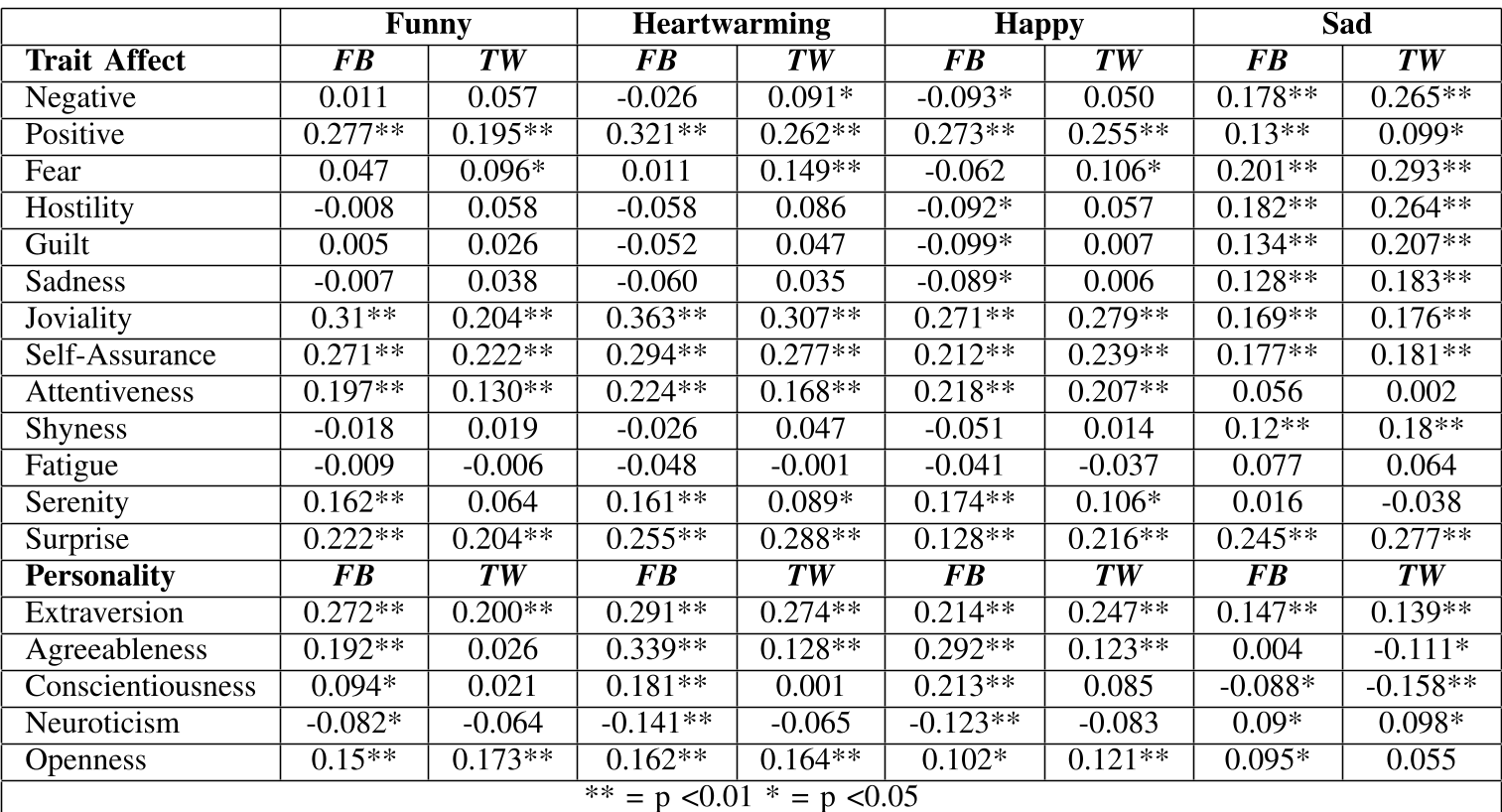
Agreeableness was strongly associated with positive content on Facebook (Heartwarming, Happy, Funny), but had almost no significant correlation with Twitter activity. This suggests that Facebook is a primary environment for those who wish to maintain social harmony and conform to positive social norms.
3. Neuroticism and the "Sad" Topic Link
Interestingly, while high Neuroticism led to less overall posting and commenting on Facebook (perhaps due to social anxiety), it was consistently linked to a higher engagement with "Sad" topics on both platforms. This suggests that neurotic users don't necessarily use social media more, but they do consume or interact with more negative content.
Experimental Results & Statistical Significance
The study highlights that Extraversion and Trait Positive Affect (Joviality, Self-Assurance) are universal drivers. People with these traits are more active across both platforms, regardless of the topic. However, the divergence appears in specific behaviors:
- Sharing Content: Users with high Trait Negative Affect and Hostility were significantly more likely to share/retweet content on Twitter (p < 0.01) compared to Facebook.
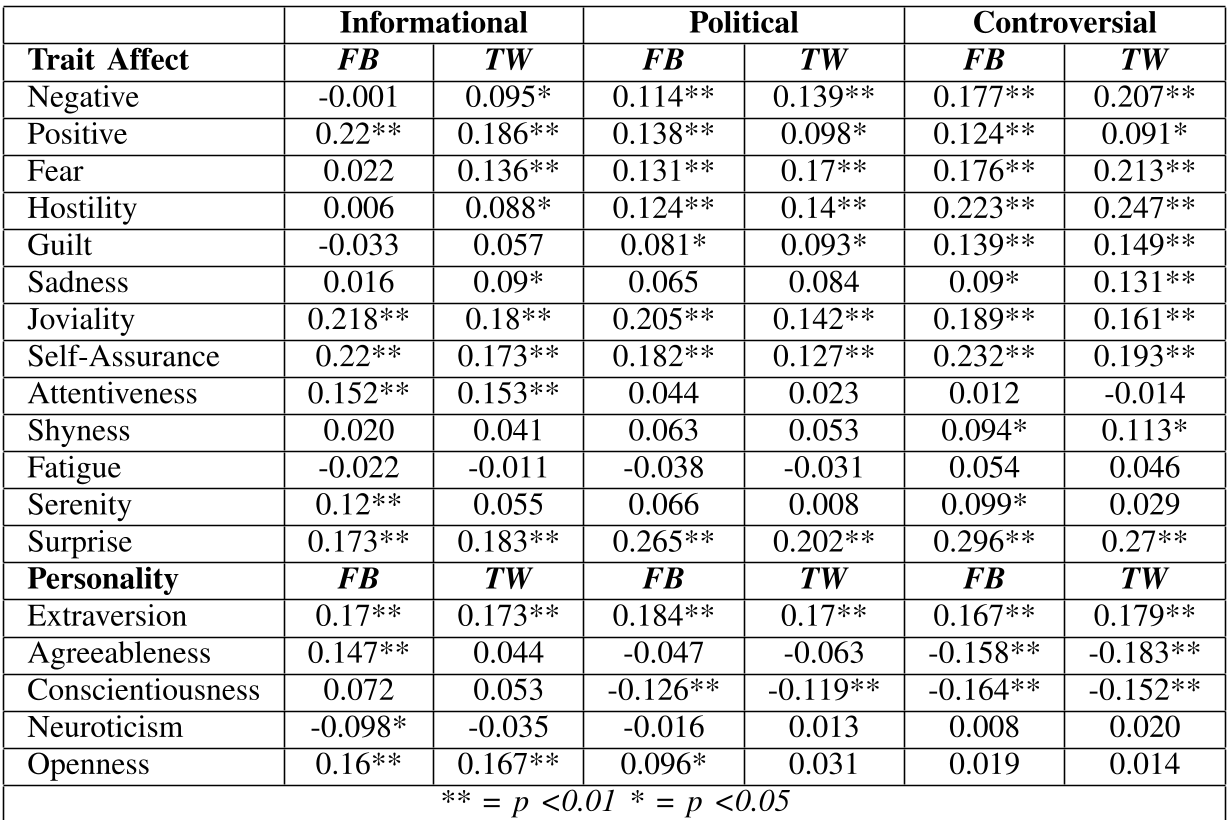
- Political/Controversial Engagement: Negative affect was a strong predictor for engaging in controversial and political content across both sites, but the effect was consistently more pronounced on Twitter.
Critical Analysis & Conclusion
This work provides a crucial bridge between digital behavior and psychology. It suggests that platform designers aren't just building tools; they are building psychological ecosystems.
Takeaway: If you want a platform that promotes civility, structure it around real-world identities and longer discussions (like Facebook). If the goal is a rapid-fire release of sentiment—for better or worse—anonymity and character limits (like Twitter) will inevitably attract more aggressive and negative trait-heavy behaviors.
Limitations: The study relies on self-reported data which can be subject to recall bias. Future research using actual API-harvested user data would provide an even more objective view of these psychological correlations.