
The "Stranger Danger" of Social Media: How Your Social Circles Dictate Your Comments
On commenting behavior of Facebook users
This paper presents a measurement study on Facebook commenting behavior, specifically analyzing how social homophily influences user interaction. By utilizing community detection on the ego networks of 50 volunteers, the authors demonstrate that users are significantly more likely to comment on a post if previous comments were made by members of their own social circle.
TL;DR
Why do you scroll past a close friend's post without commenting? It might not be the content—it might be the other people in the comment section. This paper quantifies the "Homophily Effect" on Facebook, proving that we are far more likely to engage when we see our own "tribe" already talking. Using community detection on 50 volunteer profiles, the authors show that social influence significantly trumps random interaction.
Problem & Motivation: The Myth of the "Homogeneous Friend"
Facebook treats your boss, your high school best friend, and your local barista as a single category: Friends. In reality, our social lives are segmented into distinct silos.
The authors identify a major pain point in Online Social Networks (OSNs): Social Selection vs. Social Influence.
- Social Selection: We pick friends like us.
- Social Influence: We change our behavior to match our friends.
When these two forces collide, they create Homophily. The researchers hypothesized that if a user sees a comment thread dominated by people from a different social circle, they experience a psychological barrier to entry, fearing their comment will be "lost" or "out of place."
Methodology: Mapping the Ego Network
To test this, the team developed a "Facebook Content Sharing Survey" app to extract the Mutual Friendship Graphs (MFG) of 50 volunteers.
1. Community Detection
They didn't just look at total friends; they used algorithms to find clusters:
- Girvan-Newman (GN): Finds edges that act as "bridges" between groups and cuts them.
- Iterative Conductance Cutting (ICC): Splits clusters based on the tightness of internal vs. external links.
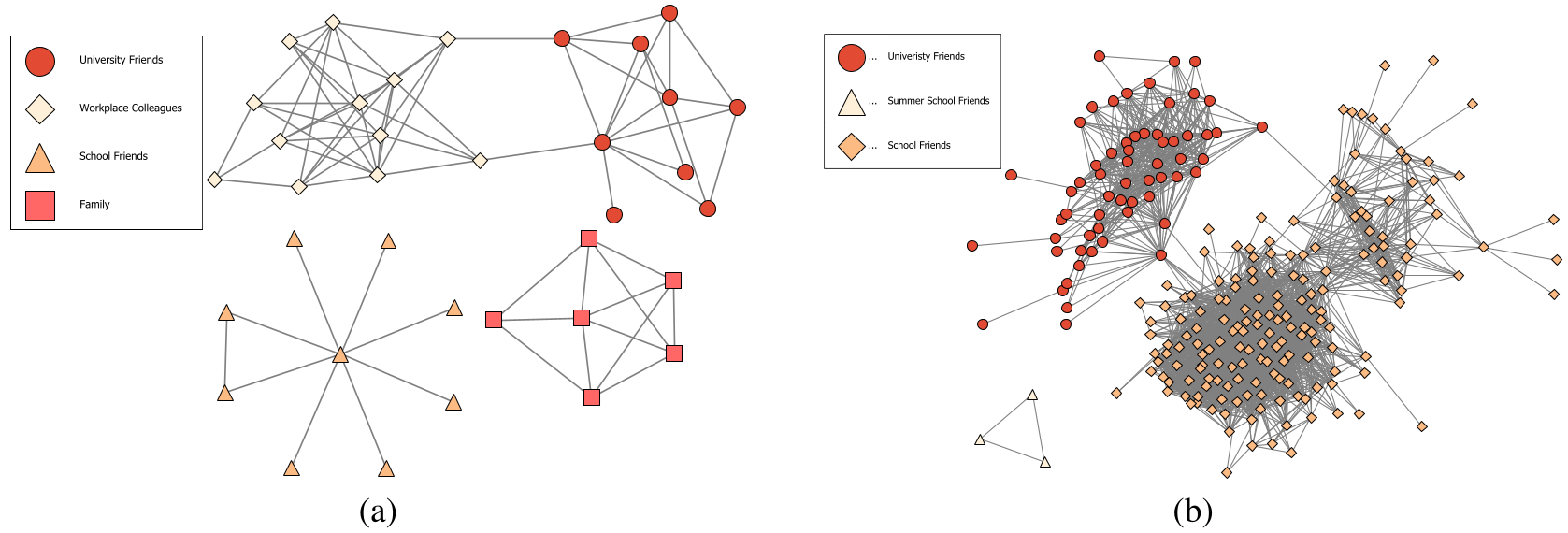 In the figure above, you can see how a user's friends naturally gravitate into 3 or 4 distinct clusters.
2. The Probability Model
The authors modeled the decision to comment as a Bernoulli trial: .
- N: Total comments already on the post.
- Y: Comments from the user's specific community.
Results: The "Tribe" Effect
The data from 5,778 status updates confirmed the hunch: Peer presence acts as a catalyst.
While a single comment () has an ambiguous effect, a clear trend emerges as the thread grows. When a post has 4 comments (), the probability of a user commenting is highest when all 4 previous commenters belong to their own community (), and lowest when none do ().
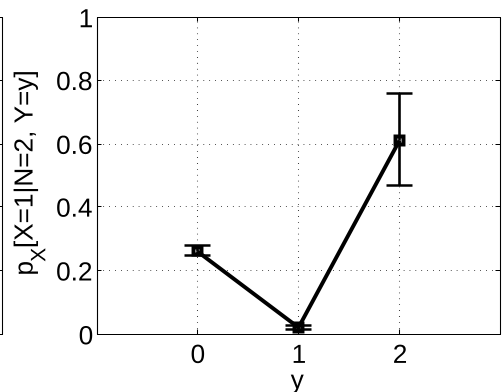 Graphs (b), (c), and (d) show a steady upward slope: the more "community mates" that comment, the more likely you are to join in.
Qualitative feedback from the survey participants provided the "Why":
- "I wouldn’t want to... intrude on another group’s conversation."
- "My comment would probably get lost among [unknown people]."
Critical Analysis & Conclusion
Takeaway
This study provides empirical evidence that Facebook’s "one-size-fits-all" comment section actually stifles interaction. Users aren't just reacting to the post; they are reacting to the audience.
Limitations
- Content Neutrality: The study assumes the content of the post doesn't matter (due to privacy/anonymization), but we know that a post about a "Wedding" will naturally attract different groups than a post about "Work."
- Algorithm Bias: Heuristic-based community detection (GN vs. ICC) yields different results, suggesting that how we define a community changes our understanding of the behavior.
Future Outlook
For product designers, the message is clear: Context is King. Future OSNs should allow for "Group-Aware Vertical Threads" or focused sharing where visibility is tailored to the community structure to revive engagement in an era of digital fatigue.