
Facebook: From Social Hub to Information Engine?
Perceptions of facebook's value as an information source
This study investigates the usage of Facebook as a "social search engine" for everyday information needs. Using a survey of 614 university staff, the researchers explore how bridging social capital and directed communication predict information-seeking behaviors, identifying specific demographic and behavioral differences between high and low information seekers.
TL;DR
Is Facebook just for cat photos and life updates, or is it a legitimate tool for solving everyday problems? This study examines how university staff use their social networks to find information on everything from health to business referrals. The researchers find that your Bridging Social Capital—the diversity of your loose connections—and your Signals of Relational Investment (the "work" you put into your network) are the primary drivers of turning social ties into informational assets.
Contextual Positioning
Published at CHI '12, this work sits at the intersection of Human-Computer Interaction (HCI) and Sociology. It moves beyond the "What" of Facebook use into the "Why" and "How" of social search, building on Granovetter's "Strength of Weak Ties" and Robert Putnam's Social Capital theories.
The Problem: The Cost of Information Seeking
Traditional information-seeking models (like search engines) often lack context and trust. The authors argue that while search engines provide facts, they don't provide recommendations tailored to the asker's specific life. However, asking a social network has a "social cost." The dilemma is: when do users feel comfortable enough to "bother" their network for information, and what makes some people more successful at it than others?
Methodology: The Mechanics of Social Capital
The researchers surveyed 614 individuals, measuring:
- Bridging Social Capital: The ability to access new ideas and diverse perspectives.
- SRI (Signals of Relational Investment): Actions like wishing someone a happy birthday or liking a post—effectively "maintaining the machinery" of the relationship.
- Appropriateness: Whether the user believes Facebook is a valid place for "serious" questions.
The Interaction Effect
One of the most profound insights of the paper is the interaction between SRI and Appropriateness.
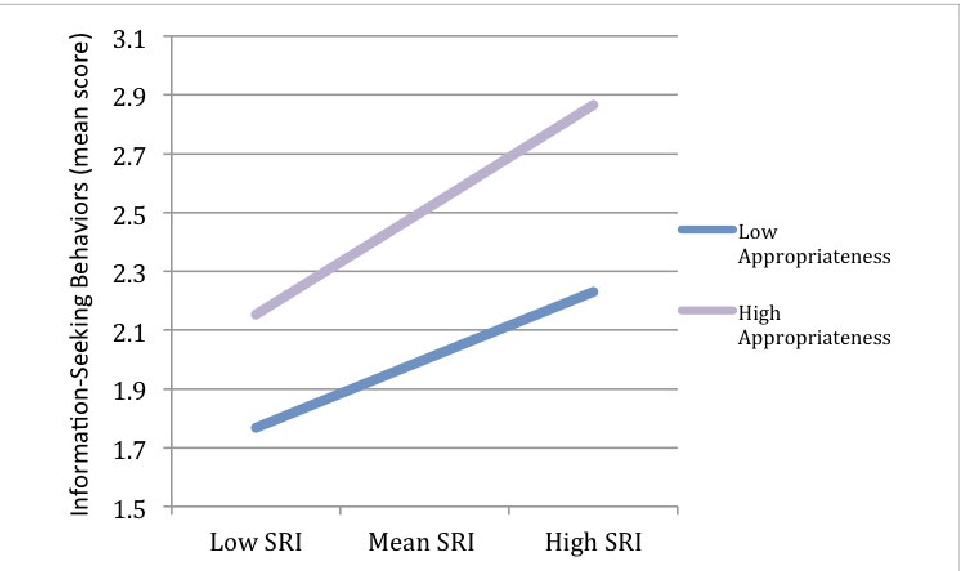 Figure 1: Simple slope analysis showing that users only reap the information benefits of their social grooming (SRI) if they also perceive the platform as an appropriate place to ask questions.
Experiments & Results: High vs. Low Seekers
The study divided users into quartiles to see what separates the "Power Seekers" from the passive scrollers.
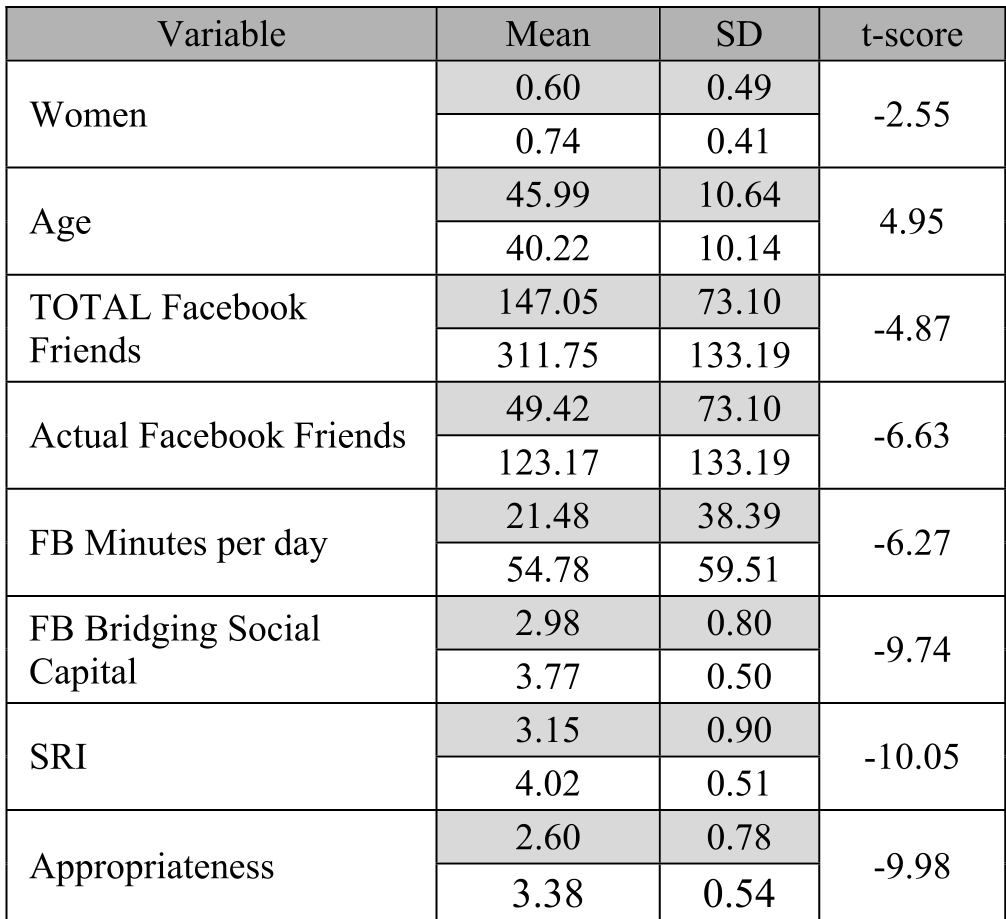 Table 4: High vs. Low Information Seekers. High seekers had nearly double the "Actual Friends" (123 vs 49) and spent significantly more time on the platform (54 vs 21 mins).
Key Takeaways from the Data:
- Age and Gender: High seekers were generally younger and more likely to be female.
- Reciprocity: The "Information Usefulness" of Facebook (Score: 3.54/5) was higher than the actual "Information Seeking Behaviors" (Score: 2.30/5), suggesting that many people get value incidentally without even asking.
Deep Insight: "Grooming" your Network
The paper introduces the concept of "Social Grooming." Just as primates groom each other to maintain social bonds, Facebook users "groom" their network by liking posts and sending messages. This isn't just vanity; it's a strategic investment. When you eventually ask, "Does anyone know a good plumber?", those you have "groomed" are significantly more likely to respond.
Limitations & Future Outlook
The study acknowledges that university staff represent a specific demographic. Furthermore, the data was collected via self-reporting rather than direct observation of server logs.
The Future of SNS Design: The authors suggest that Facebook’s News Feed algorithm should perhaps prioritize "informational" updates—like questions—across diverse clusters to maximize the utility of the network. As we move into an era of AI-driven search, the human-vetted, high-trust nature of social search identified in this paper remains a critical differentiator for platforms.
Final Summary
To get the most out of a social network, you can't just be a "lurker." Successful information seeking requires active engagement, a diverse network of weak ties, and a mental shift in viewing social media as a professional and practical toolkit.