
Beyond Fact-Checking: Neutralizing Misinformation with Emotional Pedagogical Agents
Fact Checking Misinformation Using Recommendations from Emotional Pedagogical Agents
This paper introduces a novel fact-checking recommendation system that combines crowd-sourced social collaborative argumentation with "Emotional Pedagogical Agents" (PAs). By integrating Multi-Attribute Utility Theory (MAUT) and sentiment analysis, the system provides personalized stances on controversial topics to mitigate misinformation and cognitive biases.
TL;DR
In an era of "alternative facts," simply presenting data is often insufficient to change minds. This paper proposes a system that goes beyond binary true/false labels by using Emotional Pedagogical Agents and Multi-Attribute Utility Theory (MAUT). By modeling both the semantic strength of an argument and the emotional profile of the user, the system guides users through controversial topics—like political crowd sizes or scientific myths—in a way that respects their psychological state while encouraging critical thinking.
The "Backfire Effect": Why Facts Aren't Enough
The core motivation behind this research is a frustrating psychological reality known as the Backfire Effect. When people are confronted with evidence that contradicts their deeply held beliefs, their original opinions often become stronger rather than weaker.
Traditional fact-checking fails because it treats humans as rational logic processors. The authors argue that to combat misinformation effectively, we must:
- Address the Role of Emotion: Recognize that reasoning is an affective process.
- Enable Lateral Reading: Avoid deep dives into single sources in favor of broad, multi-attribute assessments of credibility, authority, and trust.
Methodology: Fusing Math with Psychology
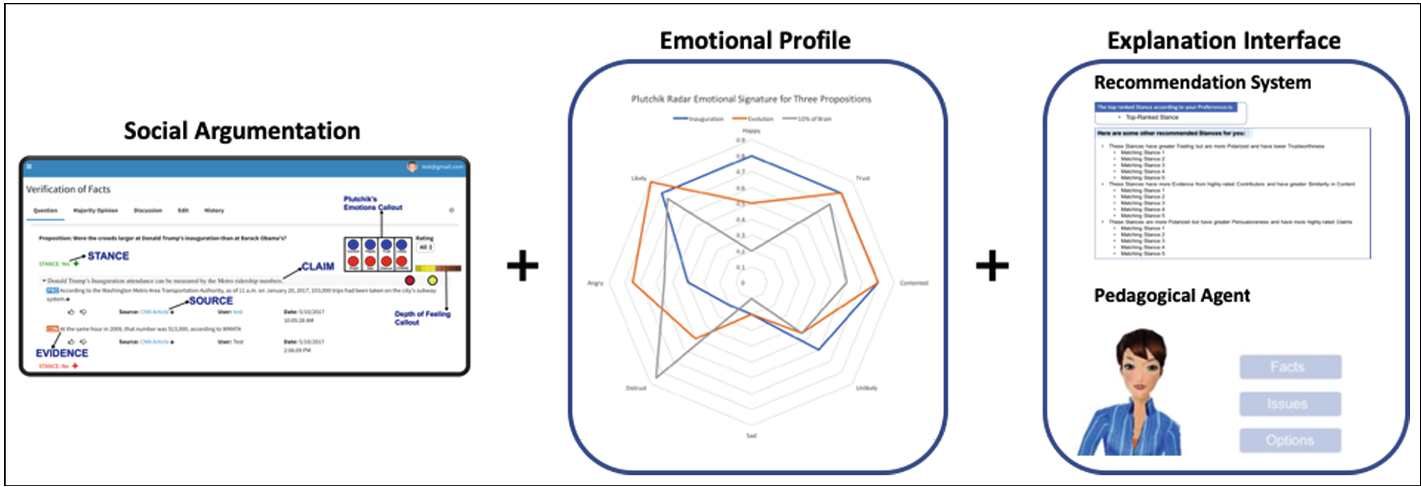
The system architecture is a three-tier framework that moves from raw data to human guidance.
1. The Argumentation Graph
Instead of flat text, the system uses a graph where nodes represent Claims, Evidence, and Sources. This allows for a structured "Semantic Profile" that tracks the authority and trust of contributors.
2. The MAUT Recommendation Engine
At the heart of the system is a utility model based on Multi-Attribute Utility Theory. The goal is to determine the "Utility" () of a specific stance () for a viewer ().
The formula used to calculate this utility balances the viewer's attribute preferences () with the sentiment model values ():
This allows the system to weigh evidence not just on "truth" but on how it aligns with the user's emotional and cognitive priorities, making the recommendation more persuasive and less likely to trigger a defensive response.
3. Emotional Pedagogical Agents (PAs)
The most innovative aspect is the delivery mechanism. Users interact with a PA—a virtual mentor. These agents can be customized with different "personalities" (e.g., Angry Independent, Friendly Republican).
The PA uses the recommendation engine's output to explain why it is showing a specific stance. Instead of saying "You are wrong," the agent might say, "This stance has more evidence from highly-rated contributors and covers areas you haven't explored yet."
Results and Insights
The study highlights the necessity of Diversity (D) in recommendations. Using a specific diversity calculation (Eq 4), the system ensures that the categories of stances presented are sufficiently different from one another, preventing the creation of new "echo chambers" within the tool itself.
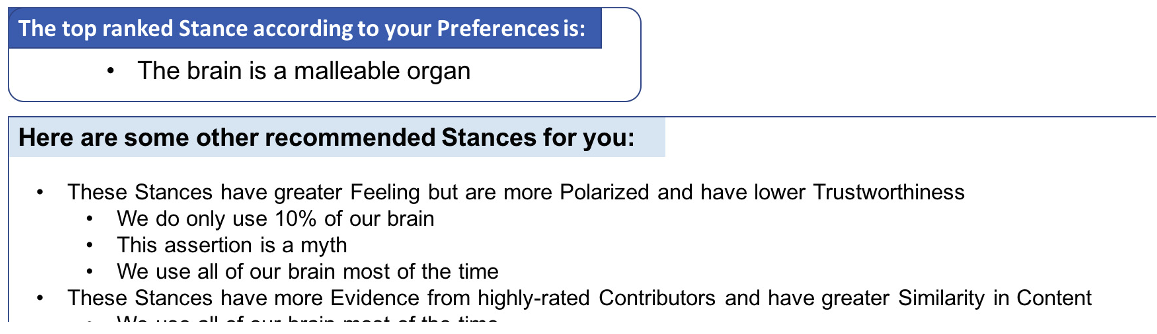 Fig 2: Mockup showing how a PA might present diverse stances based on evidence and contributor trust.
Key Takeaways:
- Emotional Alignment: Personalized sentiment analysis helps gauge the extent of the backfire effect.
- Explainability: Category titles served as transparency mechanisms, showing the tradeoffs between different claims.
- Scalability: The framework is designed for everything from online classrooms to large-scale social networks like Facebook.
Critical Analysis & Future Outlook
While the initial framework is robust, the challenge remains in the crowdsourced nature of the argumentation graph. Maintaining quality and preventing bad actors (trolls) from gaming the "authority" ratings of the graph is an ongoing battle.
Furthermore, as AI continues to evolve, the integration of Large Language Models could allow these Pedagogical Agents to have more natural, fluid conversations, potentially making them even more effective at "de-escalating" people from misinformation rabbit holes.
The future of truth online may not lie in better data, but in better digital empathy.