
Beyond Fixed Seeds: A Factor Analysis of Influence Maximization
Factor Analysis for Influence Maximization Problem in Social Networks
This paper introduces a factor analysis approach for the Influence Maximization (IM) problem, proposing two new metrics—node's gain and rate of gain—to dynamically determine the optimal seed set size . By utilizing the CELF algorithm on real-world arXiv collaboration networks, the study moves beyond fixed- assumptions to optimize the influence spread based on marginal returns and stability.
TL;DR
In the world of viral marketing, finding the "Initial Set" of influencers is known as the Influence Maximization (IM) problem. While most researchers focus on how to find these influencers for a fixed number , this paper asks a more fundamental question: How many influencers do we actually need? Using new metrics for marginal gain and stability, the authors provide a framework to stop the search when the "bang for the buck" diminishes.
Background & Motivation: The "K" Dilemma
The IM problem, originally formulated by Domingos and Richardson and refined by Kempe et al., is usually treated as a discrete optimization task: pick nodes to maximize spread .
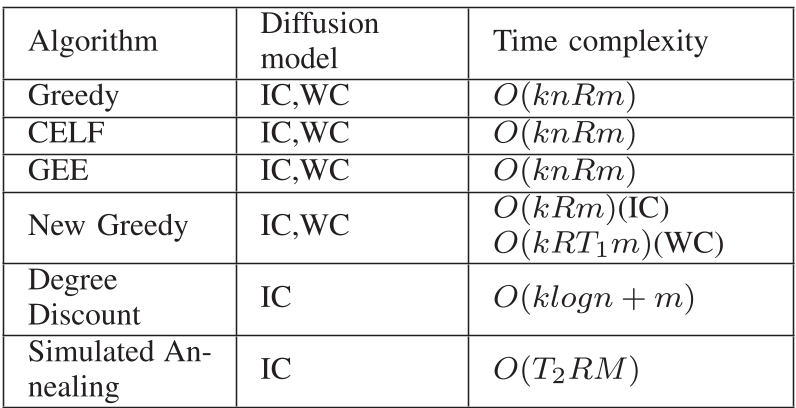
The Problem: In practice, a marketing manager doesn't know if they should pick 50, 100, or 500 people. Picking too many is expensive; picking too few misses the viral tipping point. Existing algorithms (Greedy, CELF, GEE) all treat as an input, not a variable to be optimized.
Methodology: Let the Data Decide
The authors suggest that the algorithm should terminate based on the "nature of the social network itself." They introduce two key criteria:
- Node’s Gain (): The marginal increase in influence spread when adding the -th node. If (where is a threshold, e.g., 1.0), it means the new node isn't even influencing one additional person beyond itself.
- Node’s Rate of Gain (): The absolute difference between the gain of the -th node and the -th node. This identifies the "elbow" in the curve where the returns start to flatten out significantly.
Algorithmic Foundation
To test these, they utilize the CELF (Cost-Effective Lazy Forward) algorithm, which leverages the sub-modularity property (the law of diminishing returns) to speed up the greedy selection by up to 700x.
Deep Dive: Stability and Performance
One overlooked aspect of IM is Stability (). If you run an algorithm for and , is the set of 10 nodes a subset of the 11? If algorithms are unstable, marketing strategies become unpredictable.
The authors defined stability as:
Experimental Evidence
The study used two real-world arXiv collaboration networks (GrQc and HEP-TH).
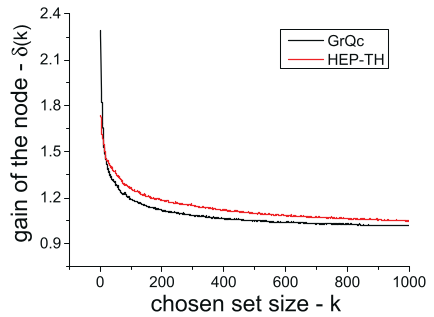 Figure: The "Gain" curves show a massive drop-off, suggesting that the most influential nodes are found very early in the process ().
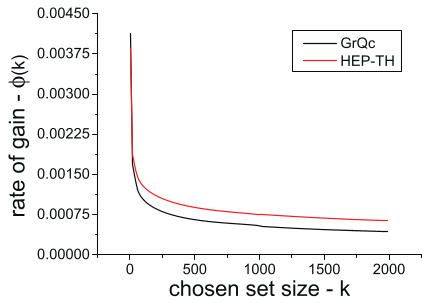 Figure: Stability scores consistently stayed above 0.8, proving that the greedy approach provides a reliable and consistent path for expanding the seed set.
Critical Insight: The Return on Investment (ROI)
The most striking takeaway is the transition point. In the HEP-TH dataset, the marginal gain drops from over 2.0 to near 1.1 within the first 500 nodes, then stays flat for the next 4,500 nodes.
Why does this matter? It suggests that for many social networks, there is a "gold mine" of high-influence nodes, followed by a very long "plateau" of mediocre influencers. Using the Rate of Gain () allows a system to automatically detect this transition and save costs.
Summary & Future Outlook
This paper shifts the IM conversation from "efficiency of search" to "logic of selection." By analyzing as a factor of ROI rather than a constraint, the authors provide a more practical toolkit for social network analysis.
Future Work: The authors suggest incorporating Node Cost Distributions. In a real scenario, the #1 influencer (e.g., a celebrity) costs much more than the #100 influencer (a micro-influencer). Future models will likely bridge the gap between graph theory and behavioral economics to calculate the true Average Bonus of an influence campaign.