
Factorization vs. Regularization: Unlocking the Power of Heterogeneous Social Ties in Recommendations
Factorization vs. regularization: Fusing heterogeneous social relationships in top-n recommendation
The paper proposes a hybrid recommendation framework that fuses heterogeneous social relations—friendship and membership—into implicit Collaborative Filtering. It introduces a unified model using Collective Matrix Factorization (CMF) for bipartite membership data and social regularization for one-mode friendship data, achieving SOTA performance in Top-N recommendation under high data sparsity.
TL;DR
This seminal work from RecSys '11 addresses the pervasive "sparsity problem" in Recommender Systems. By distinguishing between two different types of social ties—Friendship (who you know) and Membership (what groups you join)—the authors demonstrate that fusing these heterogeneous signals via a combination of Social Regularization and Collective Matrix Factorization (CMF) significantly outperforms traditional Collaborative Filtering, particularly for "cold-start" users.
Context: Within the academic landscape, this paper stands as a critical bridge between early trust-based recommendation and modern heterogeneous information networks.
The Core Insight: One-Mode vs. Bipartite Data
The fundamental contribution of this paper lies in its structural analysis of social data. The authors argue that not all social relations should be treated equally:
- One-Mode Data (Friendship): Connections between the same type of entity (User-User). This is best handled by Social Regularization, which forces the latent preferences of friends to be similar.
- Bipartite Data (Membership): Connections between different entities (User-Group). This is richer because joining a group is a direct proxy for interest. The authors suggest Factorization is superior here, as it maps users and groups into a shared latent space without losing info through "one-mode projection."
Methodology: The Hybrid Fusion Model (MF.FM)
The paper introduces a unified objective function that handles both types of data simultaneously.
1. Handling Friendship (Regularization)
The model adds a penalty term to the Matrix Factorization loss. It minimizes the Euclidean distance between a user's latent factor and the average latent factors of their friends:
2. Handling Membership (CMF)
Instead of transforming group membership into a user-user network, the authors use Collective Matrix Factorization. They decompose the User-Item matrix () and the User-Group matrix () simultaneously. Crucially, the User Latent Factor () is shared between both tasks.
 Note: Above reflects the conceptual flow of fusing heterogeneous sources into the latent space.
Experimental Showdown
The authors tested their framework using Last.fm data across five levels of sparsity.
Key Findings:
- Membership > Friendship: Membership data provided a much stronger signal for interest. In sparse settings, MF.M (Membership only) improved Recall@10 by ~18%, while MF.F (Friendship only) only improved it by ~4.6%.
- The Synergistic Effect: Fusing both (MF.FM) yielded the best results, achieving a 20.56% boost in Recall@5 on the sparsest dataset.
- The Denoiser Effect: As the user-item interaction data becomes denser (moving from 10% to 50% training data), the benefit of social data vanishes. At high density, social signals can actually become "noise," slightly degrading performance.
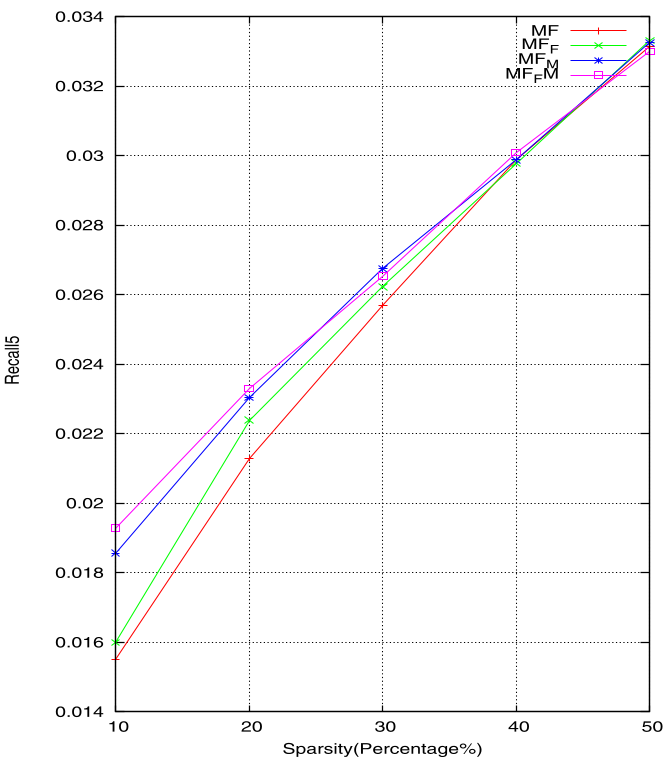 Figure: Performance gains are most dramatic when the behavioral matrix is extremely sparse.
Critical Analysis & Takeaways
The distinction between "Why we are friends" (vague) and "Why we join a group" (specific) is a masterclass in feature engineering intuition.
Strengths:
- For the first time, it proves that social data boosts Top-N recommendation (implicit feedback), not just rating prediction.
- It provides a clear mathematical justification for using CMF over Regularization for bipartite data.
Limitations:
- The model assumes a static social network. In modern dynamic environments, the evolution of social ties might require Temporal Factorization.
- The computational cost of Alternating Least Squares (ALS) in CMF remains high for web-scale deployment without distributed optimization.
Conclusion: If you are building a recommender for a new platform with sparse data, look beyond the "friend list." The "membership" data (groups, subreddits, followed tags) is likely your most potent weapon against the cold-start problem.