
High-Tech Industry and Regional Synergy: Why More Diffusion Isn't Always Better
14429_Factors Affecting Regional Economic Synergy in China - Based on Research on High-Tech Industry.
This paper investigates the drivers of regional economic synergy in China by analyzing the high-tech industry across 28 provinces (2004–2016). Utilizing System GMM and panel threshold models, it identifies that while capital flow promotes economic coordination, industrial diffusion and labor/technology flows paradoxically inhibit it under current structural conditions.
TL;DR
Economic intuition suggests that spreading high-tech industries across a country should narrow regional gaps. However, this study reveals a more complex reality in China: while capital flow acts as a bridge for coordination, industrial diffusion, labor mobility, and technology transfer currently act as inhibitors. By identifying specific "thresholds" of industrial spread, the research highlights that pushing industry outward without the right structural support can actually deepen regional imbalances.
The Motivation: Growth Without Balance?
In the "new normal" of China's economy, innovation is the primary engine. Yet, high-tech development is a double-edged sword. Developed regions benefit from "location advantages," while late-developing regions struggle with resource scarcity. The authors argue that we cannot understand regional synergy by looking at industrial clustering alone; we must examine the flow of factors—the literal movement of money, people, and ideas—that accompanies industrial spread.
Methodology: Beyond Simple Regressions
The researchers utilized data from 28 provinces (2004–2016) and moved beyond standard OLS models to address two major hurdles:
- Endogeneity: They used System GMM to ensure that the causal relationship between industrial growth and economic synergy wasn't being circular.
- Non-linearity: They applied Hansen’s Threshold Model to find "tipping points" where the behavior of the economy fundamentally changes.
The Decoupling Framework
The study uses "decoupling theory" to define industrial diffusion. If a region's high-tech growth lags behind the national average, the industry is considered to be "diffusing" out of that region.
 Table 1: Defining the states of industrial agglomeration and diffusion.
The Core Finding: The Double Threshold Effect
The most striking insight is the Threshold Effect. The impact of capital on regional synergy is not constant.
- Low Diffusion Stage: When industrial diffusion is low, capital flow significantly helps coordinate the regional economy (Coefficient: 0.18).
- High Diffusion Stage: Once diffusion crosses a certain threshold, further capital flow actually begins to hinder balanced development (Coefficient: -0.26).
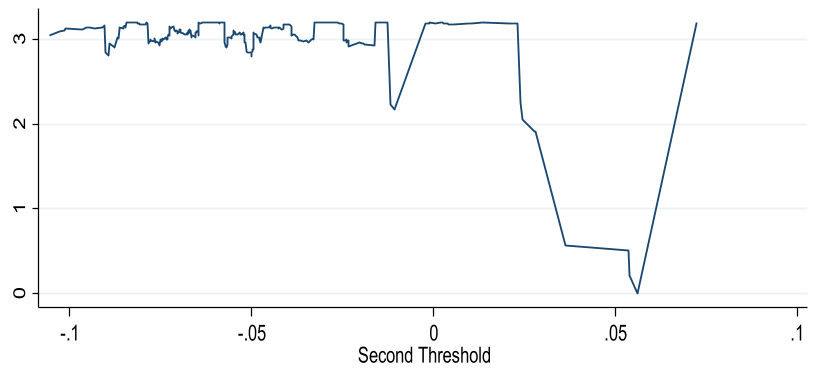 Figure 1: The Likelihood Ratio (LR) test confirms the existence of a double threshold for capital flow.
Why is Technology Flow Inhibiting Coordination?
The model shows that technology flow and R&D investment often have a negative sign regarding regional synergy. This suggests that large-scale investments in tech aren't being converted into actual local innovation in underdeveloped provinces. Instead, "knowledge decay" and a lack of local absorptive capacity mean that the tech "flow" mostly benefits already-dominant hubs.
Experimental Results Summary
The System GMM results provide a sobering look at the "Labor Migration Puzzle": labor flows predominantly from underdeveloped to developed areas, which strengthens the leader but drains the follower, thus inhibiting overall regional synergy.
 Table 3: Comparing FE, RE, and GMM models to ensure robust results.
Critical Analysis & Conclusion
Takeaways: Regional economic coordination is not a byproduct of simply moving factories or offices. It requires a specific balance of capital. If a region diffuses its industry too quickly without building up its internal property rights structure (SOE efficiency) and financial "soft power" (deposit/loan balances), it risks falling into a trap where factor flows only benefit the giants.
Limitations: The study focuses on 2004–2016 data. Since the 2019 Sino-US trade friction mentioned in the introduction, the "internal circulation" and self-reliance policies of China have likely shifted these thresholds. Future research should investigate whether "digital factor flows" (data) follow the same threshold patterns as traditional capital and labor.