
Mining the Business of Healing: Detecting Delays in Healthcare Reimbursement
An Investigation to Identify Factors that Lead to Delay in Healthcare Reimbursement Process: A Brazilian case
This study proposes a hybrid framework combining Process Mining (PM) and Association Rule Mining (ARM) to analyze delays in the healthcare reimbursement process within a Brazilian hospital. The approach maps a real-world event log to identify bottlenecks and uses the Apriori algorithm to uncover hidden patterns correlating clinical attributes with administrative delays.
TL;DR
Efficient healthcare isn't just about clinical outcomes; it's about financial sustainability. This study tackles the "Black Box" of healthcare reimbursement in Brazil by combining Process Mining to map bottlenecks and Data Mining (Apriori) to find out why they happen. The result? A clear roadmap for hospital managers to reduce the 30-day payment lag by identifying specific procedural failures.
The Motivation: A Financial Crisis in the Back Office
In the US alone, improper payments in Medicare account for over $43 billion annually. In Brazil, non-profit hospitals are caught between dwindling government support and the high complexity of Private Insurance billing (Fee-For-Service).
The problem is that traditional auditing only sees the "What" (e.g., an invoice is late). It doesn’t see the "How" or the "Why." Previous research has heavily focused on clinical pathways (improving patient recovery), but this paper shifts the lens to the Administrative Machine—the coding, billing, and auditing cycle that keeps the lights on.
Methodology: Fusing Workflow with Intelligence
The authors adopted a two-pronged technical strategy within the CRISP-DM framework:
- Process Discovery: Using the Fuzzy Miner algorithm via Disco, they visualized the event logs of 5,008 process instances. This revealed the "Ground Truth" of how invoices move from patient discharge to final payment.
- Pattern Extraction: To dig deeper than just "flowcharts," they used Random Forest to rank which features (Unit Name, Issue Type, length of stay) most impacted duration. Finally, they applied the Apriori Algorithm to generate rules like:
- If [Issue = Missing Signature] AND [Unit = Surgical Center] THEN [Delay = High].
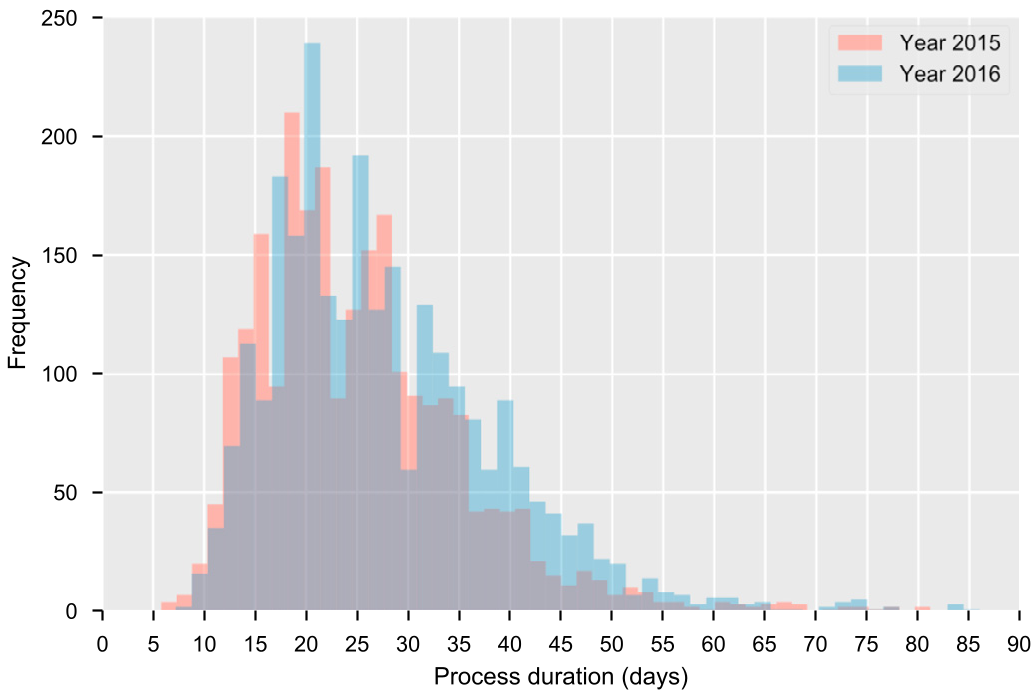 Figure 1: The discovered process model showing frequency (a) and performance/time perspective (b).
Critical Findings: Where the Time Goes
The research highlighted some counter-intuitive bottlenecks:
- The Audit Trap: Issues are identified within a mean time of 5 days in the audit phase but solving them takes significantly longer.
- The Scheduled Paradox: One might assume scheduled surgeries are easier to bill for. However, the data showed that Scheduled Admissions often had high rates of "Inconsistent medical procedure information," leading to massive delays.
- The Signature Gap: A simple lack of professional signatures in the Surgical Center was a recurring pattern in cases taking over 30 days.
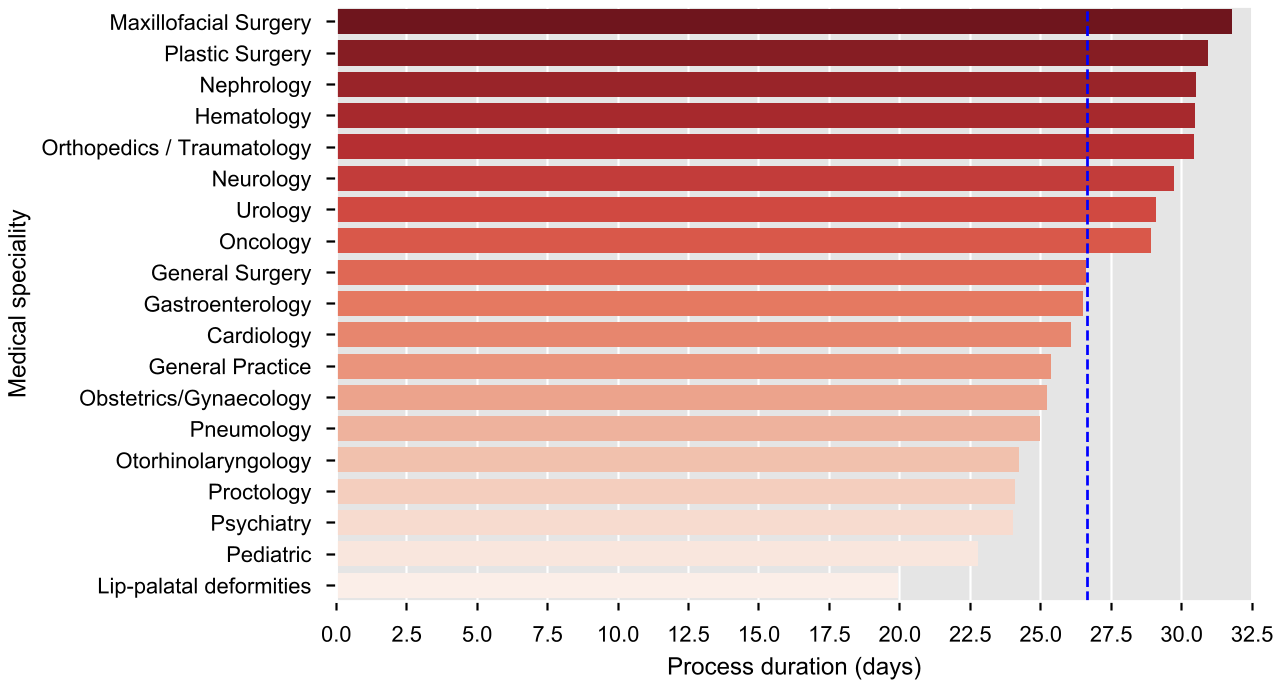 Figure 2: Distribution of process duration, showing a significant "long tail" of cases exceeding 30 days.
Technical Insight: Why This Combination Works
While Process Mining provides the "Macro" view of the sequence of events, Association Rules provide the "Micro" context. Standard process mining might show that "Audit - Regularization" is a bottleneck, but it won't tell you that it's specifically happening because of "Obstetrics" patients during "December." By combining these, the paper creates an actionable intelligence layer that standard Business Intelligence (BI) tools miss.
Conclusion & Takeaways
The study proves that administrative efficiency is a data science problem. By automating the identification of delay factors, hospitals can:
- Automate Alerts: Send reminders to surgeons about missing signatures in real-time.
- Resource Allocation: Shift more auditors to specific units (like General Surgery) during peak months identified by the model.
Limitations: The study is localized to one Brazilian institution and the Fee-For-Service model. Future research should look into how these patterns change in Diagnostic Related Group (DRG) or Value-Based payment environments where the incentives differ.
Final takeaway: The path to hospital sustainability isn't just better medicine—it's cleaner data and smarter process analysis.