
Fair Classification vs. Social Welfare: Why "More Fair" Can Mean "Less Good"
Fair classification and social welfare
This paper presents a welfare-based analysis of fair classification, specifically evaluating how common group-parity constraints influence individual and social utility. By applying parametric programming to a Soft-Margin SVM, the authors derive "fairness-to-welfare" solution paths that track group well-being across varying levels of fairness strictness.
TL;DR
In the rush to make AI "fair," we might be making everyone worse off. This paper by Lily Hu and Yiling Chen challenges the dogma of parity-based fairness metrics (like Equality of Opportunity). By mapping the entire solution path of a constrained SVM, the authors show that increasing fairness strictness often violates the Pareto Principle—leading to outcomes where the disadvantaged group is actually worse off than they were under a "less fair" model.
The "Equality of What?" Problem
Most algorithmic fairness research operates in a vacuum of statistical metrics. We ask if False Positive Rates are equal across groups, but we rarely ask if the resulting allocation of resources (loans, jobs, health care) actually improves the life of the individuals involved.
The authors argue that when an algorithm allocates a resource, it acts as a social planner. If we tighten a fairness constraint () and the number of people receiving a positive outcome in both groups drops, have we actually achieved "justice"?
The Methodology: Tracking the Welfare Path
The core technical contribution is treating the fairness tolerance as a parameter in a Soft-Margin SVM. The authors don't just solve for one "fair" model; they solve for all of them.
1. The -Fair SVM
The paper utilizes a proxy fairness constraint based on the covariance between group membership () and the distance from the decision boundary.
2. Sensitivity and Breakpoints
By analyzing the dual Lagrangian variables (), the authors prove that the path of individual classifications is piecewise linear.
- Stable Regions: Ranges of where the classifier changes slightly, but the actual list of who gets a loan stays exactly the same.
- Breakpoints: Critical values of where an individual point moves into or out of the "margin," triggering a shift in group welfare.
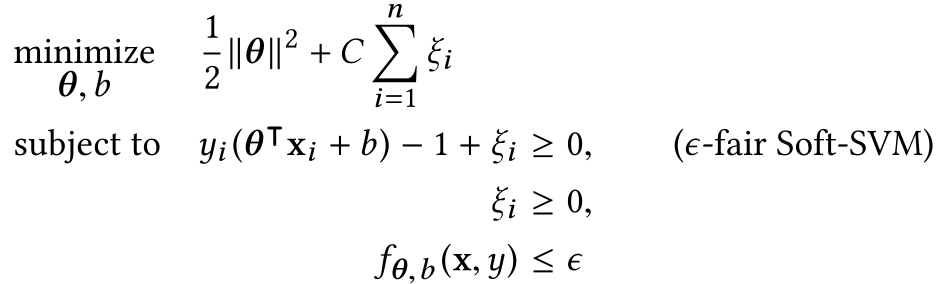 The optimization problem defines the trade-off between the margin (accuracy) and the fairness constraint.
Why the Pareto Principle Fails
The most striking finding is the violation of the Pareto Principle. In welfare economics, Outcome A is better than Outcome B if at least one person is better off and no one is worse off.
The authors prove that:
- Tightening fairness () can move a classifier to a state that is Pareto-dominated.
- In these cases, a "less fair" classifier would provide more resources to the disadvantaged group than the "more fair" one.
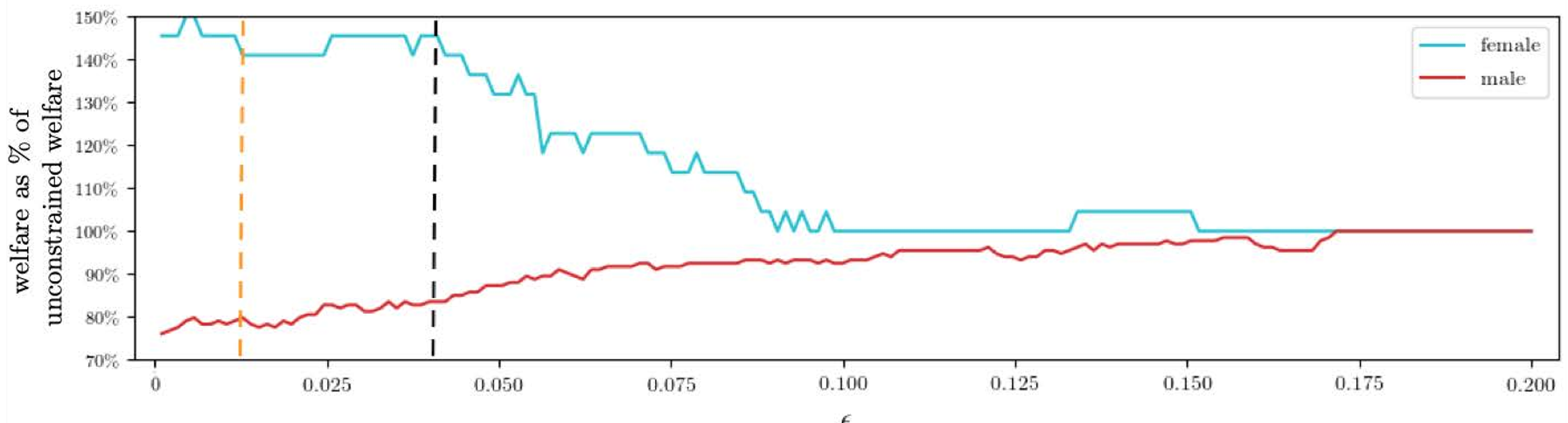 In the bottom panel (Adult dataset), the orange dashed lines indicate areas where a more 'fair' constraint leads to lower absolute welfare for both groups compared to the black lines.
Experimental Insight: The Adult Dataset
Testing on the Census "Adult" dataset (predicting income >$50k), the authors visualize the "journey" of individuals. As the fairness constraint tightens (moving left on the X-axis), we see female welfare generally rise, but not monotonically. There are specific "dips" where the algorithm, in an attempt to satisfy the parity constraint, has to reject more people from both groups to keep the ratios balanced.
Critical Analysis & Conclusion
This paper serves as a necessary intervention in the field of AI Ethics. It highlights that parity is not a proxy for justice.
Key Takeaways:
- Efficiency: The "Fairness-to-Welfare" algorithm is computationally efficient, meaning practitioners can (and should) plot these curves before deploying a model.
- The Parity Trap: Satisfying a mathematical equality can be a "race to the bottom" where equality is achieved by harming everyone rather than helping the vulnerable.
- Future Direction: We need to move toward Social Welfare Functions that value absolute improvement for the marginalized, rather than just relative similarity to the privileged.
Is the algorithm being fair, or is it just being mathematically tidy? As computer scientists are cast as social planners, we must ensure our metrics align with the material well-being of the people we aim to serve.