
FairCrowd: Boosting AI Fairness and Accuracy via Batch-Level Crowdsourcing
FairCrowd: Fair Human Face Dataset Sampling via Batch-Level Crowdsourcing Bias Inference
FairCrowd is a novel crowdsourcing-based data sampling framework designed to create fair human face sub-datasets from biased large-scale pools. It leverages batch-level demographic inference and an accuracy-fairness-aware shuffling mechanism to achieve SOTA performance in face attribute prediction (FAP) tasks.
TL;DR
FairCrowd is a first-of-its-kind framework that solves the "bias vs. cost" trade-off in facial AI. By asking crowd workers to estimate the bias of batches rather than individual images, it efficiently labels demographics to balance datasets. The result? AI models that are not only fairer but also more accurate and faster to train.
Background: The Hidden Bias in Big Data
Most modern facial recognition and attribute prediction services (FAP) are trained on massive datasets like CelebA or VGGFace2. However, these datasets are naturally skewed—often favoring younger, lighter-skinned, or specific gender groups. Historically, fixing this required either:
- Expensive Manual Labeling: Paying humans to categorize every single face.
- Algorithmic Fixes: Adjusting the model's loss function, which often sacrifices overall accuracy for fairness.
FairCrowd takes a different path: Fair Data Sampling. It focuses on curating a balanced "silver" sub-dataset from a biased "gold" pool.
The Problem: The Cost of Fairness
The authors identify two primary hurdles:
- The Annotation Bottle-neck: High-resolution facial datasets are too large for individual human annotation.
- The Fairness-Accuracy Trade-off: Removing majority-group samples can sometimes hurt the model’s ability to generalize, leading to a "fair but useless" service.
Methodology: The FairCrowd Architecture
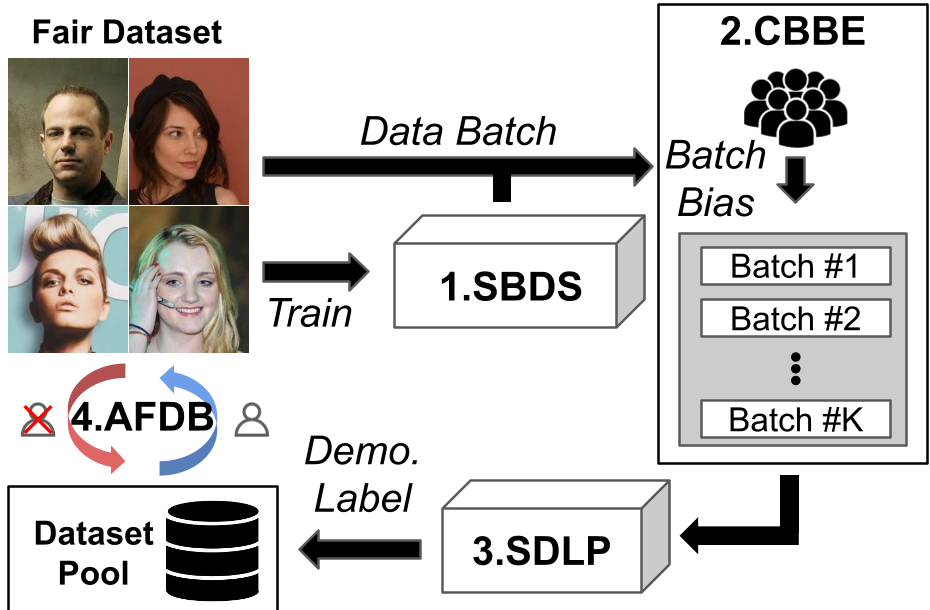
The framework operates through a four-stage pipeline:
- Service Specific Batch Data Sampler (SBDS): It identifies which images the current model gets wrong and samples them into batches.
- Crowdsourcing Batch Bias Estimator (CBBE): Instead of labeling "Image A is Male," workers answer "Does this batch have more males or females?" This is faster and captures the "distributional" essence of bias.
- Similarity Based Label Predictor (SDLP): Using deep embeddings (like FaceNet), the system propagates the batch-level bias to individual images. If a face is highly similar to a batch labeled "majority-female," it is inferred as female.
- Accuracy-Fairness-Aware Dataset Balancer (AFDB): This is the "brain." It shuffles images in and out of the sub-dataset. It prioritizes keeping images that contribute to fairness (minority groups) AND accuracy (high-entropy/informative samples).
Experimental Breakthroughs
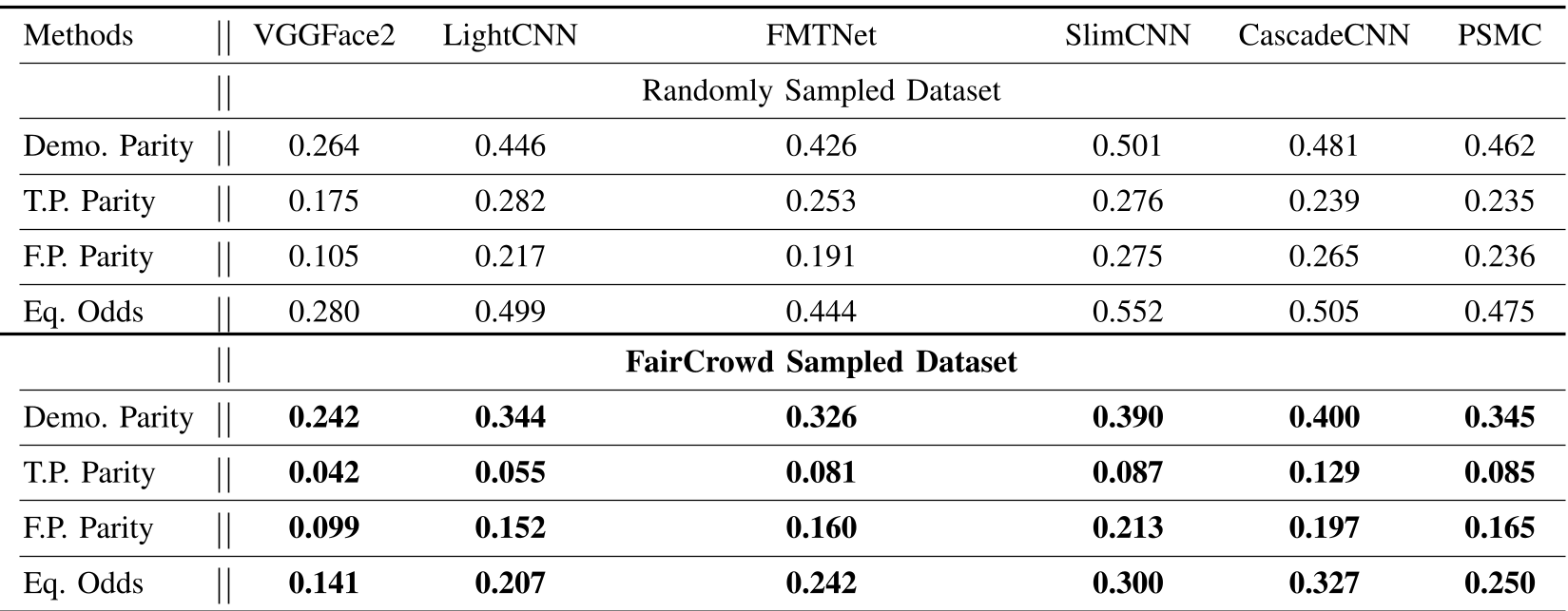
The authors tested FairCrowd against SOTA models like VGGFace2 and LightCNN. The results were striking:
- Fairness Gains: Equalized Odds (a measure of disparate impact) dropped significantly across all models. For the LightCNN model, bias was cut by more than half (0.499 to 0.207).
- Accuracy Boost: Surprisingly, the models trained on smaller, FairCrowd-sampled datasets performed better than those on larger, random ones. FMTNet saw an accuracy jump from 78.1% to 80.3%.
- Efficiency: Because the sampled dataset is more concise, training time was reduced (e.g., PSMC training time dropped by nearly 26 minutes).
Critical Insight: Why Does Shuffling Work?
The secret sauce is the Max Entropy score. In machine learning, "easy" samples (those the model is very sure about) often provide less learning value than "hard" samples. FairCrowd intelligently keeps hard samples from minority groups while pruning redundant samples from the majority, creating a high-density learning environment.
Conclusion & Future Outlook
FairCrowd represents a shift from "Model-Centric AI" to "Data-Centric AI." By treating the dataset pool as a dynamic resource to be shuffled and balanced, it bypasses the need for massive, expensive ground-truth labeling.
Limitations: The reliance on similarity-based propagation means that if the initial feature extractor (e.g., FaceNet) is itself heavily biased, it might lead to incorrect label propagation. Future research should look into "unbiased feature extraction" as a precursor to the FairCrowd pipeline.
Final Takeaway: Fairness doesn't have to be a tax on performance. With smart sampling, we can build AI that is both more equitable and more capable.