
Game Theory Meets Fairness: Balancing the Scales in Spatial Crowdsourcing
Fairness-aware Task Assignment in Spatial Crowdsourcing: Game-Theoretic Approaches
This paper introduces a novel framework for Fairness-aware Task Assignment (FTA) in Spatial Crowdsourcing (SC). It proposes two game-theoretic algorithms, FGT (Fairness-aware Game-Theoretic) and IEGT (Improved Evolutionary Game-Theoretic), to balance individual worker payoffs with collective fairness, achieving a state where reward-to-travel-time ratios are balanced across participants.
TL;DR
In the booming "gig economy" of Spatial Crowdsourcing (SC)—think food delivery and package couriers—algorithms usually prioritize speed or total profit. This paper argues that fairness is the key to worker retention. By modeling task assignment as a multi-player game and an evolutionary process, the authors propose methods to minimize "payoff envy" among workers while maintaining high system efficiency.
The Fairness Crisis in Crowdsourcing
Why do delivery workers quit? Often, it’s not just about the low pay, but the inequity. Traditional algorithms are either "greedy" (favoring the fastest) or "utilitarian" (maximizing total platform profit). Both result in some workers getting "hero" routes with high rewards and short distances, while others are stuck with "charity" routes.
From a behavioral economics perspective, humans are inequity-averse. We are often willing to sacrifice a bit of our own gain to ensure a more equitable distribution. This paper addresses the Fairness-aware Task Assignment (FTA) problem, which is mathematically NP-hard because it involves not just assigning a task, but scheduling a sequence of delivery points under strict deadlines.
Methodology: Valid Sequences and Strategic Games
The authors break the problem into two distinct stages:
1. Strategy Generation (VDPS)
Before workers can play the "game," we must know what their possible moves are. The authors use a Dynamic Programming algorithm to generate Valid Delivery Point Sets (VDPS).
- The Insight: Not every route is viable. A route is only "valid" if the worker can hit every delivery point before the tasks expire.
- Pruning: To avoid the exponential explosion of possibilities, they use a distance-constrained pruning strategy, ignoring delivery points that are too far apart to be profitable.
2. The Game Frameworks
The paper proposes two ways to find the "fair" assignment:
-
FGT (Fairness-aware Game-Theoretic): This treats workers as rational players using an Inequity Aversion based Utility (IAU). A worker's utility isn't just their payoff; it's their payoff minus a penalty for being significantly richer or poorer than their peers. The system reaches a Nash Equilibrium where no worker can improve their "happiness" by unilaterally switching routes.
-
IEGT (Improved Evolutionary Game-Theoretic): This is the more realistic model. It assumes workers have bounded rationality—they learn and adapt over time. Using replicator dynamics (inspired by biological evolution), workers "migrate" from low-payoff strategies to higher ones until the population reaches an Evolutionary Equilibrium.
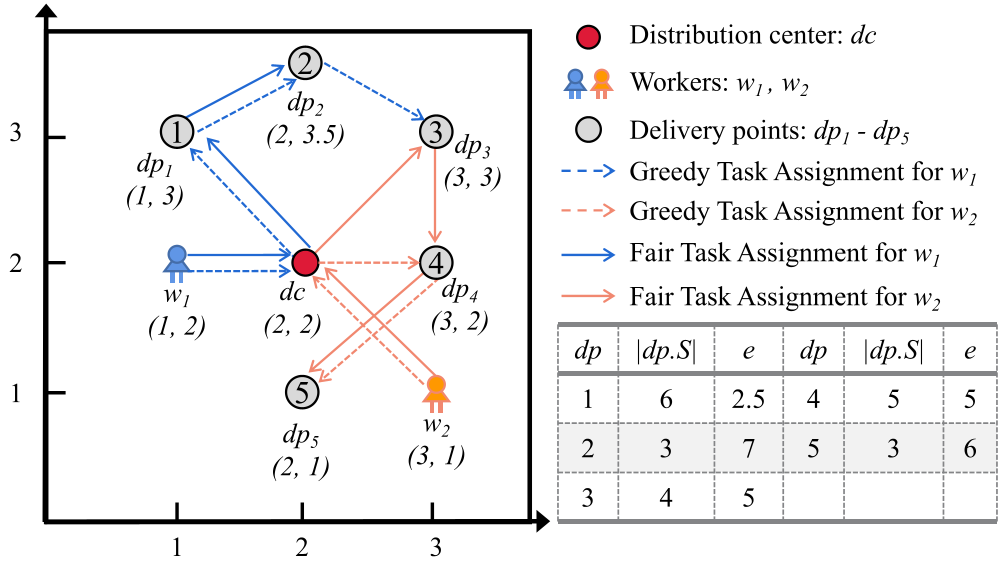 Figure 1: A typical SC scenario where tasks (dp) must be assigned to workers (w) from a distribution center (dc).
Experimental Battleground
The authors tested their methods against MPTA (Maximum Payoff) and GTA (Greedy).
Key Findings:
- Massive Fairness Gains: IEGT reduced the payoff difference between workers to a fraction (sometimes as low as 13%) of what the greedy approach produced.
- Efficiency: While MPTA (the optimizer) struggled with computation time as delivery points increased, the game-theoretic approaches remained efficient thanks to the pruning strategy.
- The "Fairness Cost": There is a slight trade-off. To achieve extreme fairness (IEGT), the average payoff drops slightly compared to the profit-maximizing MPTA, but the system becomes much more stable for the workers.
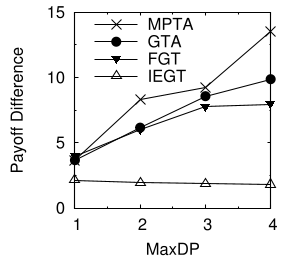 Figure 2: IEGT (lowest curve) consistently maintains the smallest payoff difference across varying numbers of delivery points, proving its superior fairness.
Critical Insight: Why Evolutionary Games Work
The beauty of the IEGT approach is its resilience. In a standard Nash Equilibrium (FGT), every player needs perfect information about everyone else's routes. In the Evolutionary model (IEGT), workers only need to know how they are doing compared to the average. This makes it much more applicable to real-world apps where a worker doesn't see every other worker's dashboard, but has a "sense" of the market average.
Summary and Limitations
This work marks a shift from "Profit-First" to "Worker-First" algorithm design in Spatial Crowdsourcing.
- Limitations: The current model assumes all tasks have equal rewards and all workers move at the same speed.
- Future Path: Integrating Priority-aware fairness (where more experienced or higher-rated workers get slight advantages) would be the next logical step for commercial platforms like Meituan, UberEats, or DoorDash.
By treating the workforce as an evolving ecosystem rather than a set of variables in an optimization formula, we can build platforms that are not just efficient, but sustainable.