
Beyond Skin Tone: Decoding the Morphological Roots of Gender Classification Bias
Understanding Fairness of Gender Classification Algorithms Across Gender-Race Groups
This paper presents a comprehensive study on the fairness of deep learning-based gender classification algorithms across diverse gender-race groups. By evaluating architectures like VGG, ResNet, and InceptionNet on the FairFace and UTKFace datasets, the authors identify systemic performance disparities, particularly the consistent underperformance for Black females, and propose facial morphological similarity as a primary biological driver of bias.
TL;DR
While the industry has long blamed "biased data" for the failure of AI to recognize diverse faces, this paper reveals a deeper truth. By evaluating open-source CNNs on large-scale datasets, the researchers found that Black females are consistently misclassified not just because of training imbalances, but due to facial morphology. High structural similarity between Black males and females creates a biological "collision" in the latent space of even the most balanced models.
The "Black Box" Problem in Fairness
Most previous investigations into gender classification bias (like the famous MIT "Gender Shades" study) relied on commercial APIs from IBM or Amazon. These "black-box" evaluations could tell us that a system was biased, but not why.
The authors of this paper shift the focus to a "white-box" approach, testing variables such as:
- Architectural Differences: Does ResNet-50 handle race better than VGG-16?
- Dataset Skew: How much does over-representing males in training actually hurt performance for females?
- Facial Morphology: Are there biological similarities in bone structure that confuse AI?
Methodology: Testing Under the Hood
The study utilized five prominent architectures: VGG-16, VGG-19, VGGFace, ResNet-50, and InceptionNet-v4. These were fine-tuned on UTKFace (skewed) and FairFace (balanced) datasets.
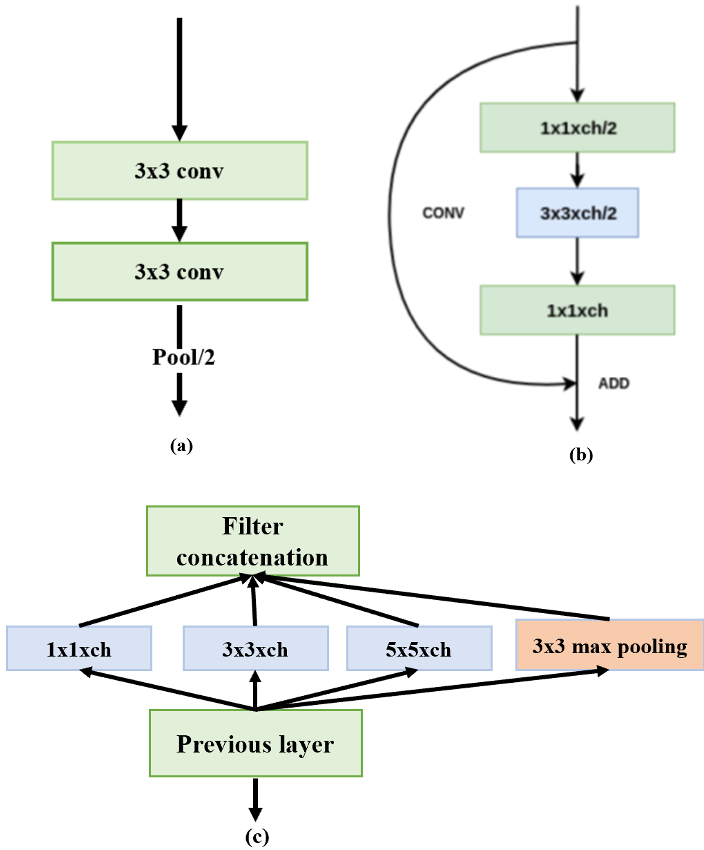 Fig 1: The standard CNN architectures used to test if bias is algorithm-dependent.
To dig into the "Why," the authors extracted 68 facial landmarks via Dlib and applied K-means clustering to see how different demographic groups "cluster" in terms of physical shape.
Key Findings: The Persistent Gap
1. The Algorithm Doesn't Save You
The results were startlingly consistent: regardless of the architecture, Black females always obtained the lowest accuracy. In contrast, Middle Eastern males and Latino females consistently outperformed other groups. This suggests that bias is not simply a "bug" in one specific model like ResNet, but a systemic challenge across convolutional feature extractors.
2. Data Imbalance Escalates Bias
When trained on a male-skewed dataset (UTKFace), the accuracy gap widened. Interestingly, VGG-16 changed its "preference"—when trained on balanced data, it was more accurate for females, but once trained on skewed data, it shifted significantly toward male accuracy.
 Table 1: Detailed accuracy breakdown showing the consistent dip for Black females (avg 0.749) compared to Latino females (avg 0.887).
The Smoking Gun: Facial Morphology
The most profound contribution of this work is the landmark analysis. The study found that:
- 96.8% of Black females clustered into a group distinct from other races.
- There is a high morphological similarity between Black males and Black females compared to other groups.
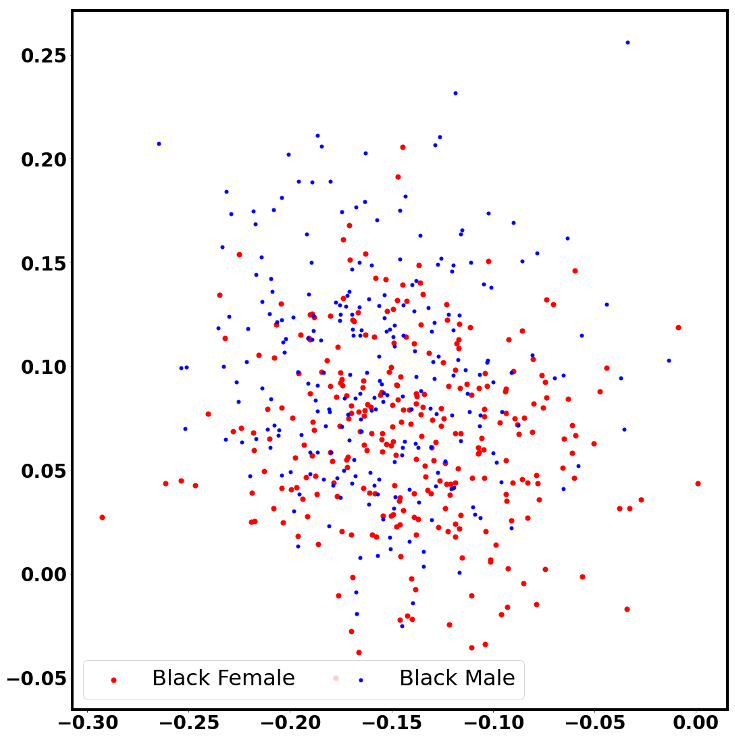 Fig 2: High overlap in landmarks between Black males and females suggests that the AI is struggling with structural ambiguity.
This morphological overlap suggests that "gender" as defined by a CNN is heavily reliant on bone structure (soft biometrics). Because Black male and female facial structures—influenced by genetic and environmental factors—share more spatial similarities in the eyes, nose, and jawline compared to other groups, the CNNs hit a ceiling of accuracy that simple "more data" might not fix.
Critical Insight & Conclusion
This paper serves as a wake-up call for the AI community. Fairness is not just a data distribution problem; it is a feature representation problem.
Takeaways:
- Architecture matters, but only to a point: VGG and ResNet showed different "leanings," but none could overcome the morphological hurdle.
- Black females represent a unique "edge case": High rates of False Positives (females classified as males) stem from structural similarities.
- Future direction: To achieve true parity, future models must incorporate features that go beyond 2D landmarks, perhaps utilizing 3D skin texture analysis or specialized attention mechanisms that can distinguish subtle morphological markers within specific race groups.
The path to fair AI requires us to move past the "One-Size-Fits-All" model and realize that different human groups provide different geometric challenges to computer vision.